
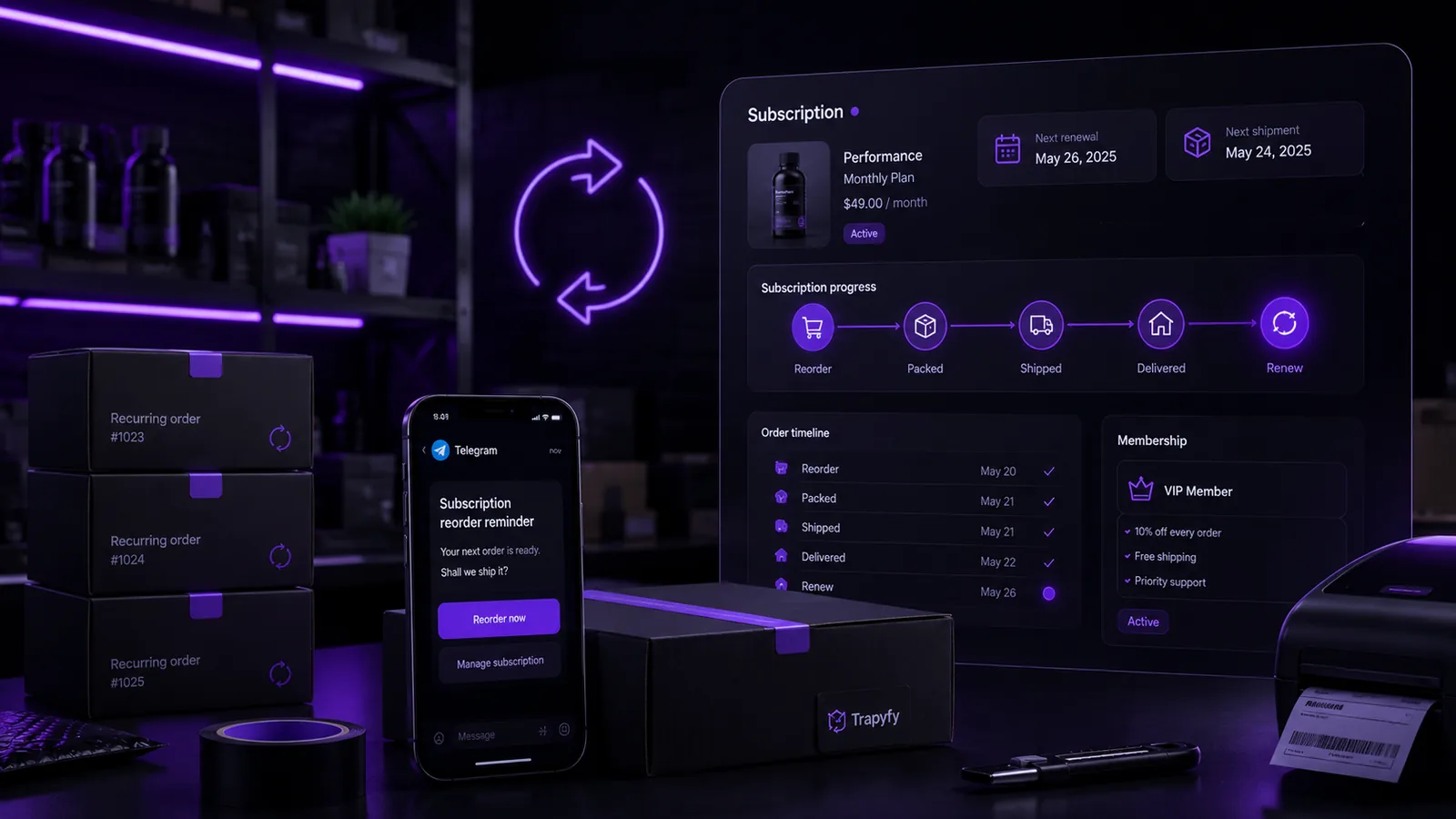
TL;DR: Telegram subscription orders are repeat, membership and replenishment purchases handled through structured flows instead of scattered chat messages. With the right setup, sellers can automate reorders, reminders and customer records, then grow into full membership or subscription-style workflows over time.
If you sell on Telegram, you almost certainly have buyers who come back every week or month. The problem is how those repeat orders get handled: a “same as last time?” message here, a manual stock check there, a reminder you forgot to send. Telegram subscription orders fix that by turning ad-hoc reordering into a repeatable flow — automating reorders, memberships and repeat purchases so you spend less time retyping order details in chat.
Manual reordering breaks down fast: missed follow-ups, repeated questions, inconsistent order details and customer history that lives in your head. This guide shows how Telegram recurring orders work, where they help, and what to automate first.
What are Telegram subscription orders?
Telegram subscription orders are repeat or subscription-style workflows that sit inside a Telegram commerce setup. Rather than promising automatic recurring billing, the practical value is in structured order journeys: planned reorders, reminders, memberships, repeat checkout flows and clean customer records.
Think of it as a spectrum. At one end, a buyer taps to reorder a product they bought before. At the other, you run a Telegram subscription store with monthly bundles, membership tiers and regular replenishment cycles. The common thread is that the order details, customer and fulfilment steps are captured once and reused.
Why repeat orders are hard to manage manually in Telegram
Telegram is brilliant for conversation, but conversation is a poor database. As repeat volume grows, the cracks show:
- Buyers return at different times — there is no single queue, just messages scattered across days.
- You repeat the same instructions — product variants, dosage of stock, sizes, delivery options, all retyped.
- Manual stock checks before you can confirm an order.
- Missed reorder opportunities because nobody nudged the customer at the right time.
- Unclear customer history — what did they order last time, and at what price?
- Fulfilment mistakes when details are copied by hand.
- Support overload as the same questions multiply with every new repeat buyer.
None of this is a Telegram fault — it is the absence of structure behind the chat. Telegram order automation is what closes the gap.
Subscription orders vs simple reorders
It helps to separate the formats, because each needs slightly different handling:
- Simple reorder: the customer buys the same item again, on demand.
- Subscription-style order: a planned repeat purchase — a bundle, membership or monthly product flow on a regular replenishment cycle.
- Membership order: access-based or community-based purchasing, where buying unlocks a tier or private group.
- Product drop repeat purchase: a recurring launch or limited-availability flow where returning buyers expect the next release.
Most sellers start with simple reorders and grow into the others. You do not need automatic billing to run any of these well — you need Telegram repeat purchases captured as structured flows.
Use cases for Telegram subscription orders
- Wellness or supplement replenishment on a regular cycle.
- Repeat CBD or vape accessory orders from returning customers.
- Private community memberships with access-based purchasing.
- Monthly product bundles and curated boxes.
- Limited product drops where buyers come back for each release.
- Creator communities selling to a known audience.
- VIP customer clubs with member-only pricing.
- Consumable products with predictable reorder cycles.
What sellers should automate
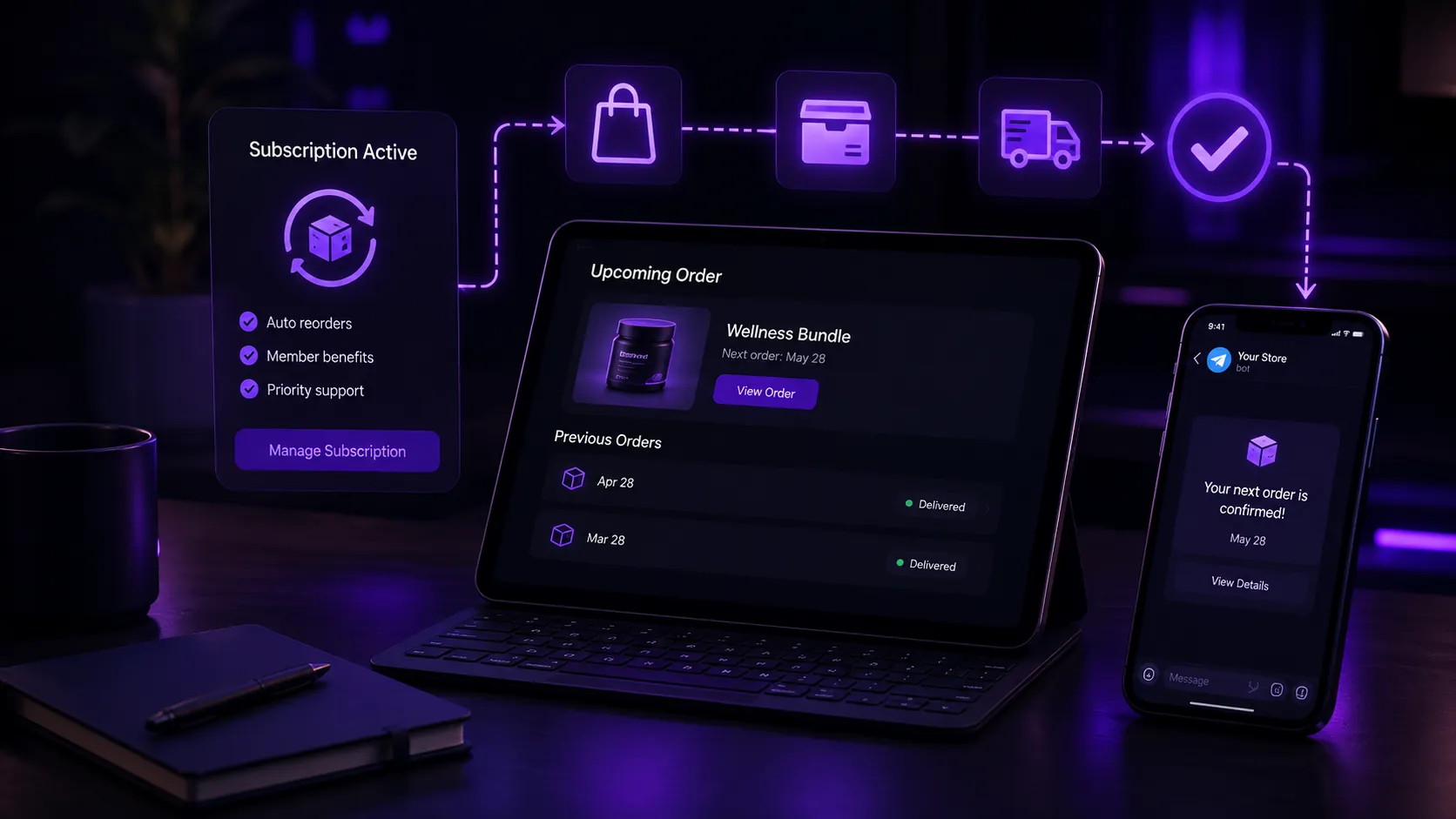
You do not have to automate everything at once. Work down this list as volume grows:
- Product selection from a structured catalogue rather than free text.
- Reorder reminders timed to each customer’s cycle.
- Checkout links or repeat checkout flows that pre-fill the last order.
- Customer details stored once and reused.
- Order confirmation sent automatically.
- Inventory checks so you never sell what you cannot ship — see product and inventory control.
- Fulfilment routing to the right warehouse or supplier via automated fulfilment routing.
- Tracking updates pushed back into the chat.
- Support messages for the predictable, repeated questions.
How subscription-style workflows improve customer experience
When you automate reorders on Telegram, the buyer feels the difference immediately. There are fewer repeated questions, faster checkout and easier reordering. Order status is clear, trust goes up, and the whole experience feels more professional — which is exactly what makes someone buy again.
A smooth subscription-style Telegram checkout removes friction at the moment a customer is already willing to spend. That is the cheapest growth you will ever buy.
Why customer records matter for repeat purchases
Repeat customer flows depend on memory the seller can actually query: previous orders, preferred products, fulfilment details and support context. Without records, every returning buyer is treated like a stranger, and you re-ask questions you should already know the answer to.
With structured customer records, you can recognise a returning buyer, surface their last order and prompt the right reorder at the right time. That is the backbone of any Telegram membership orders model.
How Trapyfy helps automate Telegram subscription orders
Trapyfy lets sellers build a no-code Telegram storefront and run the full order lifecycle from one place. For recurring buyers, that means:
- A structured product catalogue instead of pasted text.
- Repeat order flows that reuse a customer’s previous choices.
- Customer data and order history kept together.
- Order automation for confirmation, reminders and updates.
- Fulfilment logic that routes each order correctly.
- Workflows that support product drops and membership-style buying.
- Cleaner admin for sellers who already have recurring buyers.
The result is Telegram ecommerce automation that scales with you, rather than a chat inbox that gets heavier every week.
Start with reorders before building a full subscription model
Do not over-engineer. The fastest win is to automate the basics: repeat checkout flows, reorder reminders and customer records. Once those run smoothly, layer on memberships, bundles or scheduled replenishment.
Starting small keeps the experience reliable and gives you real data on which products people actually reorder — before you invest in a heavier subscription model. Check the pricing plans to match a tier to your current volume.
Key takeaways
- Telegram subscription orders turn ad-hoc reordering into structured, repeatable flows.
- Manual reordering causes missed follow-ups, repeated questions and fulfilment errors as you scale.
- Reorders, subscriptions, memberships and product drops each need slightly different handling.
- Automate product selection, reminders, checkout, records, inventory and fulfilment first.
- Start with simple reorders, then grow into a full subscription store.
FAQ: Telegram subscription orders
Do Telegram subscription orders charge customers automatically?
Not by default. The practical model is subscription-style workflows: structured repeat checkout, reminders and reorder flows. Treat any automatic recurring billing as a separate feature to confirm, not a given.
What is the difference between a reorder and a subscription order?
A simple reorder is an on-demand repeat purchase. A subscription-style order is a planned, recurring purchase — a bundle, membership or monthly replenishment cycle — handled as a structured flow.
What kinds of sellers use Telegram recurring orders?
Wellness and supplement shops, CBD and vape accessory sellers, creator communities, VIP clubs and any business with consumable products on a predictable reorder cycle.
How do I start automating repeat purchases on Telegram?
Begin with a structured catalogue, repeat checkout flows, reorder reminders and customer records. Trapyfy lets you set this up no-code, then add memberships or bundles as you grow.
Turn repeat orders into a real commerce flow
If your Telegram buyers come back every week or month, Trapyfy helps you turn repeat orders into a structured commerce flow — instead of managing every reorder manually in chat. Build the catalogue, automate the reminders and let your customer records do the remembering.