
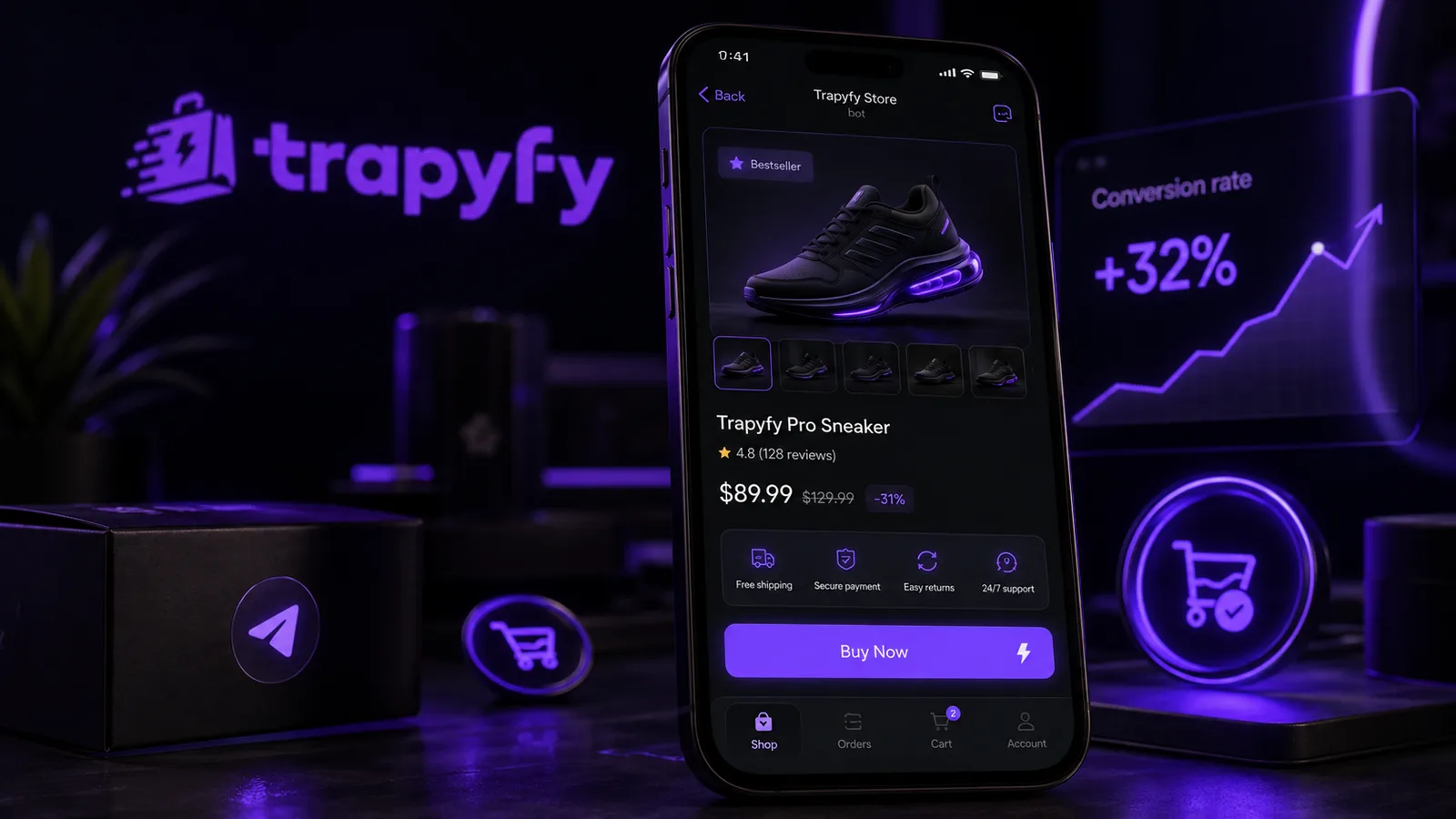
Telegram store conversion is the distance between the people who open your shop and the people who actually pay. Merchants who ask about it rarely have a traffic problem. They have a clarity problem: buyers arrive with real intent, hesitate somewhere between the category list and the payment button, and quietly leave.
Conversion inside Telegram is decided by information far more than by persuasion. A buyer needs to find the right product quickly, understand what they are getting, see the full price before committing, and trust that someone will confirm the order afterwards. Every gap in that chain costs orders.
This guide follows the whole journey — discovery, product page, messages, checkout, confirmation and tracking — and shows where each stage leaks.
What Telegram store conversion actually measures
Telegram store conversion is the percentage of qualified store visitors who complete a defined commercial action inside your bot storefront:
Telegram store conversion rate = completed purchases ÷ qualified store visitors × 100
A completed purchase is not the only action worth measuring. Depending on your model, a conversion can be a paid order, a started checkout, a product added to the cart, a commercial enquiry, or a pre-order.
Choose one primary conversion and treat the rest as supporting steps. The objective is not more taps — it is a shorter distance between intent and a confirmed order. What to review week to week sits in our breakdown of Telegram store KPIs.
Why Telegram shop traffic stalls before payment
Traffic that does not convert is usually blocked by something specific, not by weak demand. When Telegram store conversion drops while visits hold steady, the same friction points appear again and again:
- Confusing categories — buyers cannot tell where a product lives, so they stop browsing.
- Products that are hard to compare — similar items described at different depths leave the decision unresolved.
- Vague product names — internal codes force the buyer to open every item to find out what it is.
- Hidden or partial pricing — a price that appears only at the final step reads as a risk.
- Too many steps — each extra confirmation is another chance to abandon.
- Generic messages — automated replies that answer nothing specific stall the conversation.
- Missing payment or delivery detail — buyers will not pay for an outcome they cannot picture.
- No confirmation after payment — silence turns a completed order into a support ticket.
These are information gaps, not design flaws. Close them in the order a customer meets them and the funnel tightens at every stage.
Category structure that shortens the path to a product
At the discovery stage, conversion depends on one number: how many taps stand between opening the shop and seeing a product the buyer might want. Deep category trees add taps; shallow, intent-led ones remove them.
Keep top-level categories few and recognisable, and name them the way customers describe the products rather than the way your warehouse does. Entry points such as best sellers or a specific use case work when they match how people genuinely shop, and add noise when they are decorative.
Watch the drop-off between store opens and first product views. If that number is poor, the problem is structural — and the underlying architecture is covered in our guide to structuring a Telegram store product catalog.
Product names that answer the buyer’s first question
A product name has one job here: to tell the buyer what the item is and which version they are looking at, without opening it. The reliable pattern is product plus its main distinguishing attribute, then variant, size or format when that matters.
| Weak product name | Improved product name |
|---|---|
| REF-4471-B | Cotton crew t-shirt — black, size M |
| Midnight Dream | Sleep support capsules — 60 count |
| Starter pack | Starter pack — 3 sample sizes, 10 ml each |
Internal references belong in your back office. Creative names can stay, provided a plain description sits beside them — and when names follow the same pattern across categories, comparison becomes effortless.
How to optimise Telegram product pages for conversion
Telegram product pages convert when they answer the buyer’s questions in the order those questions arrive, then stop. Detail added before the decision point delays it rather than supporting it. A page that converts shows a clear image of the actual product, the main benefit in the first line, a short scannable description, selectable variants, current availability, delivery expectations, the returns position where it applies, and one primary action.
If a buyer has to scroll past a specification table to reach the buy button, the page is working against itself.
Pricing that removes the risk of a surprise
Unclear pricing is one of the most expensive problems in a Telegram shop, because it does its damage silently. The buyer does not complain — they simply stop.
Show the total the customer will pay, in a clearly labelled currency. State shipping, fees and any applicable taxes before the final step, and present discounts so both the original and reduced price are legible. A cost that appears for the first time at checkout undoes the confidence built everywhere else.
If you sell across borders, pricing in the buyer’s own currency removes a step that mental arithmetic would otherwise add. Trapyfy supports EUR, GBP and USD; the practicalities of a multi-currency Telegram store are worth reviewing first.
Calls to action that match what the buyer is ready to do
A call to action converts when it names the next real step. One label used across every product pushes some buyers into an action they are not ready for, and leaves others unsure what a tap will do.
| Situation | Weak CTA | Better CTA |
|---|---|---|
| In stock, low consideration | Continue | Buy now |
| Higher-value or technical product | Click here | View details |
| Stock not yet arrived | Buy now | Pre-order |
| Cart ready, payment pending | Next | Complete payment |
Keep one primary action per screen. Secondary options can stay available, but should never compete visually with the step you want the buyer to take.
Automated messages that move the order forward
Messages are where a Telegram shop either guides the buyer or interrupts them. The test for each one is simple: does it remove an obstacle the customer currently has?
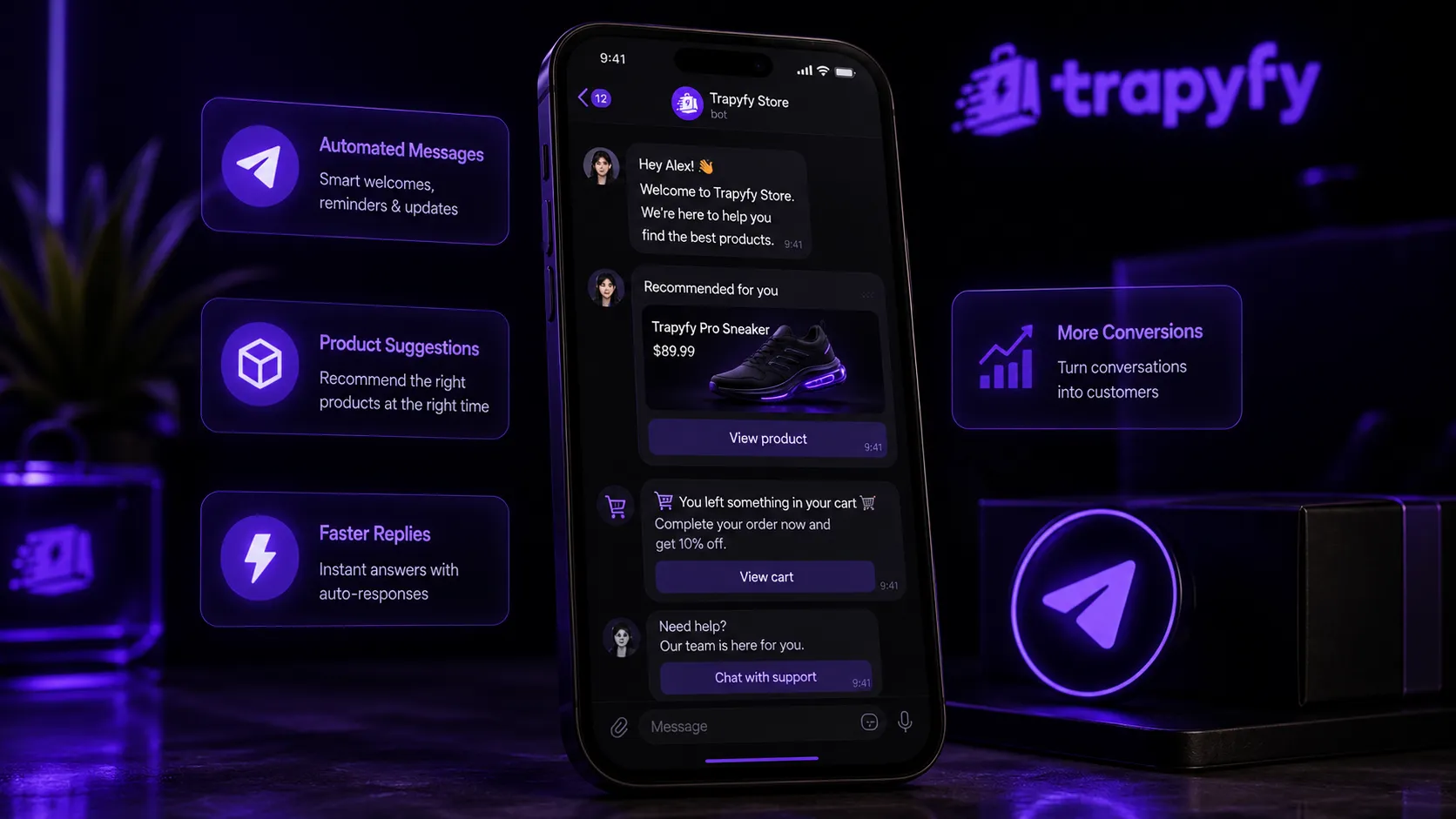
The messages that reliably earn their place are welcome messages, product recommendations, cart reminders, checkout assistance, payment instructions, order confirmation, shipping updates and support replies. Each should carry one purpose and one next step.
Short and specific beats enthusiastic. A useful cart reminder reads like “Your cart is still saved — two items, £48 total. Complete payment or change your selection.” A useful payment instruction names the method, the amount and what happens next. Neither needs an exclamation mark to work. For the underlying copy, a tested set of customer message templates for Telegram stores beats writing each flow from scratch.
Telegram checkout clarity before the payment step
Telegram checkout converts when the buyer can see the complete shape of the order before authorising anything. Uncertainty here is fatal, because it arrives at the exact moment money is involved.
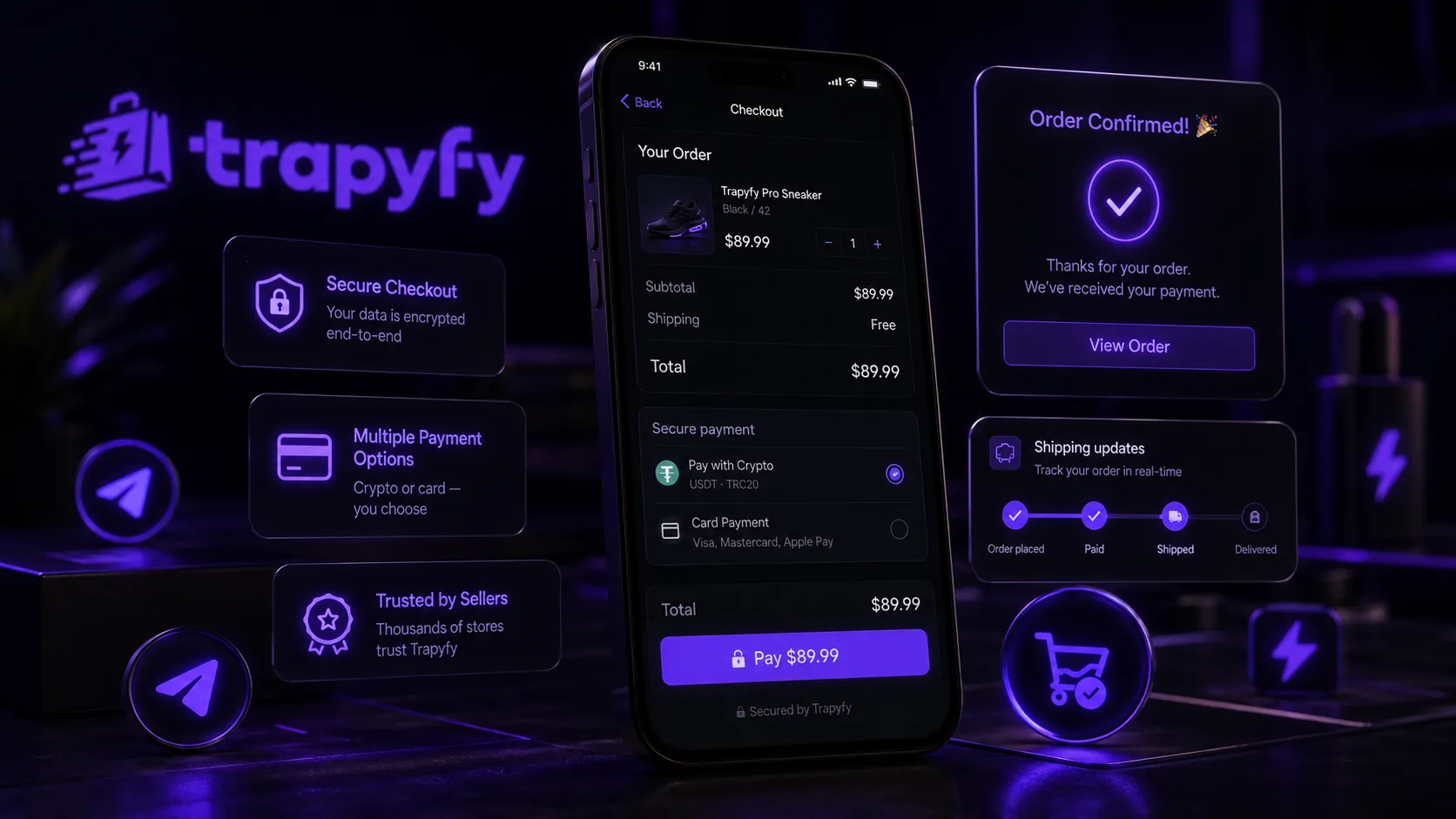
Before the payment button, the buyer should see the product, quantity, selected variants, subtotal, shipping, total, currency, payment method, an estimated delivery time, any policy affecting the order, and how to reach support. That is one summary, not a sequence of extra screens.
Payment options depend on your account, market and configuration. Trapyfy supports card payments and crypto through Niftipay, and what a specific merchant can offer follows approval and setup rather than being universal; Telegram’s Bot Payments API documentation is the reference for what the platform itself supports. Button hierarchy, step count and confirmation wording are covered in our guide to Telegram checkout optimization.
Trust signals that earn the payment
Trust is not a badge. It is the accumulated impression that this shop is run by someone who will still be there tomorrow, and buyers assemble it from small, verifiable details.
Identify the seller clearly. Keep the checkout visually consistent with the shop, so nothing feels like a redirect. Use payment methods buyers recognise, and tell them the payment will be checked before the order is processed. Make shipping, returns and relevant policies easy to find, and show that support responds.
Avoid manufactured urgency, invented review counts and countdowns that reset — experienced buyers read those as warnings. Confirming that payment is genuinely verified does more for confidence than any badge, and automated payment verification protects you from fake receipts on the other side of the same transaction.
Order confirmation that closes the loop
The moment after payment sets the tone for everything that follows. A confirmation that arrives immediately and carries real detail removes the buyer’s last doubt and prevents the first support message.
A complete confirmation states the order number, the product and variant ordered, the total paid, payment status, the initial order status, the next step and who takes it, an estimated timeframe, how to track the order, and the support channel. Silence at this point is the most common reason a completed order still generates a complaint.
Tracking and support protect the orders you have already won
Conversion does not end at payment. What happens next decides whether the customer buys again, recommends the shop, or opens a dispute.
Proactive status updates reduce inbound questions, and a buyer who can check their own order rarely needs to ask. A repeatable workflow from paid to delivered — the kind set out in our guide to Telegram order tracking — holds that expectation without manual effort.
Support carries the same weight. Slow or inconsistent replies raise refund requests and chargebacks, both of which cost more than the original conversion was worth. Structured routing, as described in our overview of customer support automation, protects that confidence as volume grows.
Telegram store conversion checklist
Work through this in the order a customer meets your shop. Each group covers one stage where Telegram store conversion is usually won or lost.
Before product view
- Top-level categories are few, clearly named and consistent.
- The path from opening the shop to a first product is short.
- High-intent entry points reflect real demand.
Product page
- Main image shows the actual product.
- The main benefit appears in the first line.
- Variants, availability and delivery are visible.
- Total price and currency are clear.
- One primary action sits above the detail.
Messages
- The welcome message explains what the shop sells and how to browse.
- Cart reminders are timed and specific.
- Pre-purchase questions get a direct answer.
- Every automated message carries one next step.
Checkout
- The full order summary appears before payment.
- Shipping, taxes and fees are stated, not implied.
- Payment methods are named and recognisable.
- Support is reachable from the checkout itself.
After payment
- Confirmation is immediate and complete.
- Payment status is explicit.
- Tracking is available without asking.
- Support responses follow a defined standard.
How Trapyfy supports a connected Telegram shop conversion journey
Most conversion problems in Telegram come from disconnection. The catalogue lives in one place, messages in another, payment confirmation in a chat thread and order status in someone’s head — so buyers meet a different standard at each stage.
Trapyfy keeps those stages in one flow. The bot storefront holds products, stock and pricing; automated messages guide the buyer; checkout collects the order; payment verification confirms it; and confirmation, tracking and support automation carry it through to delivery, with multi-currency pricing for cross-border stores.
The advantage is consistency. When every stage shares the same product data, order record and customer, the buyer stops encountering gaps — and gaps are what cost you the sale.
Frequently asked questions
What is a good Telegram store conversion rate?
There is no universal benchmark. The rate depends on traffic quality, product category, price point, buyer intent and whether you sell one-off items, pre-orders or repeat purchases — a shop with warm community traffic and one running cold paid traffic are not comparable. Set your own baseline, then measure against it.
How can I improve conversion in a Telegram shop?
Work through the journey in order: simplify categories, make product names and prices unambiguous, tighten product pages around one clear action, use automated messages that answer real questions, show the full order summary before payment, and confirm every order immediately.
What should a Telegram product page include?
A clear main image, the main benefit in the first line, a short scannable description, selectable variants, current availability, delivery expectations, returns information where relevant, visible trust signals, and one primary call to action.
Why do customers abandon Telegram checkout?
Most abandonment traces back to uncertainty rather than price: an unclear total, unexpected shipping costs, an unfamiliar payment method, too many steps, or no visible confirmation that the order will be processed after payment.
Do automated messages improve Telegram shop conversion?
They help when each message removes a specific obstacle — answering a pre-purchase question, recovering a saved cart, explaining payment or confirming an order. Frequent messages with no clear purpose have the opposite effect.
How can I build trust before a customer pays?
Identify the seller, keep the checkout consistent with the shop, use recognisable payment methods, state that payment will be verified, make shipping and returns information easy to find, and show that support is available. Avoid artificial urgency and unverifiable claims.
How does Trapyfy help convert Telegram traffic into orders?
Trapyfy connects the storefront, product and inventory data, automated messages, checkout, payment verification, order confirmation, tracking and support automation inside one Telegram flow, so the buyer meets the same standard of clarity at every stage.
Where the next order is actually won
Improving Telegram store conversion is rarely one dramatic change. It is a series of small removals — an unclear name, a hidden cost, a missing confirmation — each giving a buyer who already wanted to purchase one less reason to stop. Audit your shop in the order a customer meets it and the leaks become obvious quickly.
When the storefront, messages, checkout and post-purchase updates run from the same system, that clarity holds as volume grows instead of degrading — which is what you can build with Trapyfy around the traffic you already have.