
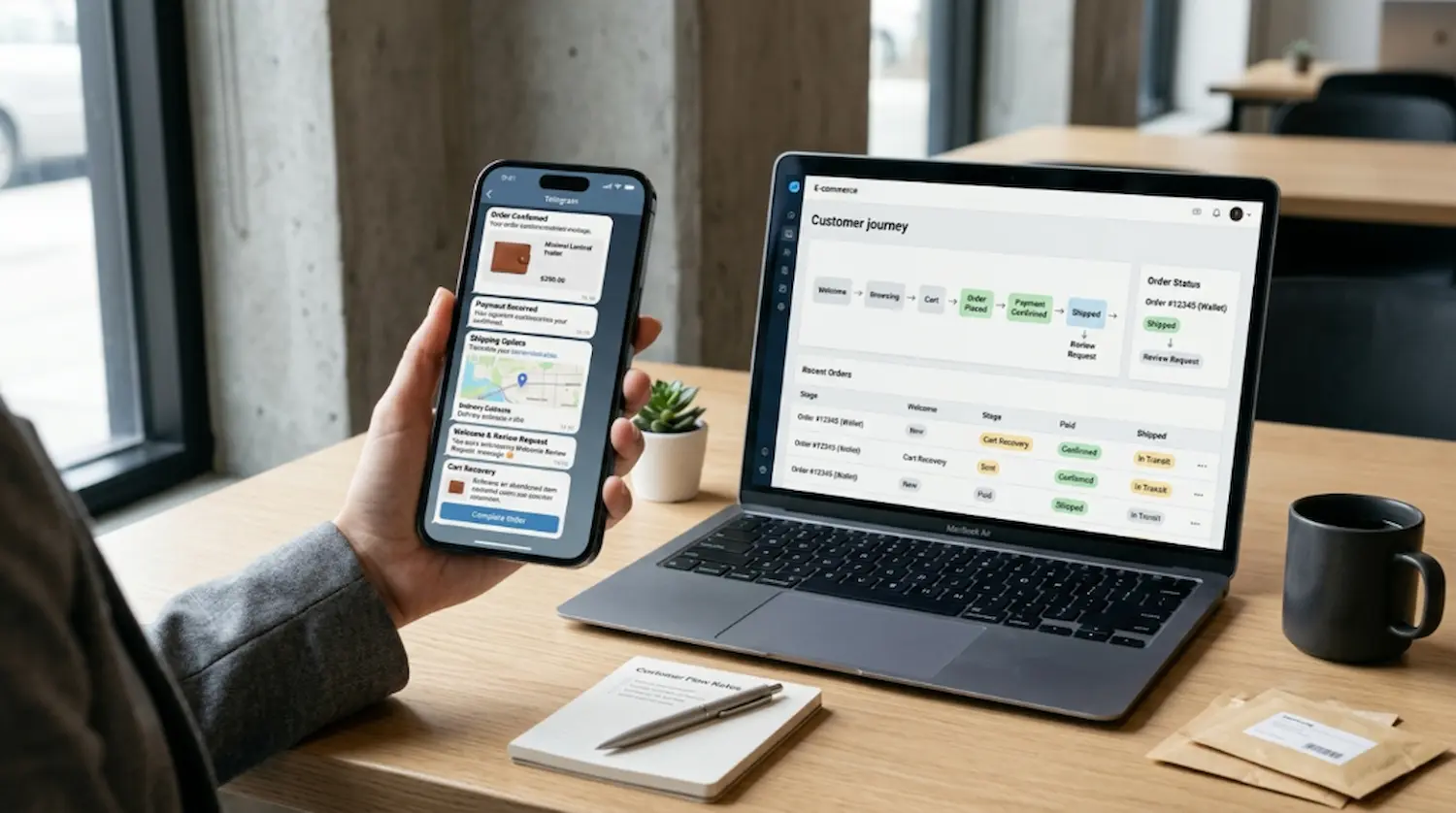
Message Templates for Telegram Stores can make the difference between a Telegram shop that feels clear and reliable and one that creates friction at every step. A customer opens the chat, browses products, asks a question, and places an order. But as soon as activity starts to grow, messaging stops being a small detail and becomes part of how the store actually runs.
That is where many stores begin to lose control.
Some buyers never get a clear starting point. Others reach checkout and disappear. Some complete payment but are left waiting without a clear update on what happens next. In a chat-based sales environment, those gaps create friction quickly.
Strong message flows help remove that friction. They guide the first interaction, recover stalled orders, and make the post-purchase experience feel more structured and more reliable.
For stores handling more regulated or complex products, that clarity matters even more. When the customer journey, the payment step, and the follow-up all happen in the same chat, communication becomes part of operations rather than an afterthought.
Why messaging matters more in a Telegram store
In a traditional ecommerce setup, communication is often spread across product pages, email flows, and account dashboards. In Telegram, most of that experience is compressed into one place: the conversation itself.
That changes the role of messaging.
A welcome message is not just a greeting. It sets direction.
A recovery message is not just a reminder. It removes uncertainty when an order is close to being lost.
A post-purchase message is not just an update. It helps the store feel reliable after payment, which is often where trust is either reinforced or weakened.
This becomes even more important when you are working with a more structured Telegram shop setup, where product discovery, checkout, and customer updates need to feel connected rather than improvised. Once you start accepting payments directly inside Telegram, clear messaging becomes even more important around checkout, confirmation, and post-purchase updates.
What good Telegram store messages actually do
Good message templates are not about sounding polished for the sake of it. Their job is much simpler.
They should:
- explain what is happening
- show the next step clearly
- keep the customer moving without confusion
That means most messages should answer three simple questions:
- Why am I receiving this?
- What should I do now?
- What happens next?
If a message does not answer at least one of those questions, it usually becomes noise. And in Telegram, noise slows the whole store down.
Start with message intent before writing the template
Before writing any telegram store message templates, it helps to define the role each one plays in the customer journey.
Most Telegram stores rely on a small number of key interaction points:
- entry into the store
- movement toward checkout
- payment confirmation
- order progress updates
- exceptions, delays, or support clarification
The most valuable templates usually sit around three moments: welcome, recovery, and post-purchase. Those are the stages where customer confidence is either reinforced or lost.
Welcome message templates for Telegram stores
The first message should do more than greet the customer. It should help them understand where they are, what they can do next, and how to move through the store.
A weak welcome message says hello and leaves the customer to figure everything else out alone.
A useful one creates momentum.
Welcome template 1: direct entry point
Hi and welcome. You can browse products, check categories, and place your order directly here in Telegram.
If you already know what you want, reply with the product name or open the menu to get started.
If you need help choosing, send us a message and we will guide you.
Welcome template 2: category-led welcome
Welcome to the store.
You can start by browsing:
- New arrivals
- Best sellers
- [Category]
- [Category]
If you are not sure where to begin, tell us what you are looking for and we will point you in the right direction.
Welcome template 3: guided support version
Welcome. You can explore products, check availability, and complete your order directly in this chat.
If you have any questions before ordering, reply here and we will help.
To begin, open the store menu or tell us what you need.
Welcome template 4: returning customer message
Welcome back.
You can continue browsing, check availability, or pick up where you left off.
If you need help with a previous order or want a quick recommendation, just reply here.
A strong welcome message reduces hesitation early. This matters even more when you are setting up a Telegram shop without coding and want the first interaction to feel clear from the start rather than manually handled every time.
Common mistakes in welcome messages
The most common problem is not poor wording. It is lack of direction.
A welcome message often fails when it:
- says hello without guiding the next action
- gives too many choices at once
- sounds generic or copied from another platform
- makes the customer work to understand what happens next
The best version is usually the clearest one.
Recovery message templates for abandoned or delayed orders
This is one of the most important stages in the store flow because it sits close to lost revenue.
Customers pause for different reasons. Some get distracted. Some hesitate around payment. Some want clarification before moving forward. Others assume the order did not go through.
A good recovery message does not push. It reduces friction.
Recovery template 1: incomplete checkout
It looks like your order was started but not completed.
If you ran into an issue during checkout, reply here and we will help you finish it.
If you are still ready, you can continue from where you left off.
Recovery template 2: hesitation support
Just checking in in case you had any questions before completing your order.
If you need help with payment, product details, or availability, send us a message and we will assist.
Recovery template 3: pending confirmation
Your order is still pending confirmation.
If you already completed payment, let us know and we will check the status.
If not, you can return to checkout whenever you are ready.
Recovery template 4: availability reminder
Your selected item is still available.
If you want to complete your order, you can continue from your last step.
If anything is blocking the purchase, reply and we will help.
Recovery template 5: clarification-led follow-up
Your order is still incomplete.
This usually happens when something needs clarification before moving forward, whether that is product details, payment, or delivery.
If that is the case, reply here and we will help you finish it.
These templates become much more useful when you understand how recovery flows work inside a Telegram store instead of treating them like generic follow-up messages. The closer the message is to the real point of friction, the more likely it is to bring the customer back into the order journey.
Why recovery matters more in complex or regulated store flows
Some stores can rely on very simple transactions and short sales cycles. Others cannot.
When the product category, payment process, or operational requirements are more complex, unclear recovery messaging creates even more hesitation. The customer is not only deciding whether to complete the order. They are also deciding whether the process feels trustworthy enough to continue.
That is one reason Trapyfy’s positioning makes sense here. It is designed for businesses that need a store flow with more structure, more control, and fewer loose ends inside Telegram.
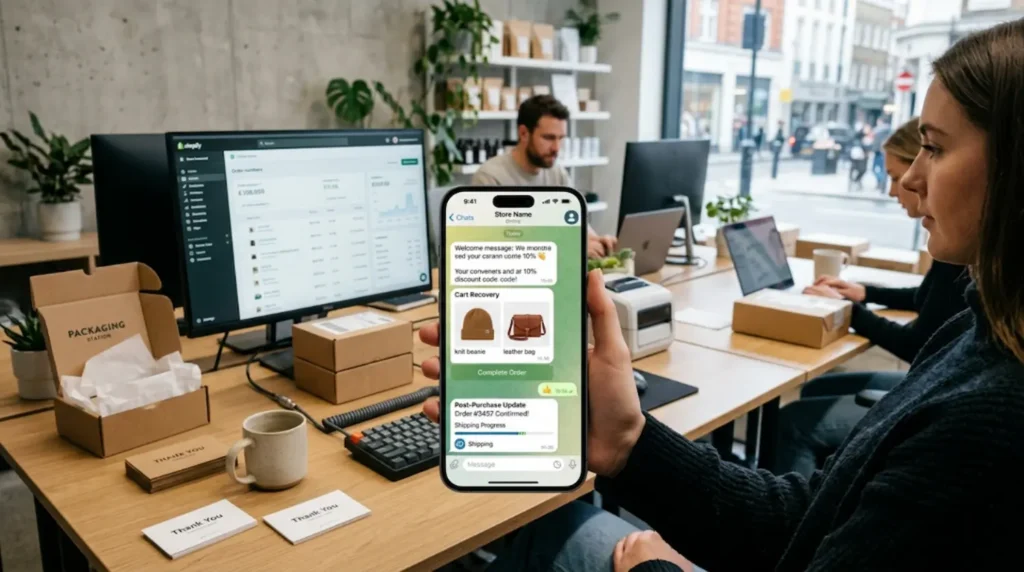
Post-purchase message templates for Telegram stores
Once the payment is completed, the customer is no longer deciding whether to buy. They are deciding whether the store feels reliable.
That is why post-purchase messaging matters so much.
A strong post-purchase flow reduces repeated support questions and makes the store feel organized after the sale, not only before it.
Post-purchase template 1: payment confirmation
Your payment has been received and your order is confirmed.
We are processing it now. You will receive the next update here.
If you need anything in the meantime, reply to this chat.
Post-purchase template 2: order in progress
Your order is currently being prepared.
We will send the next update here once it moves to the next stage.
If you need to check any detail, reply here and we will review it with you.
Post-purchase template 3: progress update
Your order has moved to the next stage and is now in progress.
We will keep you updated here if anything changes.
For support, reply in this chat with your order reference.
Post-purchase template 4: delay message
Your order is taking longer than expected.
We are reviewing it and will send the next update as soon as we have confirmation.
If your request is time-sensitive, reply here and we will assist directly.
Post-purchase template 5: re-engagement
Thanks again for your order.
If you want to reorder, browse related products, or check availability, you can continue directly here.
If you need help choosing your next order, just send us a message.
What matters here is not only the wording. It is whether the message supports a more connected post-purchase flow, where customers do not feel abandoned after payment and the store does not end up relying on scattered manual replies.
How to keep message templates from sounding robotic
The easiest way to make a message sound artificial is to overexplain it.
In Telegram, clarity usually performs better than formality.
A simple structure works well:
context + status + next step + support option
For example:
- context: your order was started but not completed
- status: it is still pending
- next step: continue checkout or reply for help
- support option: message us here
That is enough in most cases.
When brands try too hard to sound polished, the message often becomes slower, heavier, and less useful. In a chat-based sales flow, simple language usually feels more reliable.
Where these templates fit inside a real Telegram store workflow
Templates are not just shortcuts for the support team. They are part of the operating logic of the store.
A basic sequence often looks like this:
- welcome
- checkout
- recovery if the order stalls
- confirmation after payment
- order progress updates
- exception handling
- re-engagement after completion
As soon as those steps depend entirely on manual replies, things begin to slow down. Messages become inconsistent, support loses context, and simple questions start turning into missed orders.
That is where structure matters.
In Trapyfy, the goal is not to treat messages as isolated replies inside a chat. The value comes from having a store setup that connects catalog, payments, and messaging inside the same Telegram environment. That matters for any business, but especially for stores handling more regulated or operationally demanding products where clarity and control are part of the customer experience.
This is also why it helps to think beyond templates and look at what a Telegram shop builder should include from the beginning, especially if the store is expected to manage customer communication, payments, and order logic in one place.
What to customize before using these templates
Templates should always match the reality of the store behind them.
Before using them, adapt:
- product language
- tone of voice
- payment wording
- support availability
- order status labels
- timing expectations
- any compliance-sensitive phrasing that matters to your category
This is especially important for stores handling more regulated or complex products. If the message sounds more confident or more simplified than the actual process behind it, trust drops quickly.
What starts to improve when messaging is done properly
As order volume grows, messaging becomes part of daily operations.
A clear welcome reduces hesitation at the entry point. Recovery messages protect orders that would otherwise disappear. Post-purchase updates make the store feel more consistent after payment, which often matters just as much as the checkout itself.
Better messaging also helps with turning more store interactions into completed orders, because it removes uncertainty at the points where customers are most likely to pause, ask questions, or drop off.
That is usually where the difference becomes visible.
Not only in how the store looks, but in how it behaves once real customers start moving through it.