
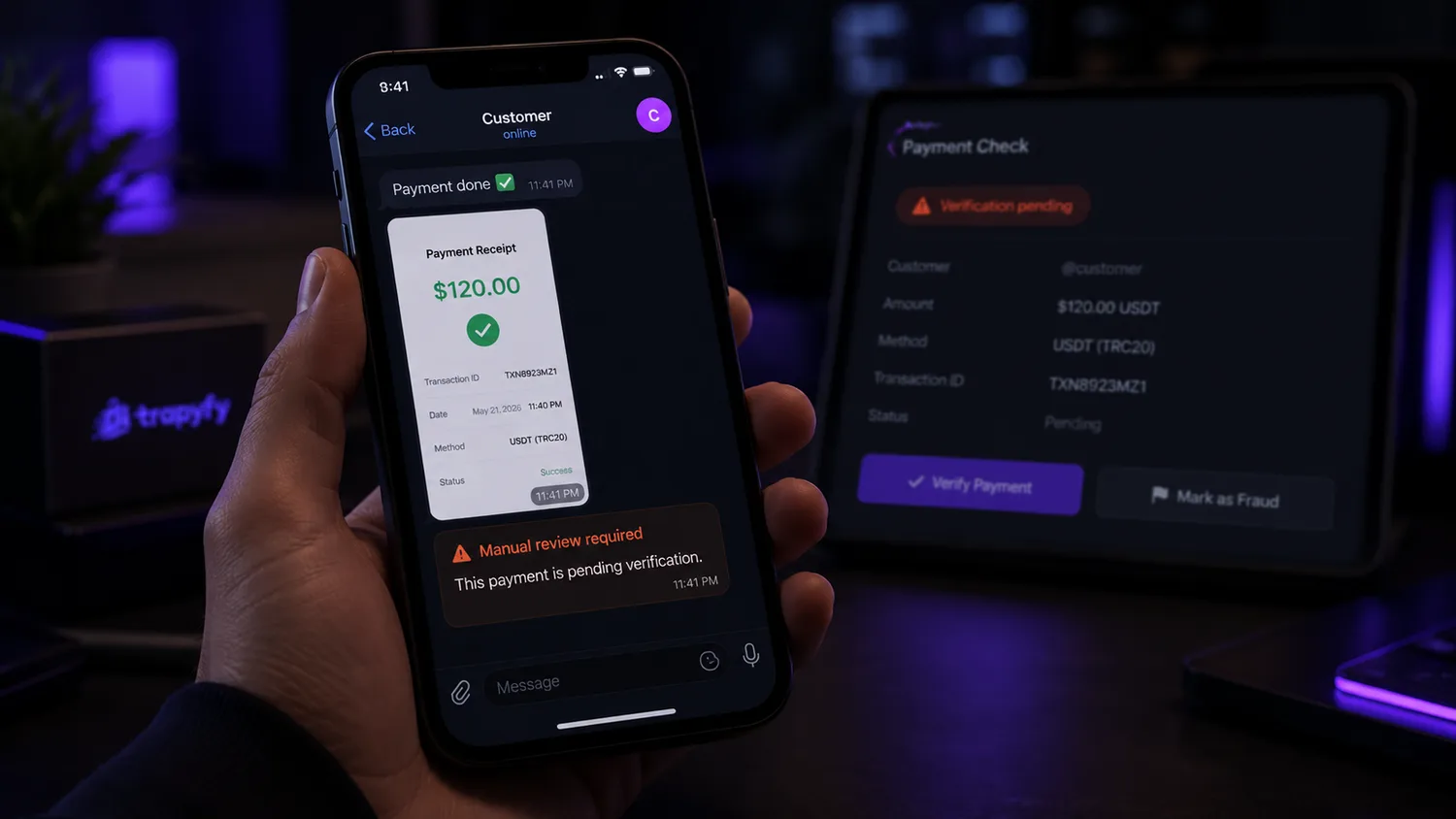
Telegram payment verification is the layer that decides whether a Telegram order is real before it leaves the warehouse. For sellers running storefronts on Telegram, the gap between “customer says they paid” and “the platform confirms the payment” is where fake receipts, screenshot edits and slow manual checks quietly drain margin.
This article explains how automated Telegram payment verification works, why it matters for high-risk and direct-to-customer sellers, and what to look for in a verification workflow that can keep up with order volume without putting a human in the loop on every transaction.
Why fake receipts and manual checks hurt Telegram sellers
Most Telegram stores still rely on a familiar pattern: the buyer sends a payment screenshot to the seller’s bot or operator, and someone on the team eyeballs it before releasing the order. That works until it doesn’t.
Screenshot-based confirmation is fragile for three reasons. First, edited receipts are trivial to produce: a few seconds in any image editor changes the amount, reference or status. Second, the verifier becomes the bottleneck — orders pile up overnight or during peak hours waiting for a human to compare a screenshot against a bank statement. Third, mistakes are expensive: a fake receipt that passes review ships real inventory the seller never got paid for. Closing that exposure is less about reading screenshots more carefully and more about the security layer the store runs on.
For high-risk categories like CBD, vape, peptides or adult products, the cost of one bad fulfillment is even higher. Chargebacks are limited because most transactions are not card-based, so the loss falls entirely on the seller. Protect Telegram store payments with verification that does not rely on human eyes catching a forged screenshot at 2 a.m.
What Telegram payment verification actually means
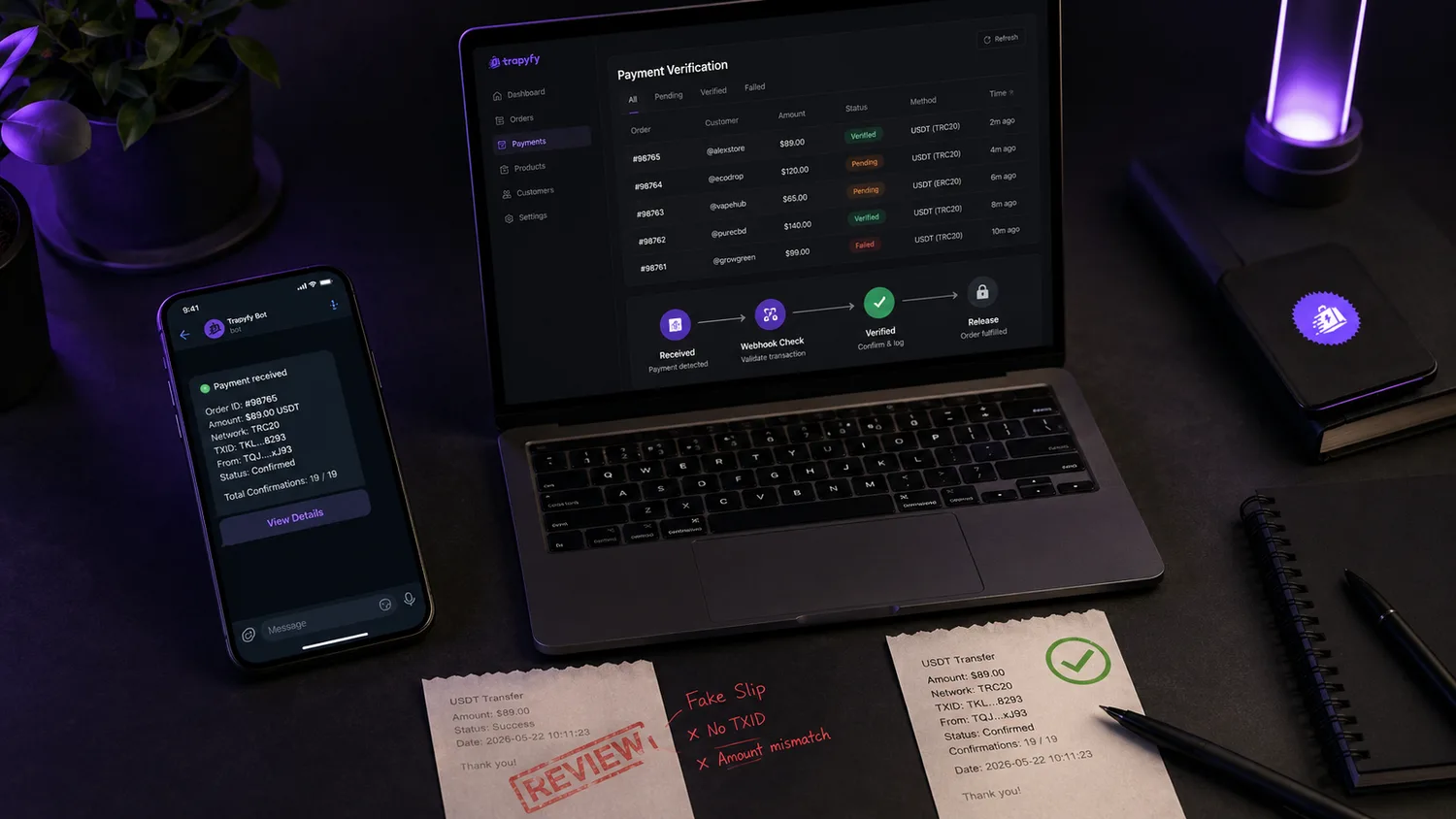
Telegram payment verification is the process of confirming, from a trusted source, that a buyer’s payment reached the seller in the exact amount and currency the order requires, and then linking that confirmation to the correct order inside the Telegram bot.
There are three signals that matter:
- Source of truth. The confirmation comes from the payment processor or blockchain, not from a buyer-uploaded image.
- Order match. The amount, currency and reference tie back to a specific cart in the bot, not just “a payment arrived today”.
- Status gate. Fulfillment only fires when the order moves to
paidbased on that confirmation — never on human approval of a screenshot.
This is the difference between Telegram payment confirmation and Telegram payment verification. Confirmation tells the buyer the request was received; verification tells the seller the money actually settled and that the order can ship.
Where this fits in the order lifecycle
A verified Telegram order moves through four states: pending when the bot quotes a price, awaiting payment when the buyer is sent payment instructions, paid when verification succeeds, and fulfilled when stock leaves the warehouse. The only state transition fulfillment cares about is awaiting payment → paid, and that transition has to be machine-driven.
How automated payment verification works in Telegram
Automation removes the screenshot from the loop entirely. Instead of asking the buyer to prove they paid, the bot listens to the processor and reconciles incoming payments against open orders by reference, amount and timestamp.
The typical flow looks like this:
- Buyer confirms cart inside the Telegram bot.
- Bot generates an invoice with a unique reference (and a wallet, link or processor session, depending on the rail).
- Buyer pays through their preferred method — bank transfer, card, stablecoin, crypto.
- Processor or watcher sends a webhook to the bot backend the moment funds settle.
- Backend matches reference + amount + currency, marks the order
paid, and triggers fulfillment, receipt and customer notification.
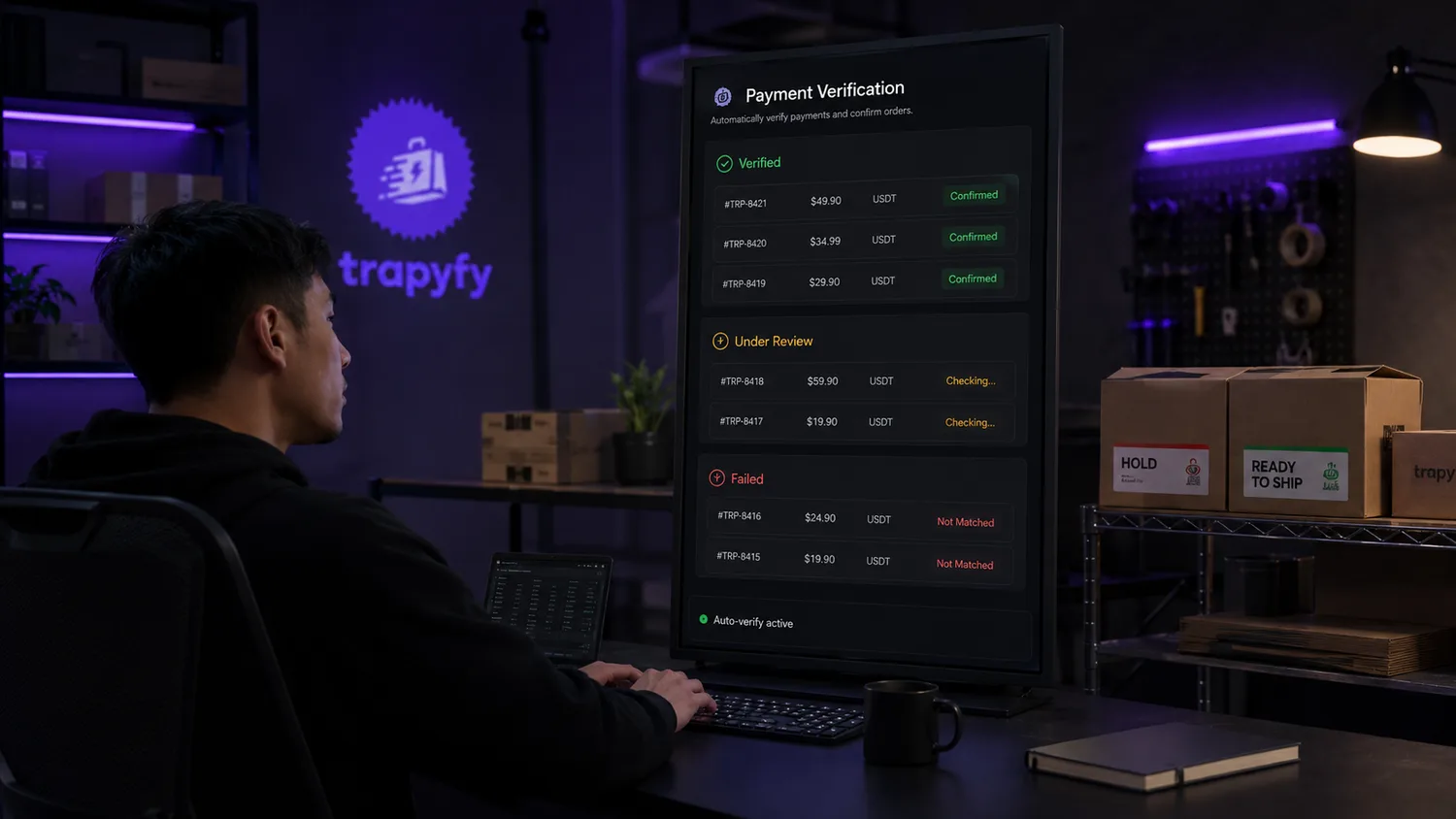
The buyer never has to send a screenshot. The seller never has to open one. The order either matches or it doesn’t, and unmatched payments stay in a review queue with the original processor data attached for context.
Webhooks as the connective tissue
Webhooks are how the verification layer hears from the outside world. Each payment rail publishes events — payment.succeeded, transfer.confirmed, charge.captured — that arrive at the bot’s backend within seconds. A verified Telegram store treats these events as the only acceptable proof of payment. The bot’s database is the system of record; the processor is the authority. For a deeper look at how this glue layer is built, see Telegram webhooks for ecommerce.
Building blocks of a Telegram payment verification stack
A workable verification stack has four parts, and skipping any of them recreates the manual problem somewhere else.
| Component | Role | Failure if missing |
|---|---|---|
| Invoice with unique reference | Ties payment to a specific cart | Payments can’t be matched to orders |
| Processor webhook listener | Receives settlement events in real time | Team falls back to screenshots |
| Reconciliation engine | Matches amount, currency and reference | Partial or duplicate payments slip through |
| Fulfillment gate | Blocks shipping until paid status fires | Forged receipts trigger real shipments |
Sellers operating across multiple currencies — USD, GBP, EUR or stablecoins — also need the reconciliation engine to normalize exchange rates at settlement time, not at invoice time. Otherwise a small FX swing between quote and capture can leave an order under-paid by a few cents and silently flagged for manual review.
What to look for in a Telegram payment automation platform
If verification is the goal, the platform around it has to support the workflow end to end. The checklist sellers should run before committing to a stack:
- Native Telegram bot integration so the same system that quotes the order also tracks its payment status.
- Multiple payment rails covering cards, transfers and crypto — verification matters most where chargebacks don’t exist.
- Webhook-driven status changes rather than scheduled polling, which adds minutes of latency.
- Per-order audit log showing which event marked the order paid, when, and from which processor.
- Fulfillment hooks that can pause or route an order if reconciliation fails.
- Operator alerts for the small subset of payments that genuinely need human review — partial amounts, late settlements, refunds.
Pair this with a clear paid-order workflow on the operations side: confirm orders before fulfillment by routing only paid orders into the picking queue. The verification layer should be invisible to good buyers and a hard wall for bad ones.
Where high-risk sellers gain the most
For regulated or restricted categories, verification doubles as a compliance signal. Logged, processor-sourced proof of payment per order is the kind of audit trail acquirers and banking partners ask for when reviewing seller accounts. Sellers comparing Telegram against legacy gateways often start here — see Telegram payments for high-risk products for the broader landscape.
The bottom line: verification turns Telegram into a real storefront
A Telegram store without verification is a chat thread with a payment button. A Telegram store with verification is a system: every order carries a paper trail, every shipped package matches a settled invoice, and operators stop asking the question that has eaten too many seller margins — “is this receipt real?”
The sellers winning on Telegram in 2026 are not the ones with the prettiest catalog. They are the ones whose fulfillment queue only contains orders the processor already confirmed. Telegram payment verification is what makes that queue trustworthy, and it is what separates a hobby bot from a storefront banks, partners and repeat buyers can take seriously.
The Telegram Bot Payments API already publishes the raw settlement events; verification is the layer that turns those events into a shipping-ready signal. Build that gate once, and every order after it earns its way to the warehouse — no screenshots, no second-guessing, no “I’ll check it in the morning”.
FAQ
What is Telegram payment verification?
It is the automated process of confirming, from the payment processor or blockchain, that a buyer’s payment reached the seller in the correct amount before the order is released for fulfillment.
How is Telegram payment verification different from Telegram payment confirmation?
Confirmation acknowledges the request was received; verification proves the funds actually settled and matches them to a specific order, which is what fulfillment depends on.
Can buyers still fake receipts if I use automated verification?
They can submit forged screenshots, but the bot ignores them. The system only marks an order paid when the processor or chain webhook confirms settlement against the order’s unique reference.
Do I still need manual review for any Telegram payments?
Only for edge cases: partial amounts, late settlements, currency mismatches or refunds. The verification layer surfaces these in a queue with full processor data, instead of asking operators to review every order.
Which payment rails work with Telegram payment verification?
Anything that emits a webhook on settlement: cards, bank transfers, stablecoins and most cryptocurrencies. Multi-currency stores should make sure the reconciliation engine normalizes FX at capture time, not at invoice time.