
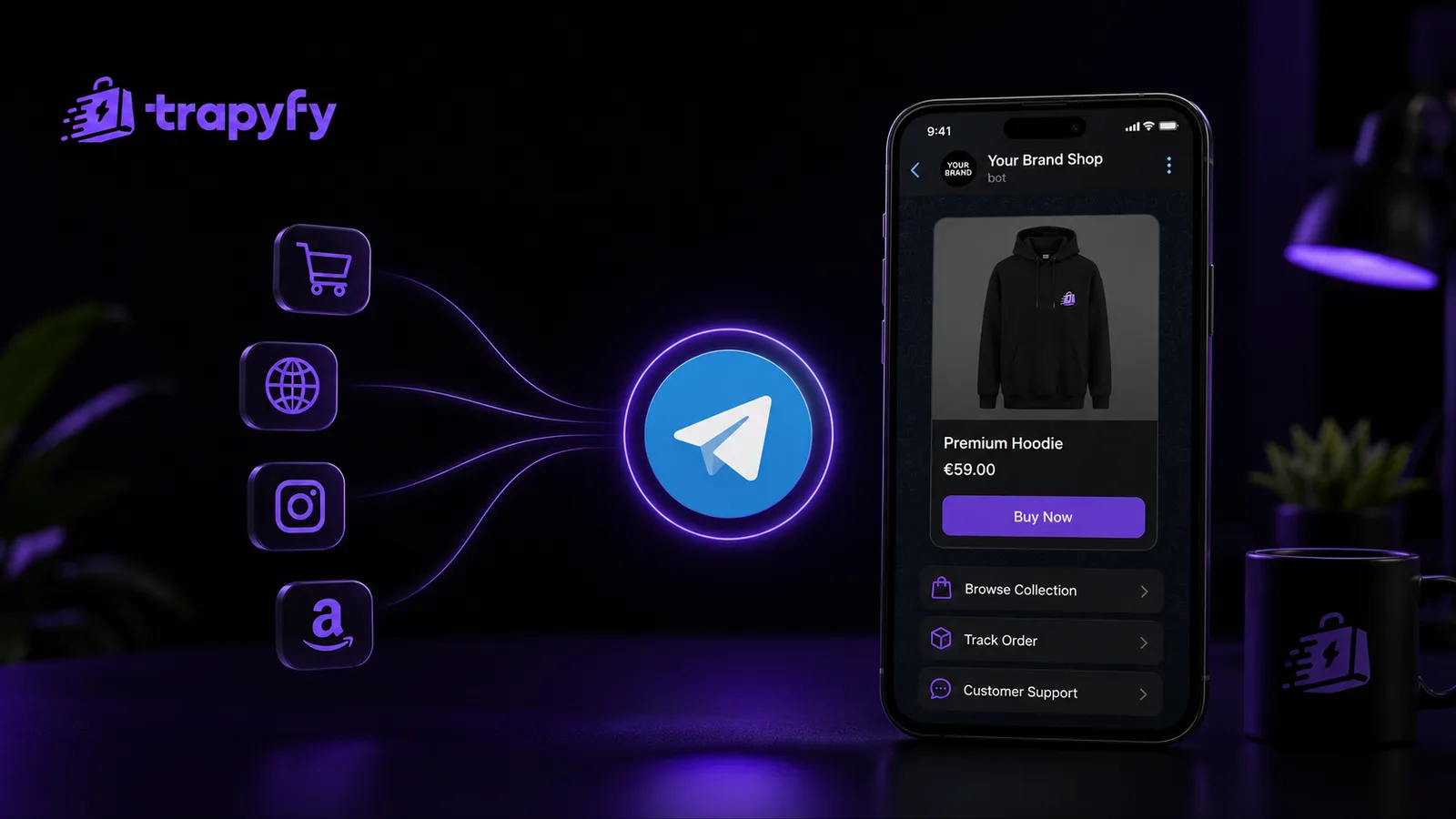
Adding a Telegram sales channel means turning a messaging app your customers already use into a working point of sale, where they can browse your catalogue, ask a question and place an order without leaving the conversation. For an established brand this is an addition, not a replacement: your website, social profiles and marketplace listings carry on doing their job, while Telegram gives community members and returning buyers a shorter route to purchase. Trapyfy supplies the commerce infrastructure behind that channel, so a brand can launch a new Telegram storefront or upgrade one it already runs.
What a Telegram sales channel actually is
A Telegram sales channel is a structured ecommerce touchpoint inside Telegram where a brand presents products, receives orders, communicates with customers and connects the buying journey to its existing operations. It is a commercial surface with a catalogue, prices, availability and an order flow, not a place to post announcements.
The distinction matters, because four different things are often called the same thing:
| Setup | What it does | What it does not do |
|---|---|---|
| Channel or group | Broadcasts updates, builds an audience | Holds no catalogue, prices or orders |
| Basic bot | Answers commands, sends replies | Rarely handles browsing, stock or order states |
| Selling by direct message | Takes orders one conversation at a time | Does not scale, leaves no structured record |
| Telegram sales channel | Catalogue, orders, status tracking, support | Does not replace your website or logistics |
A bot is part of the experience, but it is the interface, not the channel. What makes it commercial is the structure behind it: products a customer can browse, availability they can trust, an order they can complete and updates afterwards.
Why brands add Telegram to an existing ecommerce strategy
The reason is rarely dissatisfaction with the current platform. It is proximity: the audience is already there, and the distance between interest and order is short.
- A direct touchpoint with customers who already follow the brand.
- Fewer steps to order, since browsing, questions and checkout share one conversation.
- Support beside the sale, so a question does not become an abandoned basket.
- A home for launches and drops, where an existing audience is served immediately.
- A route to markets or communities that a general storefront serves poorly.
- An extra channel without rebuilding operations, keeping your products, pricing and suppliers.
None of this is automatic. Performance depends on the audience you bring, the offer, the buying experience, the operational capacity behind it and the relevance of the traffic you send there.
How Telegram fits alongside the channels you already run
The channel works best when its role is defined against everything else the brand operates. Each existing channel keeps a distinct job.
Your ecommerce website
The website can remain the centre of search visibility, content, brand information and the full catalogue. Telegram then serves a different purpose: a direct route for people who already know the brand, and a buying space for a community already gathered there.
Social media
Social platforms are strong at discovery and reach. They handle the middle of the journey less well, where a customer has a question or is ready to order. Telegram can absorb part of that attention and convert it into a conversation, catalogue access and an order.
Communities
An active community gives a brand attention and trust, and a commerce channel gives it more direct access to products, launches and support. A community is not a shop, though. Conversation stays in the community; the storefront is a separate surface members reach when they want to buy.
Marketplaces
Marketplaces contribute reach and buyer confidence, and should keep doing so. Telegram can build a more direct relationship with customers who already know the brand, with people who choose to join, and within the terms of each marketplace the brand sells on.
Which ecommerce brands are best suited to selling in Telegram
Telegram commerce fits brands that already have demand and need a shorter path to it:
- Brands with an active community or subscriber base.
- Businesses with repeat customers and predictable reorders.
- Brands running launches, drops or limited availability.
- Specialist catalogues where buyers ask questions before ordering.
- Merchants selling across several countries.
- Businesses already taking order requests through private messages.
- Brands using Telegram for support or community, but not for selling.
- Merchants who want an unlisted storefront customers reach by link rather than through public search.
It is a weaker priority when the audience does not use Telegram, when there is no capacity to handle orders promptly, when product information is not ready, or when consistent support is unrealistic.
How to add Telegram to ecommerce, step by step
1. Define the role of Telegram
Decide what the channel is for before building anything: a full sales channel, a curated selection, an unlisted store shared by link, a launch channel, a repeat-purchase route, or an entry point for one market.
2. Decide which products to sell
The channel need not mirror the whole catalogue. Consider bestsellers, drops, bundles, Telegram-exclusive items or market-specific lines. Starting narrow keeps the experience easy to manage and easy to navigate.
3. Build a structured Telegram storefront
Loose product messages create a feed, not a shop: customers cannot browse them and prices drift out of date. A storefront lets a customer move through categories, see price and availability, understand variants, start an order and reach support. Trapyfy’s approach to building a Telegram storefront is built around that flow, not around bot commands.
4. Connect products, inventory and orders
Product information, stock, availability, incoming orders and status changes should be managed centrally, so an item sold elsewhere is not still offered in Telegram.
5. Configure payments and currencies
Payment expectations vary by market, so the channel needs methods that suit its customers, clear currency and amounts before they commit, and an unambiguous confirmation once paid. The practicalities of selling across several currencies are worth reviewing first. When required, payment processing can be handled through Niftipay, which Trapyfy integrates for both crypto and fiat card payments; card availability can be limited by country, and brands with their own arrangements keep them.
6. Plan fulfilment and delivery
Before the first order, define delivery zones, timeframes, shipping costs, how each order is assigned to a warehouse or supplier, and how tracking reaches the customer. Fulfilment problems are far more visible when the customer is already in conversation with you.
7. Automate repetitive order tasks
Confirmations, status changes, notifications and internal routing consume the most time as volume grows. Automated Telegram order handling covers payment confirmation, routing and customer updates. Automation should still sound like the brand; confusing replies undo the benefit.
8. Guide customers into the channel
A new channel receives no traffic by default. Invite customers from the website, email, social profiles, the community, QR codes on packaging and support conversations. Every entry should be the customer’s choice; adding people automatically or messaging them unsolicited damages trust.
9. Measure the channel separately
Do not blend Telegram into one site-wide figure. Decide which measures matter: channel entries, products viewed, orders, conversion from entry to order, average order value, repeat purchases and performance by market. Agree the definitions before launch.
How a Telegram sales channel fits an international operation
Selling across borders inside a messaging channel raises familiar questions in a more compressed space. Communities in different countries expect prices in a currency they recognise, product information in a language they read, delivery information that reflects where they live, and clarity on which markets the brand ships to. Regulatory requirements for some products vary by country, so a brand should confirm its own obligations in each market. The groundwork for selling to international buyers in Telegram covers language, shipping zones and local payment expectations.
Common mistakes when adding Telegram as a sales channel
- Treating the channel as a promotional feed with no way to buy.
- Launching a bot without an organised buying experience behind it.
- Duplicating the full catalogue without controlling availability.
- Leaving payment and delivery terms unexplained until the customer asks.
- Never defining what role Telegram plays in the wider strategy.
- Offering no visible support route inside the channel.
- Loading too many products in at launch, which makes browsing harder.
- Expecting orders without directing any audience to the channel.
- Measuring Telegram inside a single blended performance figure.
- Trying to move every channel into Telegram at once.
- Using impersonal or confusing automated replies.
Adding Telegram is not the same as replacing your ecommerce platform
Adding this channel does not mean leaving the platform you already run. A website continues to serve search visibility, content and discovery, and often remains the primary catalogue. Telegram offers a more direct experience for particular audiences, especially returning customers and communities. Which one carries more weight depends on the business model, and the comparison between a Telegram shop and a Shopify store is a separate decision from the one covered here.
How Trapyfy helps brands launch or upgrade a Telegram commerce channel
Trapyfy is commerce infrastructure for Telegram. The brand keeps its products, its customers and its business; Trapyfy provides the system that turns Telegram into a structured channel connected to daily operations.
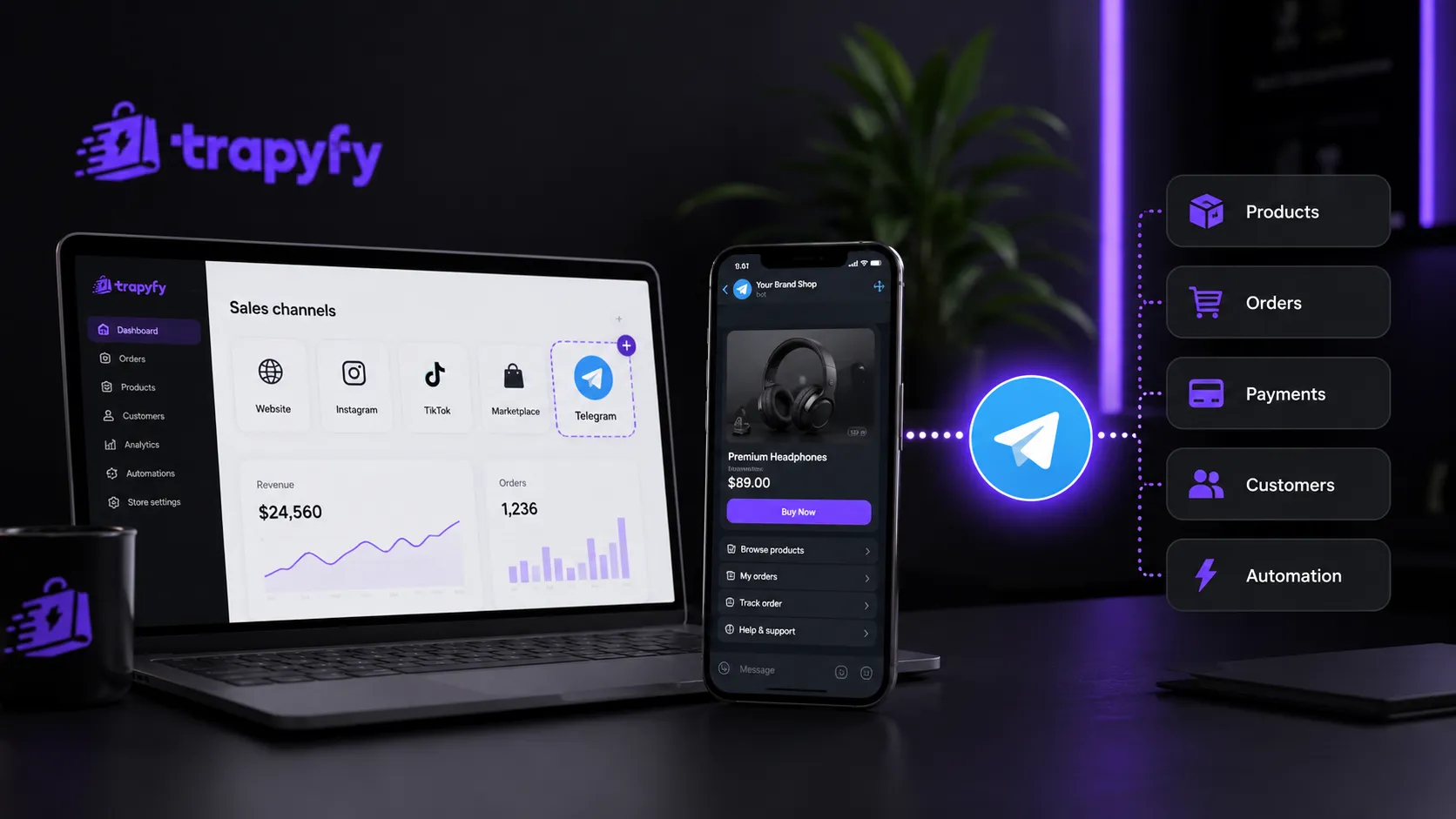
- Bot storefront creation, launching a new Telegram shop or connecting an existing one.
- Product and inventory control, with variations, per-country pricing and multi-warehouse stock.
- Order automation, covering payment confirmation, routing and status updates.
- Fulfilment routing to the right warehouse or supplier based on stock and location rules.
- Order tracking, with tracking details shared with the customer in the channel.
- Customer interactions, handling messages, support requests and order enquiries in one place.
- A developer API for brands integrating the channel with their own systems, planned for a future release.
- Payments through Niftipay where a brand needs them, rather than as a condition of use.
Trapyfy does not take over the brand’s wider ecommerce infrastructure or promise a particular commercial outcome. It runs the channel; the brand owns the offer, the audience and the operation behind it.
Telegram sales channel launch checklist
Work through these before opening the channel. For first-launch detail, the pre-launch checklist for a Telegram shop goes deeper on testing.
- The role of the channel is agreed internally and written down.
- The audience you will invite is identified and realistically sized.
- The product selection is decided and deliberately limited at launch.
- Product names, descriptions, images and variants are complete.
- Stock and availability rules across channels are defined.
- Payment methods are configured and tested end to end.
- Currencies and displayed prices are correct for each market served.
- Delivery zones, timeframes and shipping costs are published.
- A support route is visible, with response times the team can meet.
- Automated confirmations and status messages match the brand’s voice.
- Entry points from website, email, social profiles and packaging are live.
- Channel measures and their definitions are agreed before the first order.
- A full test order is completed, including payment, fulfilment and tracking.
Frequently asked questions
What is a Telegram sales channel?
It is a structured ecommerce touchpoint inside Telegram where a brand presents products, receives orders, communicates with customers and connects those orders to its existing operations. It differs from a broadcast channel because it holds a catalogue, prices and availability, and produces order records the business can act on.
Can Telegram be added to an existing ecommerce store?
Yes. Most brands that add Telegram already sell through a website, social profiles or marketplaces and keep all of them running. The practical work is deciding which products to offer in Telegram, how stock is managed across channels, and how orders reach the fulfilment process already in use.
Does a Telegram shop replace a website?
Not usually. A website keeps doing work Telegram cannot do, including search visibility, content and open discovery by new customers. A Telegram shop for brands tends to serve returning buyers, community members and specific markets more directly. Which channel matters more depends on the business model.
How can brands sell products directly through Telegram?
By building a storefront inside Telegram where customers browse categories, open products, see prices and availability, place an order and receive updates afterwards. That requires product and inventory data behind the conversation, a payment method suited to the market, defined delivery rules and a support route.
Can international brands use Telegram as a sales channel?
Yes, and it is a common reason to add one. International selling in Telegram depends on prices in currencies buyers recognise, product information in a language they read, accurate delivery zones and timeframes, and clarity about which markets the brand ships to. Regulatory requirements differ by country.
How are payments handled in a Telegram ecommerce channel?
Payment handling depends on the market and the products sold. The essentials are a method customers recognise, the amount and currency shown clearly before they commit, and an unambiguous confirmation once payment completes. Where a brand needs payment processing, Trapyfy integrates Niftipay, which covers both crypto and fiat card payments, with card availability configurable by country. It is an option, not a requirement.
What is the difference between a Telegram bot and a Telegram commerce channel?
A bot is the interface a customer interacts with. A Telegram commerce channel is the commercial system behind it: a catalogue, stock and availability, order records, payment confirmation, fulfilment and customer communication. A bot can exist without any of that and simply answer commands.
Can Trapyfy upgrade an existing Telegram shop?
Yes. A brand already selling through Telegram can connect its existing setup rather than start again. The upgrade adds structure that manual selling lacks: an organised catalogue, inventory control, automated confirmation and status updates, fulfilment routing and one place to manage customer interactions.
Launch or upgrade your Telegram sales channel
The brands that get value from Telegram are rarely the ones that post the most. They are the ones that give an audience they already have a clear, well-run place to buy, then treat it as a real channel with its own catalogue, operations and measurement. Trapyfy helps ecommerce brands do that, turning Telegram into a structured sales channel with a storefront, product and inventory management, customer interactions, order automation and fulfilment tools, with payments through Niftipay where needed. If you already have the audience, give it somewhere to order: create your Telegram shop with Trapyfy.