
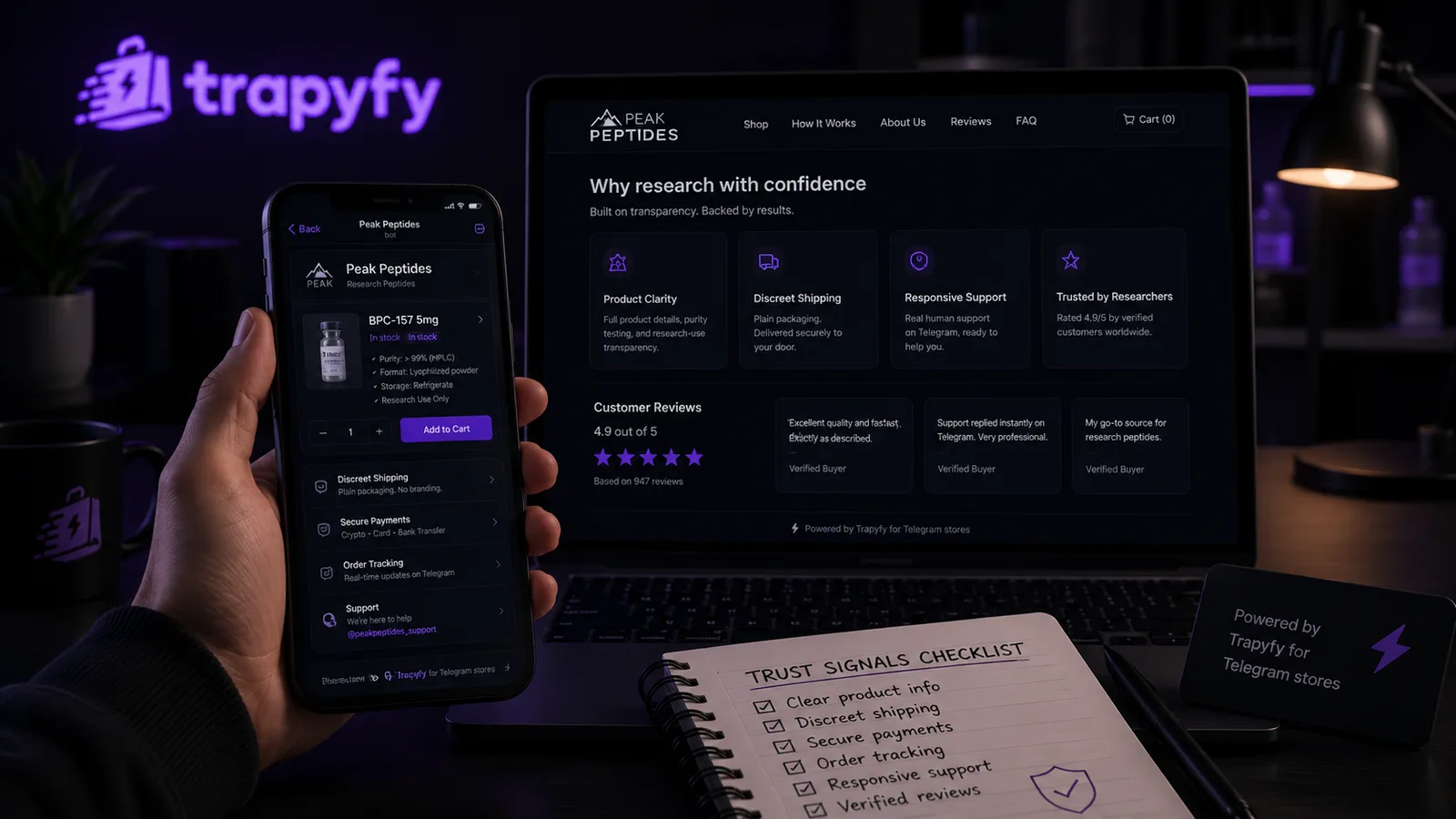
Telegram shop trust signals answer the question almost every new buyer asks before paying: can I trust a store that operates inside a chat app? Buyers do not really judge Telegram itself. They judge one specific shop, on what that shop shows them. A Telegram storefront can feel as clear and professional as any other ecommerce channel, provided the buyer can see who is selling, what the product is, what the total will be, when it should arrive and how to get help.
That clarity comes from editorial and operational decisions, not from badges. Trapyfy is the commerce platform brands use to create or upgrade a Telegram sales channel; the shop, the products and the promises always belong to the merchant.
What Telegram shop trust signals are, and what they are not
Telegram shop trust signals are the visible pieces of information and communication that let a buyer understand who is selling, what they are buying, how much they will pay in total, how payment is handled, when the order should arrive and where to get support. They are commercial signals: statements a customer can read, compare and hold the seller to afterwards.
They are not technical security. Encryption, access control and infrastructure protection matter, but a buyer never sees them; that side is covered in our guide to Telegram shop security. A shop can be well protected and still lose the sale because the delivery estimate is missing.
Why buyers hesitate before purchasing inside Telegram
Hesitation is rarely about the platform. It comes from gaps a particular seller has left open:
- The seller is unidentifiable. A bot name with no business behind it gives the buyer nothing to evaluate.
- Product information is thin. One photograph and a price leave every practical question unanswered.
- The payment process is unclear. A buyer who cannot picture how payment works postpones it.
- Delivery is unspecified. No timeframe, method or delivery area means no way to judge the offer.
- What follows payment is unstated. Buyers assume silence, and silence reads as risk.
- Support is invisible. With no contact route, the purchase looks unrecoverable if it goes wrong.
These are information gaps, not defects in Telegram. Close them in the order the customer meets them and hesitation falls away well before the payment button.
The trust signals every Telegram shop should show before checkout
These follow the sequence a customer experiences, and each is something a merchant can genuinely provide and stand behind.
Clear and complete product information
A product entry should say what the item is without prompting a question: a descriptive name, real photographs of the actual product, available variants, the price for the selected variant, current availability, and any condition or limitation affecting the purchase.
Claim only what the business can evidence. Words such as “tested”, “certified” or “authentic” carry weight solely when the merchant can produce the documentation behind them on request.
Delivery information before payment
Before payment, state the countries or regions served, estimated dispatch and delivery times, shipping cost, available shipping methods, whether tracking is provided, and any restriction that could stop an order being fulfilled. Estimates should be ones the operation can meet: a realistic five to seven working days builds more confidence than a next-day promise that fails.
Transparent payment information
At the payment step the buyer needs the accepted payment methods, the currency, an itemised total including shipping and any extra charge, the point at which payment counts as confirmed, and the confirmation they will receive.
Where the merchant’s configuration supports it, payments can be processed through Niftipay. What matters commercially is that the buyer is told when a payment is settled rather than left guessing, and that the seller checks it properly, as our guide to automated payment verification sets out.
Visible and accessible customer support
Support is a trust signal before it is ever used. Show how to reach a person, what support can resolve, and a realistic response window. “Replies within one working day, Monday to Friday” is stronger than an unqualified “24/7” the team cannot sustain. Routing enquiries consistently as volume grows is the harder part, covered in our overview of Telegram customer support automation.
Order confirmation and receipts
The seconds after payment decide whether a buyer relaxes or starts worrying. A confirmation should arrive immediately carrying the order reference, an itemised summary, the amount paid, the payment status, the delivery details on file, the expected next step and the support route.
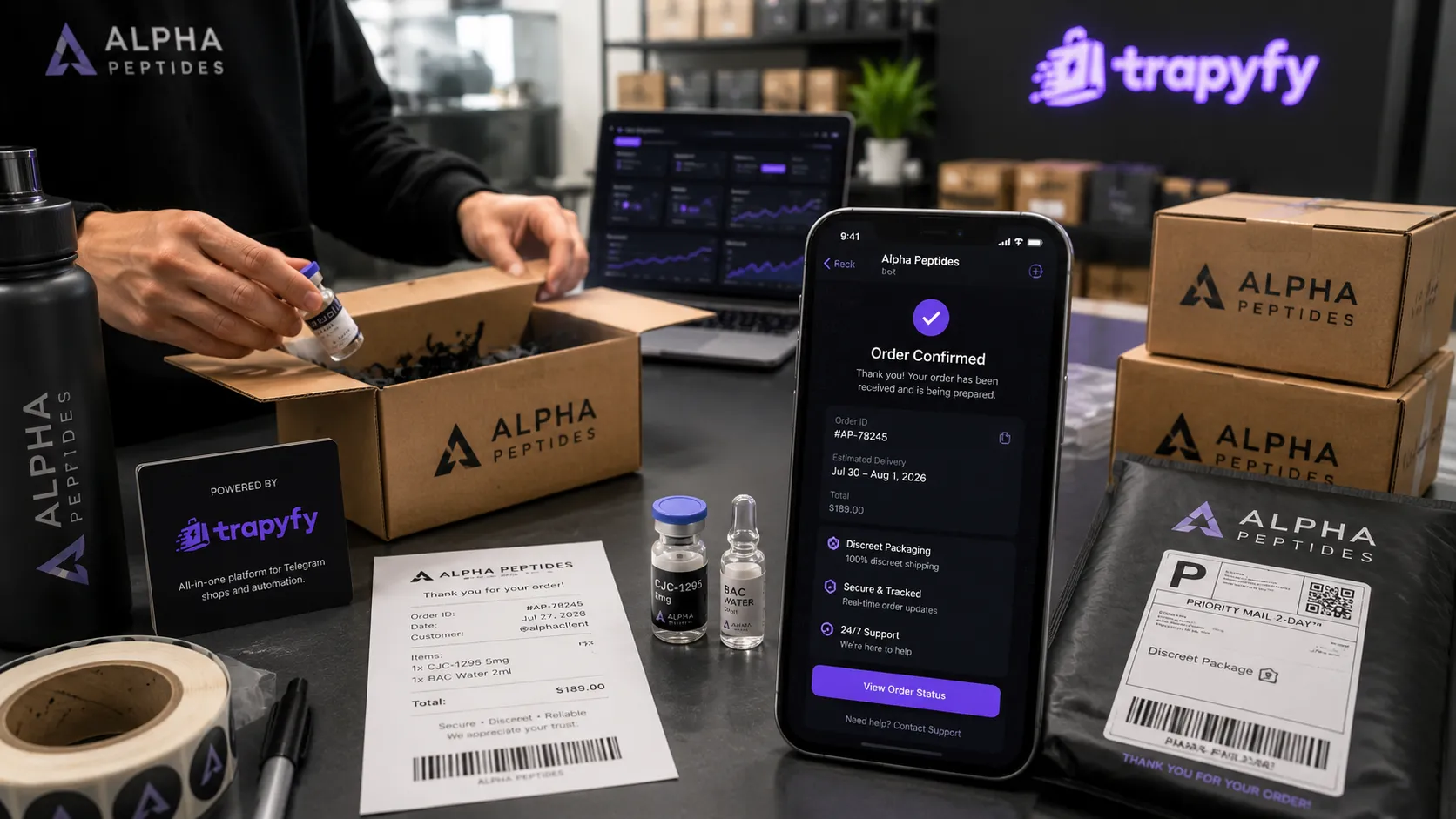
A receipt is also a working document: buyers reference it to chase an order or claim a return, so it should still make sense on its own months later.
Order status and tracking
Uncertainty between payment and delivery generates most support messages. A typical sequence runs from order received to payment confirmed, preparing, shipped and delivered, though the stages depend on the merchant’s fulfilment model and carrier. A digital product will not share the steps of an international shipment, so publish the stages that genuinely apply. The workflow behind self-service status checks sits in our guide to Telegram order tracking.
Private access without making the store feel secretive
Invitation-only shops are legitimate, and for some categories they are the sensible model. There is a real difference, though, between a store that is exclusive and one that is opaque: exclusivity limits who can enter, opacity hides information from the people already inside. An approved buyer still needs the full set of signals, as our guide to running a private Telegram store explains.
Consistent customer communication
The messages worth sending are few: a welcome explaining what the shop sells and how ordering works, a delivery explanation, a payment confirmation, status updates, an incident message when something has gone wrong, and a delay notice sent before the customer asks. Consistency is the signal: when the storefront, the automated messages and the checkout state the same delivery window and the same total, the shop reads as organised.
Trust signals before, during and after checkout
A signal delivered late does almost no work, so map each one against the moment the buyer needs it.
| Stage | What the buyer needs to see | Question it answers |
|---|---|---|
| Before checkout | Seller identity, product detail and photographs, variants, availability, delivery areas and timeframes, price, support route | Who is selling, what am I buying and when does it arrive? |
| During checkout | Payment methods, currency, itemised total including shipping, confirmation point, stated next step | What exactly am I paying and what happens when I do? |
| After checkout | Receipt with order reference, status updates, tracking where available, proactive communication, support access | Did it work, where is my order and who do I ask? |
Common trust mistakes Telegram sellers should avoid
Most of the damage is self-inflicted and easily corrected:
- Invented badges and seals representing no real certification.
- Unsupported verification claims, such as calling a product tested or authentic with no documentation.
- Late delivery costs revealed at the final step, after the buyer had decided.
- No explanation of what follows payment, leaving buyers to assume nothing will.
- Automated replies that answer nothing, which read as evasion.
- Delivery estimates the operation cannot meet. One missed promise costs more than a slower, accurate one.
- No visible contact route, implying none will exist after payment either.
- Contradictory information across the storefront, the messages and the checkout.
- Treating private access as a reason to explain less.
How Trapyfy helps brands build a more trustworthy Telegram buying experience
Most of these signals fail for structural reasons rather than editorial ones. A seller running orders manually through chat threads cannot keep pricing, availability, delivery information and order status consistent for long, and inconsistency is what buyers read as risk.
Trapyfy is the platform brands use to create a Telegram storefront or upgrade one they already run. It provides bot storefront creation, product and inventory management so pricing and availability stay in sync, order automation so confirmations and status updates go out without manual chasing, customer interaction handling inside the bot, fulfilment routing across warehouses or suppliers, and private store access.
What Trapyfy does not do matters just as much. Trapyfy does not certify sellers, verify product quality, test laboratories, guarantee delivery or issue security certifications, and it does not become the seller of the merchant’s products. Claims about a product and its provenance belong to the brand making them.
Telegram shop trust signals checklist
Work through this against a live shop. Every item is something a buyer can see and a merchant can verify.
- The seller is identifiable, with a business name and a contact route.
- Products carry descriptive names, real photographs, variants, price and availability.
- Conditions, restrictions and limitations appear on the product itself.
- Delivery areas, timeframes, costs and methods are stated before payment.
- The itemised total, including shipping and extras, is visible before the payment button.
- Payment methods and currency are named, with the point of confirmation stated.
- Support is reachable, with a realistic response window.
- An order confirmation arrives immediately, with a reference and an itemised summary.
- Status updates reflect the stages the operation genuinely runs, and tracking is offered where the fulfilment method supports it.
- Storefront, automated messages and checkout state the same prices and timeframes.
Frequently asked questions
Can buyers trust a shop operating inside Telegram?
Buyers can trust a Telegram shop when that shop makes its commercial information visible. Telegram is the channel, not the seller, so trust depends on what the individual merchant shows: identity, product detail, total price, payment handling, delivery timeframes, order confirmation and a working support route.
What are the most important Telegram shop trust signals?
The signals carrying most weight are clear product information with real photographs, delivery areas and timeframes stated before payment, an itemised total with no hidden costs, named payment methods with a stated confirmation point, an immediate order confirmation with a reference number, and a visible support route with a realistic response time.
How can a Telegram seller make checkout feel safer?
Show the complete shape of the order before the payment button: product, quantity, variant, shipping cost, total, currency and payment method, plus an estimated delivery date and the support contact. Then state what happens once payment goes through and when the buyer will next hear from the shop.
Should a private Telegram store still show seller information?
Yes. Restricted access controls who may enter a store; it does not reduce what an approved buyer needs to know. Inside a private shop the seller should still be identifiable, and product, pricing, payment, delivery and support information should be as complete as in any public storefront.
Do order confirmations increase buyer trust?
An immediate confirmation is one of the strongest signals available, because it resolves the buyer’s largest uncertainty at the point it peaks. A confirmation carrying an order reference, an itemised summary, the amount paid, the payment status and the next step also reduces inbound support enquiries.
How does order tracking improve the customer experience?
Tracking replaces waiting with information. When a buyer can see an order move from confirmed to preparing to shipped, they stop wondering whether anything is happening. Available stages depend on the merchant’s fulfilment method and carrier, so publish the stages that genuinely apply and let buyers check status themselves.
Can Trapyfy help an existing brand add trust signals to its Telegram shop?
Trapyfy provides the structure those signals rely on: a bot storefront, centralised product and inventory management, order automation with confirmations and status updates, customer interaction handling, fulfilment routing and private store access. The commercial claims and service promises remain the merchant’s own, because only the merchant can stand behind them.
Build a Telegram shop buyers can understand and trust
The shops that convert inside Telegram are not the ones shouting about security. They are the ones where a buyer works out, in under a minute, who is selling, what the product costs in full, how payment is handled, when it will arrive and who to contact if it does not. Telegram shop trust signals are simply that information, placed where the customer needs it.
Trapyfy helps brands create or upgrade a structured Telegram commerce channel with clearer product journeys, organised customer interactions, order automation and the tools needed to support buyers throughout the purchase. If your setup makes those signals hard to keep consistent, start building your Telegram store with Trapyfy and give buyers a shop that explains itself.