

Most online shops want as many visitors as possible. A growing group of sellers wants the opposite — fewer browsers, more screened buyers and a checkout that never sits on the open web. A private Telegram store answers that brief: a closed storefront that runs inside a chat, opens only to approved customers, and keeps every order, payment and conversation in the same window.
For brands selling restricted, high-ticket or community-driven products, a public storefront often creates more friction than it solves. Card processors flag whole categories at random, scrapers lift product feeds within minutes, and curious onlookers fill the support queue without ever buying. Telegram offers a different starting point — direct, gated and conversational — which is why a growing number of sellers are rebuilding their commercial side around it.
What is a private Telegram store?
A private Telegram store is a bot-driven storefront that lives inside Telegram and is invisible to anyone who has not been granted access. There is no public domain to crawl, no open landing page, no shopping cart sitting exposed in a browser. Customers reach the bot through an invite link, a referral or a manual approval flow, and only then see the catalogue, prices and stock.
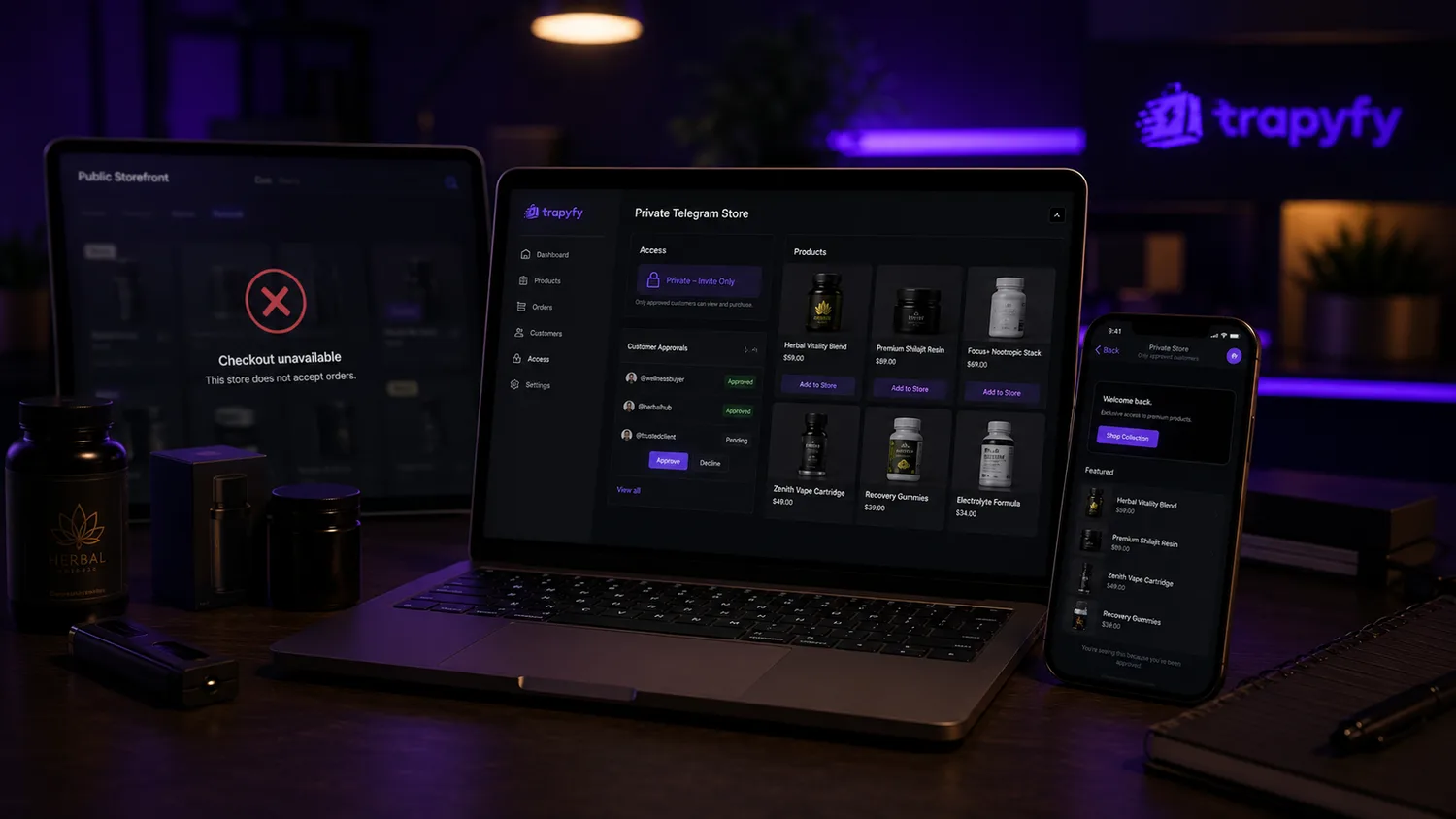
The bot handles browsing, ordering and checkout inside the chat. The seller manages the catalogue, customer list and orders from an admin panel that talks to the same bot. Because the storefront is bound to the chat, every action — product views, questions, payments, delivery updates — produces a clean trail the seller actually owns.
Why some brands avoid fully public checkout flows
A public ecommerce site assumes the visitor is worth the bandwidth. That assumption breaks down quickly when the catalogue includes age-restricted goods, geographically limited products, exclusive drops or anything categorised as high-risk ecommerce alternative by mainstream payment providers.
Brands in those categories deal with three recurring problems: aggressive scraping that drains servers and reveals pricing, processor risk that closes a working store overnight, and noisy traffic that distorts analytics and support load. A gated Telegram store removes all three by inverting the access model — nothing is visible by default, and the seller decides who graduates from chat to checkout. Access control of that kind is one part of secure Telegram commerce, alongside payment verification and order controls.
The trade-off is reach. A private Telegram shop will never replace SEO-driven discovery. It earns its place by converting traffic that is already qualified — community members, referrals, repeat customers and waitlists — at a much higher rate than an open store can.
How approved customer access works inside Telegram
Approval is the heart of a private Telegram shop. Sellers define who can see the catalogue, and the bot enforces it. Common patterns include invite-only access through unique links, application forms inside the bot, allowlists imported from existing CRMs, and tiered access linked to loyalty, geography or product type.
Once approved, the customer sees a personalised store: only the products available to their tier, in their currency, with shipping options matched to their region. Rejected or unverified users see nothing — the bot simply does not reveal stock to them. This approved customer checkout model gives brands the same gatekeeping power a physical members-only shop has, but without the overhead.
What sellers can control in a private Telegram shop
Inside a closed Telegram storefront, control is granular by default. Sellers usually manage at least the following without leaving the bot:
- Who sees the catalogue — approval rules, allowlists, regional gating.
- What each tier sees — exclusive products, hidden stock, member-only pricing.
- How orders flow — checkout steps, confirmation messages, fulfilment routing.
- Which payment methods appear — card processors, bank transfer, crypto.
- How customers communicate — automated replies, live chat takeover, broadcast updates.
That level of control matters because the alternative — running orders through DMs, spreadsheets and screenshots — is exactly how private sellers lose money to manual mistakes and unreliable record-keeping.
Payments, order tracking and customer data in one flow
The case for a private Telegram store strengthens once payments enter the picture. A bot-based checkout can collect the order, generate the invoice, confirm the payment and update inventory in a single thread the buyer never leaves. Refunds, partial shipments and re-orders sit in the same conversation.
For categories where receipt fraud is a real problem, a layer of Telegram payment verification tightens the loop further: payments are matched to the order automatically, and faked screenshots are flagged before stock is committed. Combined with a Telegram CRM for sellers that retains buyer history, address books and tier status, the seller ends up with a customer record richer than most open ecommerce backends produce.
Private stores for drops, communities and restricted product categories
Closed storefronts suit three commercial shapes especially well. Drops benefit from time-boxed access, since the bot can release a product only to a specific group at a specific minute. Communities benefit from member-only catalogues, where loyalty translates into earlier or cheaper access. Restricted categories — from collectibles to age-gated goods — benefit from baseline screening before checkout is even shown.
None of this removes the legal layer. A private Telegram store does not replace the seller’s responsibility to comply with local regulation, age-verification law, tax rules or product licensing. It controls who sees the shop and who pays for what — not whether the product is allowed to be sold.
Common mistakes when running a private Telegram store manually
Many sellers begin with a fully manual setup: DMs for orders, a spreadsheet for stock, a screenshot for proof of payment. It scales for a while, then collapses. The recurring failure points are predictable:
- Lost orders when a DM thread is buried under newer messages.
- Stock errors when the same item is sold twice while one operator is offline.
- Payment disputes with no automatic match between transfer and order.
- Slow approvals that leak warm buyers to competitors.
- No customer record when staff change phones or accounts.
A purpose-built bot turns each of those into a logged event. The seller stops being a switchboard and starts being a shop operator with proper records.
How Trapyfy helps sellers build a private Telegram store
Trapyfy is a Telegram commerce platform built for sellers who need the gated model from day one. The setup wizard creates the bot, the catalogue, the approval flow and the checkout. Payments, shipping and customer data sit on top, configured per tier.
Brands can run drops, manage community pricing, route orders to multiple warehouses and keep a clean audit trail of every approval, payment and refund. The bot is the storefront the customer sees; the admin panel is the back office the seller never has to leave Telegram for. Documentation on what a Telegram bot can do is published openly by Telegram on the Telegram Bot platform.
Build a store your best customers can actually use
A private Telegram store is not for every brand. It is for the brand whose best customers already live inside a chat — the community member, the repeat buyer, the high-ticket client, the regional dealer (if that dealer resells your stock, supplying resellers on Telegram covers the wholesale side). Giving those people a clean place to browse, ask, pay and reorder turns a noisy DM workflow into a real commercial channel.
The shift is structural. The seller stops chasing scale from anonymous traffic and starts compounding revenue from buyers who have already opted in.
FAQ
Is a private Telegram store legal to run?
The store mechanics — gated access, in-chat checkout, bot-based payments — are legal in most jurisdictions. Legality depends on the product, the seller’s licensing and the local tax, advertising and consumer-protection rules. A private storefront does not exempt the seller from any of that.
How is a private Telegram store different from a private Telegram channel?
A channel broadcasts content. A private Telegram store sells. The bot handles approval, catalogue, checkout, payment and order tracking — none of which a standard channel does.
Can buyers pay inside the same chat?
Yes. The bot can present card, bank-transfer or crypto options inside the conversation, confirm the payment and update the order without the buyer leaving Telegram.
What stops random users from reaching the catalogue?
Nothing is shown by default. Until the seller approves a user — manually or through automated rules — the bot does not display products, prices or stock.
Does Trapyfy replace my existing ecommerce stack?
It can be the only storefront for sellers who run their commercial side entirely from Telegram, or sit alongside a public store as the private, members-only channel. Most brands start with the latter and migrate volume as the gated store proves itself.