
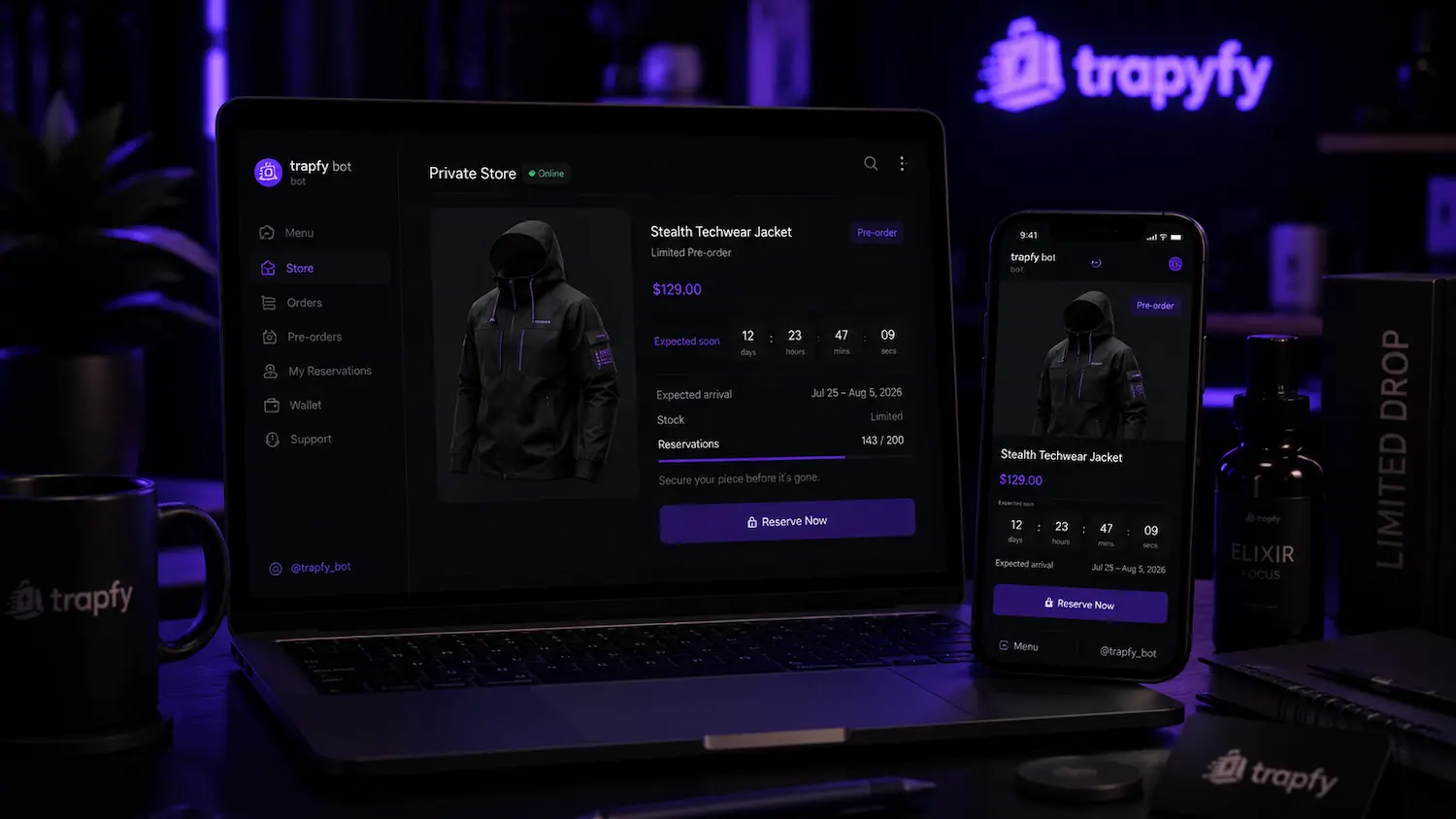
Selling before stock arrives can be a smart move. It helps sellers test demand, understand buyer interest and avoid buying too much inventory before they know what customers actually want.
But pre-orders only work when the process is controlled.
If a seller collects demand through scattered Telegram messages, the flow can become difficult very quickly. Buyers ask when the product will arrive. Some want to reserve. Some want to pay early. Some change their mind. Others need updates, receipts or delivery information before the seller even has the stock in hand.
That is why a Telegram pre order store needs more than a simple chat.
A structured Telegram store can help sellers collect demand before stock arrives, organise buyer records, manage payment status and prepare fulfilment before the product is ready to ship.
The goal is not just to create hype before a launch. The goal is to turn early interest into organised demand that the seller can actually fulfil.
Why Telegram pre-orders need structure
Pre-orders sit between marketing and fulfilment.
The seller is not only announcing a product. They are asking buyers to commit before the item is available. That creates a different type of responsibility.
A normal product sale is based on available stock. A product drop is usually based on limited stock already prepared for launch. A pre-order is different because the seller is collecting demand before the final stock is ready, received or allocated.
That means buyers need more clarity.
They need to know what they are reserving, what payment means, when the product is expected, whether their order is confirmed and what happens if the timeline changes.
When all of this happens manually in Telegram, the seller can lose control fast.
A buyer sends a message asking to reserve.
Another buyer asks for the same product.
Someone pays before the seller has confirmed availability.
The seller keeps a list in a spreadsheet.
Product quantities change before stock arrives.
Customers ask for updates in separate chats.
Fulfilment starts with incomplete buyer details.
That is not a pre-order system. It is a waiting list managed by memory.
A Telegram pre order store helps turn that process into a clearer buyer journey.
The difference between pre-orders and product drops
Pre-orders and product drops both create demand, but they solve different problems.
A product drop usually starts when the seller already has a defined amount of stock available. The challenge is to launch it without overselling, losing orders or creating checkout chaos.
A pre-order starts earlier.
The seller may not have stock yet. The product may be in production, in transit, pending supplier confirmation or being tested with a specific buyer group. The challenge is to collect demand without overpromising.
This is why pre-orders need a more careful flow.
The seller needs to capture interest, confirm buyer details, explain availability, manage payments or reservations, and keep customers updated before fulfilment begins.
A Telegram product drops flow is built around urgency and limited availability. A Telegram pre order store is built around demand collection and expectation management.
Both need structure, but the buyer psychology is different.
With a drop, the buyer wants to secure stock before it sells out.
With a pre-order, the buyer wants confidence that their reservation will be honoured later.
The problem with manual Telegram pre-orders
Many sellers already use Telegram to collect early demand.
They post a product preview, announce that stock is coming soon and ask buyers to message if they want to reserve. At first, that feels easy. A few buyers reply, the seller writes down names and the launch feels promising.
The problem appears when demand grows.
Manual pre-orders create several operational risks:
Buyer interest is scattered across chats.
Reservations are not always linked to customer records.
Payments may not match the correct buyer.
The seller may not know which orders are confirmed.
Customers may not receive consistent updates.
Stock planning becomes based on incomplete information.
Fulfilment becomes harder when the product finally arrives.
For small sellers, this may feel manageable. For a growing store, it becomes risky.
The seller needs more than a list of names. They need a structured order flow that shows who reserved, what product they selected, whether they paid, what delivery details are available and what needs to happen next.
That is where a Telegram pre order store becomes useful.
What a Telegram pre order store should include
A strong Telegram pre-order flow should help the seller collect demand before stock arrives without creating confusion for the buyer.
The exact setup depends on the product, category, payment model and fulfilment timeline, but most pre-order stores need a few important layers.
1. A clear pre-order product page
A pre-order product should not look exactly like a normal in-stock item.
The buyer needs to understand that the product is not available for immediate fulfilment. The store should make the status clear before the buyer places the order.
In Trapyfy this is a configuration choice rather than a separate product type. There is no distinct pre-order mode in the catalogue. A pre-order product is an ordinary published product with Manage Stock enabled, little or no quantity in the warehouse serving that country, and Allow Backorders switched on in the product’s Inventory tab. That last setting is the one that decides everything: a published product with zero stock and backorders disabled does not appear in the storefront, POS or kiosk at all, while the same product with backorders enabled stays visible and purchasable.
Because the storefront has no built-in pre-order badge, the wait has to be carried by the content the buyer actually sees — the product title, the description and the images. If the product page reads exactly like an in-stock item, the buyer will assume it ships this week.
This can include expected availability, order conditions, payment terms, fulfilment timing and any limits on quantity.
The goal is to avoid confusion. A buyer should not complete a pre-order thinking the product will ship immediately.
Inside Telegram, the product flow should give the buyer enough information to decide without forcing the seller to answer the same questions again and again.
This is especially useful for sellers who receive repeated messages like:
When will it arrive?
Can I reserve one?
Do I need to pay now?
How many are left?
Will you message me when stock comes in?
A structured pre-order product page helps answer those questions before they become manual support work.
2. Buyer records connected to demand
Pre-orders are only useful if the seller can understand the demand they are collecting.
A buyer saying “I want one” in a Telegram chat is not enough. The seller needs to know who the buyer is, what they want, how many units they requested, whether they are a repeat customer and whether the order has actually been paid.
A Telegram CRM for sellers helps connect pre-order interest with customer records.
This matters because pre-orders are not one-time messages. They often require updates, follow-ups and post-arrival fulfilment.
If customer data is scattered across chats, the seller may struggle to prioritise buyers when stock arrives. If the data is organised, the seller can see demand more clearly and communicate with buyers more efficiently.
For sellers testing a product before buying stock, this is even more important. The demand record becomes part of the buying decision.
3. Payment or reservation rules
Not every pre-order needs full payment upfront.
Some sellers may want to collect full payment before stock arrives. Others may prefer deposits, reservations, expressions of interest or payment only when stock is confirmed.
The right model depends on the business, product category, supplier timeline and buyer relationship.
It is worth being precise about what the platform itself can carry. Trapyfy checkout collects the order total for the items in the cart; deposits and part-payments are not a documented capability, so a deposit model has to be built as a separately priced product or agreed outside checkout and reconciled by hand. There is also no reservation object and no waitlist object. A committed pre-order in Trapyfy is an ordinary order that moves from Pending payment to Paid. Anything softer than that — an expression of interest, a tell-me-when-it-lands list — sits outside the order record and has to be run as a merchant convention.
What matters is that the rule is clear.
A Telegram pre order store should help the seller define what commitment means. Is the buyer simply joining a waitlist? Are they reserving stock? Are they paying now? Will they receive a payment request later? What happens if they do not complete payment in time?
Without clear rules, buyers may assume different things.
One buyer may think they have secured the product because they sent a message. Another may think payment is required immediately. Another may expect priority because they are a repeat customer.
A structured flow reduces that confusion by making the next step clear.
4. Payment status connected to the order
If the seller accepts payments before stock arrives, the payment flow needs to be organised.
Manual payment screenshots are risky during pre-orders because the order may not be fulfilled immediately. The seller needs to keep track of payment status over a longer period of time.
A Telegram payment reconciliation process helps connect orders, receipts and payment status.
Trapyfy carries a deliberately short set of order statuses — Pending payment, Paid, Completed and Cancelled — so the detail that matters over a long pre-order window sits in the order record rather than in a bespoke status: the payment method used, the transaction reference, the amount, the fee breakdown, and the staff or customer-visible notes attached to the order. Payment processing, settlement and payouts are handled by Niftipay rather than by Trapyfy; what the order screen tells the seller is whether the order is paid and what it was paid with.
This is important for pre-orders because there may be a delay between payment and fulfilment. The seller needs to know which buyers have paid, which buyers still need to pay, which payments need review and which orders should be prioritised when stock arrives.
Without that connection, pre-orders can create financial and operational confusion.
A buyer may ask for proof of payment. The seller may need to match a receipt to an old chat. A fulfilment team may not know whether an order has been paid. A customer may ask for an update weeks later.
A cleaner payment record helps protect both the seller and the buyer.
5. Demand visibility before stock decisions
One of the main reasons to use pre-orders is to make better stock decisions.
Instead of guessing how much inventory to buy, the seller can collect demand first.
This is useful for new product launches, private batches, limited supplier runs, high-risk product categories, imported goods or items with uncertain demand.
A Telegram store analytics routine helps sellers read how much demand a product has actually committed before they commit to a larger stock order — that guide sets out which numbers are native to Trapyfy and which have to come from elsewhere.
It pays to know which of those signals Trapyfy actually reports. Product Performance gives quantity sold by product and SKU over a date range, which is the cleanest read on how many units a pre-order has committed. The Revenue report covers order-level revenue, profit and margin with filters for order status, payment method and country, and exports to Excel. Inventory Status shows current stock, low-stock risk and out-of-stock products. The dashboard adds order activity, payment activity and returning customers.
What is not there is the top of the funnel. Store visits, product views and started checkouts are not Trapyfy metrics; a seller who wants them has to get them from their own tracking on the traffic they send to the bot. For a pre-order decision that is a smaller loss than it sounds, because the number that governs a purchasing commitment is committed units — and that one is native.
That does not remove business risk, but it gives the seller a clearer picture than relying only on comments, reactions or informal chat messages.
For growing stores, this can be the difference between ordering too much stock and ordering based on real customer demand.
6. Follow-up messages before fulfilment
Pre-orders require communication.
A buyer who places an order before stock arrives needs updates. If the seller stays silent, the buyer may become anxious, ask for support or lose trust.
The seller does not need to send constant messages, but the communication should be organised.
A good pre-order flow can support updates such as:
Pre-order received.
Payment confirmed.
Stock expected soon.
Product arrived.
Order moving to fulfilment.
Delivery details required.
Order shipped or ready for collection.
Those updates come from three different places, and it helps to know which is which. Order and status notifications reach the buyer automatically in the same Telegram chat they bought in, so payment confirmed and order completed need no work. Batch news — stock has landed, the shipment cleared, the date has moved — is an Announcement, composed in the dashboard and delivered to bot users in the countries selected, immediately or on a schedule. Announcements are country-wide rather than cohort-targeted, so they reach every bot user in that country, not only the buyers holding a pre-order. Anything that has to go to one buyer about one order belongs in that order’s customer-visible notes or in a support ticket.
This is where Telegram works well. Buyers are already inside the channel, and messages feel direct. But the flow still needs structure.
If the seller sends every update manually, support work grows with every pre-order. If updates are connected to the order status, the process becomes easier to manage.
7. Fulfilment planning before the product arrives
Pre-orders should make fulfilment easier, not harder.
When stock finally arrives, the seller should already know who ordered, what they selected, whether payment is complete and what delivery information is available.
If that information is missing, the seller loses the advantage of collecting demand early.
A pre-order flow should prepare fulfilment before the product is ready. That means customer details, product selections, payment status and order priority should be organised before the first package is packed.
This is especially important for sellers working with small batches, supplier delays or high-demand products.
One mechanical detail decides how smooth the arrival is. Stock is deducted after order confirmation, and orders still awaiting payment hold stock, so once the goods land and the quantity is entered against the warehouse on the product’s Inventory tab, the paid pre-orders are already sitting there as orders to fulfil. The same mechanism has a sharp edge: backorders do not stop counting. Nothing in the platform caps a pre-order at the number of units the seller expects to receive, so the window has to be closed deliberately — by switching backorders off, by unpublishing the product, or by watching committed quantity in Product Performance and stopping at the number that can actually be supplied.
The arrival of stock should trigger fulfilment, not another round of manual admin.
How Trapyfy helps structure Telegram pre-orders
Trapyfy helps sellers create a Telegram store where pre-orders can be handled as part of a structured commerce flow.
Instead of collecting demand through scattered messages, sellers can guide buyers through product interest, customer data collection, order creation, payment status and fulfilment preparation inside one bot-based store.
For pre-orders, this structure is useful because the sale does not end at checkout. The seller needs to manage the gap between buyer commitment and stock arrival.
Trapyfy helps organise that gap.
Buyers enter the Telegram store, open the product, place an order against stock that has not arrived yet, pay through the normal checkout, and stay connected to that order in the same chat. Sellers keep buyer records, product selections, payment status and fulfilment details in one place instead of across chat threads.
This helps reduce the manual work that usually happens before stock arrives.
Trapyfy does not replace supplier planning, legal requirements, delivery management or the seller’s responsibility to communicate accurate timelines. It manages the commerce layer — catalogue, checkout, the order record and fulfilment status. It does not raise purchase orders, chase a factory or know when a container will clear. Any date a buyer is given is the seller’s own operational commitment, not a guarantee the platform makes on their behalf, and sellers still need to be clear about availability, fulfilment expectations and product conditions.
What Trapyfy provides is the infrastructure to make pre-orders easier to control inside Telegram.
When a Telegram pre order store makes sense
A Telegram pre order store is useful when the seller wants to collect demand before committing to full stock availability.
This can apply to several situations:
A brand testing a new product before buying inventory.
A seller waiting for supplier stock to arrive.
A store taking reservations for a limited batch.
A private community selling products to known buyers.
A high-risk seller that wants more control before fulfilment.
A business that wants to avoid overbuying slow-moving stock.
A seller planning a launch but needing demand signals first.
The common point is uncertainty.
If the seller already has stable stock and predictable demand, a normal product flow may be enough. But if the seller needs to validate demand, manage reservations or prepare buyers before stock arrives, pre-orders can be a stronger model.
Pre-orders vs waitlists
A pre-order is not always the same as a waitlist.
A waitlist usually means the buyer wants to be notified when a product becomes available. It may not involve payment or a confirmed order.
A pre-order usually suggests a stronger level of commitment. The buyer may place an order, pay a deposit, complete payment or reserve stock before the product is available.
Both models can work, but sellers should be clear about which one they are using.
Only one of the two is something the platform knows about. A pre-order that has been through checkout is an order, with a customer record, a payment status and a place in the fulfilment queue. A waitlist is not an object in Trapyfy at all — it is a list the seller keeps, and the people on it are reached by an announcement or a direct message rather than by an order update.
If the buyer is only joining a list, the store should not present it like a confirmed order. If the buyer is paying upfront, the seller should provide clear confirmation and updates.
Confusing these two flows can create trust issues.
A Telegram pre order store can help separate casual interest from committed demand, which makes the seller’s planning more accurate.
What sellers should avoid with Telegram pre-orders
The biggest mistake is collecting demand without a fulfilment plan.
Pre-orders can create strong early sales, but they can also create pressure if the seller cannot deliver what buyers expect.
Sellers should avoid:
Taking payments without clear availability information.
Collecting buyer interest only through scattered chats.
Promising delivery dates they cannot control.
Mixing paid pre-orders with casual waitlist requests.
Keeping payment records separate from customer records.
Waiting until stock arrives to collect delivery details.
Failing to update buyers during delays.
Accepting more demand than they can realistically fulfil.
A pre-order flow should build trust, not uncertainty.
Buyers are willing to wait when the process feels clear. They lose confidence when the seller goes silent, changes terms or cannot explain what happens next.
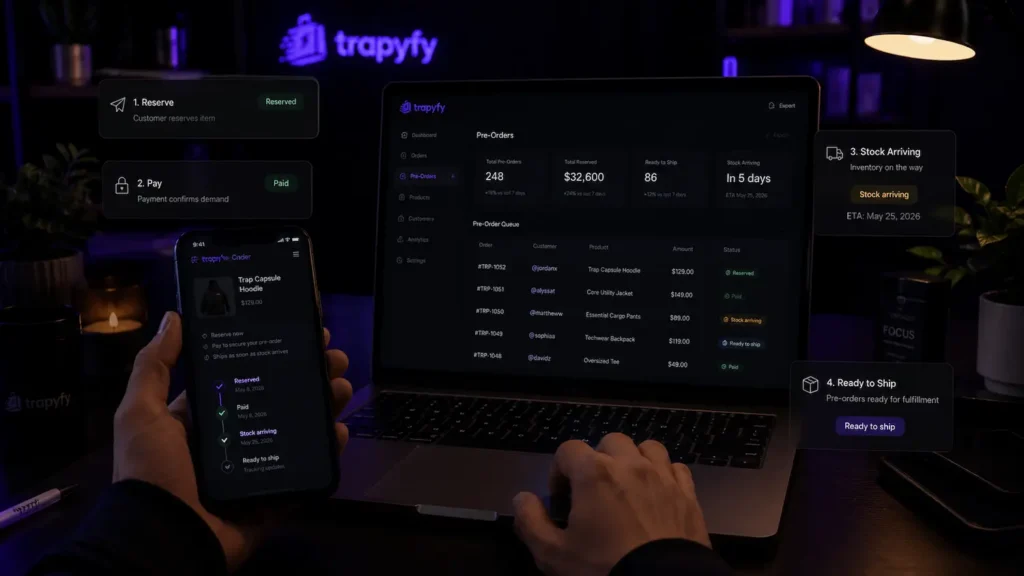
Telegram pre-orders work best when demand is organised early
Pre-orders can help sellers reduce inventory risk, test demand and prepare launches before stock arrives.
But they only work when the buyer journey is clear.
If the seller collects orders through manual Telegram messages, the process can quickly become difficult to manage. Buyer interest gets scattered, payment status becomes unclear, updates are inconsistent and fulfilment starts with missing information.
A Telegram pre order store gives sellers a more structured way to collect demand before stock arrives.
It helps organise product interest, buyer records, reservation rules, payment visibility, demand signals and fulfilment planning inside the same Telegram commerce flow.
For sellers that want to validate products, manage supplier timelines or reserve limited batches before stock lands, this can make pre-orders easier to control from the first buyer message to final fulfilment.
Trapyfy helps sellers build that structure inside Telegram, so early demand can become organised orders instead of a messy list of chat requests.
FAQs
What is a Telegram pre order store?
A Telegram pre order store is a bot-based store that lets sellers take orders for products before the stock is available to ship. In Trapyfy it is not a separate product type: the merchant publishes the product with stock management on, no quantity in the warehouse, and Allow Backorders enabled, which keeps the product visible and purchasable while stock is still on its way.
Can a Trapyfy product be sold when warehouse stock is zero?
Yes, when backorders are enabled for that product. The documented rule is that a published product with zero stock and backorders disabled does not appear in the storefront, POS or kiosk. Turning on Allow Backorders in the product’s Inventory tab keeps it visible and orderable past zero, which is exactly the behaviour a pre-order needs. It also means nothing caps demand automatically, so the seller has to close the window themselves.
How is a Telegram pre-order different from a product drop?
A product drop usually launches stock that is already available in limited quantities. A pre-order collects demand before the stock arrives, is produced or is ready to ship.
Can sellers collect payments for Telegram pre-orders?
Yes. A pre-order goes through the normal checkout, so payment can be taken before stock arrives and the order moves from Pending payment to Paid like any other. Trapyfy checkout collects the order total, though — deposits and part-payments are not a documented feature, so a deposit model has to be set up as a separately priced product or agreed and reconciled outside checkout. Whichever model is used, the terms should be clear to the buyer before they order.
Why are manual pre-orders risky in Telegram?
Manual pre-orders are risky because buyer interest, payment records, delivery details and fulfilment notes can become scattered across chats. This makes it harder to know which orders are confirmed and what needs to happen next.
How does Trapyfy help with Telegram pre-orders?
Trapyfy provides the commerce layer: a catalogue that can keep a zero-stock product purchasable through backorders, a checkout that captures the buyer’s details and payment, an order record holding payment status and fulfilment notes, and automatic order notifications in the same Telegram chat. Supplier planning, delivery dates and the promises made to buyers stay the seller’s own responsibility.