

Product drops are built around momentum. A brand announces a limited release, buyers wait for access, stock moves quickly, and the seller needs every order to be handled before the window closes.
That sounds simple until the drop happens inside a manual Telegram chat.
When buyers are messaging at the same time, asking for availability, sending payment screenshots and trying to reserve the same product, the seller can lose control fast. Stock counts become unclear. Orders get duplicated. Payments arrive without a clean record. Customers get frustrated because they do not know whether they secured the item or missed it.
That is why Telegram product drops need more than hype. They need structure.
A Telegram store can help sellers launch limited stock in a more controlled way, especially when the product is only available for a short period, a private buyer group or a specific campaign. That control depends on stock management that updates as orders land, not after the drop closes.
The goal is not just to sell out. The goal is to sell out without overselling, losing orders or creating a support mess after the launch.
Why Telegram product drops need a different flow
A normal ecommerce store is usually built for evergreen product availability. A customer visits, checks the product page, adds the item to cart and completes the checkout.
A product drop behaves differently.
There may be limited quantities. The release may only be available to approved buyers. The seller may want to open access at a specific time. Certain buyers may need early access. Some products may sell out in minutes. Others may need payment confirmation before stock is truly allocated.
This makes the drop more sensitive than a regular catalogue sale.
For sellers using Telegram, the challenge is even bigger. Telegram is fast, direct and familiar to the buyer, but a simple chat thread is not enough to manage a high-demand launch.
If the seller handles everything manually, the drop can quickly become chaotic:
Multiple buyers ask for the same product.
The seller promises stock before payment is confirmed.
Screenshots arrive out of order.
Inventory is updated too late.
Buyers keep asking if their order went through.
The seller has to reconcile payments manually.
Fulfilment starts with incomplete order details.
That is not a product drop system. It is a busy inbox.
Telegram product drops work better when the buying journey is structured before the launch begins.
The main risk: selling more stock than you actually have
Overselling is one of the biggest problems in limited-stock ecommerce.
It happens when more customers complete or attempt to complete an order than the seller can fulfil. In a manual Telegram setup, this can happen easily because the seller is often tracking availability by hand.
For example, a seller may have 50 units available. Ten buyers message at once. Five send payments. Three ask to reserve. Two change their order. Another buyer pays late. The seller updates stock in a spreadsheet, but not before more buyers ask for the same item.
By the time the seller reviews everything, there may be more paid orders than available units.
This creates several problems:
The seller has to issue refunds.
Customers lose trust.
Support messages increase.
Fulfilment becomes harder.
The brand loses control of the launch experience.
For limited releases, trust matters. Buyers understand that products can sell out, but they do not want to pay for something that was never really available.
That is why a drop needs stock visibility, order control and a clear payment sequence.
What a Telegram product drop flow should include
A strong Telegram product drop is not just a product announcement with a payment link.
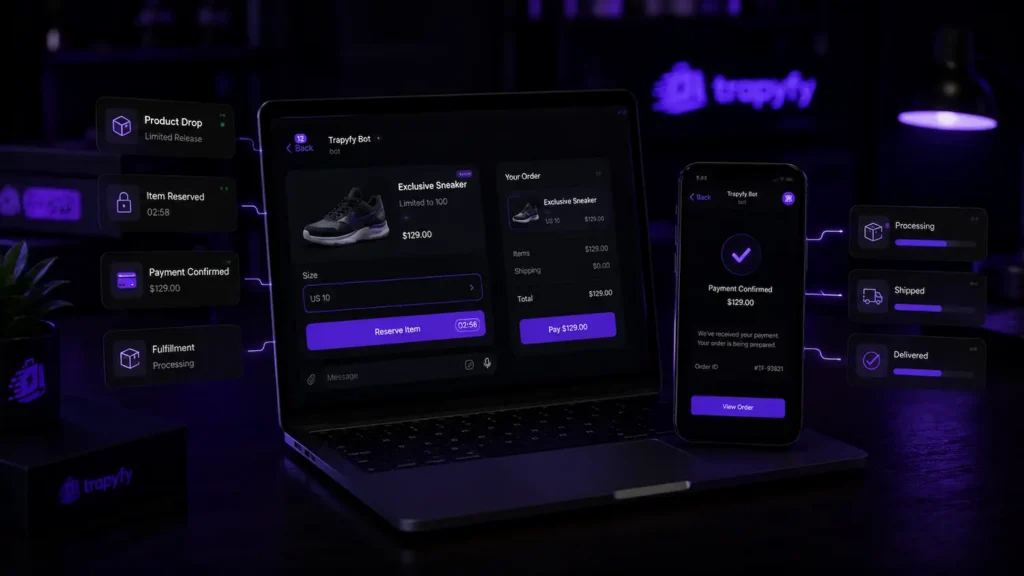
It should guide the buyer from access to checkout with as little manual intervention as possible. The seller needs to know who entered the drop, what product they selected, whether stock is still available, whether payment was completed and what should happen after the order is confirmed.
The exact setup depends on the product, audience and fulfilment model, but most Telegram product drops need several core layers.
1. Deciding who sees the drop, and how
Not every product drop needs to be public.
Some sellers may want to launch to VIP buyers first. Others may want to give early access to repeat customers, private groups, affiliate audiences or approved buyers.
Be clear about where that control actually comes from. Trapyfy has no per-customer approval queue, no buyer whitelist and no invitation gate on the storefront itself. What a bot store gives you is an unlisted surface: it is reached through a bot link you distribute, not through public search, so the audience is whoever you send the link to. A private Telegram store is built on that fact, and on the Telegram groups and channels you already control, rather than on a gate inside the platform.
That is still useful when the drop is sensitive, limited or designed for a specific customer segment. Instead of announcing to everyone, the seller sends the link to the group that should buy first, and holds the rest of the audience back by scheduling the announcement rather than by gating the product.
Keeping the invitation narrow also reduces noise. A seller does not need hundreds of casual users asking questions if the drop is only meant for a specific buyer group.
For high-demand launches, who you invite and when can be the difference between a clean drop and an overloaded inbox.
2. Product visibility at the right time
Timing matters in a drop.
If the product appears too early, buyers may start asking questions before the launch is ready. If it appears too late, the seller may lose momentum. If the product remains visible after selling out, customers may keep trying to order something that is no longer available.
Telegram product drops need clear product visibility rules.
In Trapyfy those rules are concrete rather than abstract. A product appears in the storefront only when three conditions hold at once: it is Published, it has pricing for the buyer’s country, and it has stock in a warehouse serving that country. Prepare the product unpublished, publish it when the drop opens, and when the last unit sells the product drops out of the storefront on its own — provided backorders are left switched off. Turn backorders on and the product stays purchasable past zero, which is the opposite of what most drops want.
This is different from normal Telegram inventory management. Inventory management is about keeping stock accurate across the store. A product drop is about controlling a specific launch window where demand may move faster than usual.
The buyer experience should feel simple:
The drop opens.
The buyer sees the available product.
The buyer selects the item.
The store confirms the next step.
The buyer completes checkout.
The order status is updated.
Behind that simple journey, the seller needs a system that can protect the launch from overselling.
3. What actually happens to stock between selection and payment
One of the hardest parts of a product drop is the moment between product selection and payment.
If stock is not reserved, two buyers may try to purchase the same unit. If stock is reserved for too long, serious buyers may be blocked by people who abandon checkout. If stock is only updated after payment, the seller may oversell.
This is why the checkout flow needs rules.
A structured Telegram checkout optimization process can help sellers reduce friction during this stage. The goal is to make the buyer journey fast enough for demand, but controlled enough to protect stock.
Here the honest answer matters more than the ideal one. Trapyfy has no configurable reservation timer that holds a unit for a named buyer for a set number of minutes. Inventory deducts when the order is confirmed, and an open order can hold stock while it sits pending. The two timers you can actually rely on are the organisation-wide cart expiration setting, which decides how long an unfinished cart stays valid and is normally measured in days, and Niftipay crypto payment invoices, which expire after 12 hours and then have to be regenerated. Neither was designed as a drop-day reservation window, so plan around them rather than assuming one.
For drops, that leaves sellers a set of decisions to make deliberately:
How long an unfinished cart should stay valid.
What happens to a pending order that is never paid.
Who cancels an unpaid order, and how quickly.
How units sitting in pending orders are counted before you announce a restock.
How the buyer is notified after checkout.
A good drop flow does not leave these questions to manual judgement during the launch. It defines the process before buyers start entering the store.
4. Payment confirmation connected to the order
A product drop becomes messy when payments and orders are disconnected.
If buyers send screenshots manually, the seller has to check each one, match it to the right customer, confirm the amount, update the order and adjust stock. During a busy drop, that creates too much room for mistakes.
Telegram product drops work better when payment status is connected to the order flow.
The seller should be able to see whether the buyer selected the product, whether the order was created, whether payment was confirmed and whether the item should move into fulfilment.
This is especially important for limited stock. A seller should not have to guess which payment belongs to which buyer or whether an order should be treated as confirmed.
A cleaner flow also helps the customer. Instead of asking, “Did my payment go through?”, the buyer can receive a clearer confirmation inside the Telegram journey.
5. Abandoned checkout handling
Not every buyer who enters a drop will complete the order.
Some buyers hesitate. Some get distracted. Some start checkout and never pay. Others may try to come back after the product has already sold out.
For a regular product, abandoned checkout is a conversion issue. For a product drop, it is also a stock control issue.
If an unpaid order holds stock for too long, real buyers may miss the chance to buy. If the stock is released too quickly, the original buyer may feel frustrated. The seller needs a balance.
Following up on an abandoned Telegram checkout is worth doing, but it is not something the platform does for you. Trapyfy sends no automated recovery sequence. What it gives you is the raw material: the order record shows which buyer stopped where, and scheduled customer announcements let you tell a country-level audience that stock is moving. The nudge to a specific buyer is a message someone still sends.
For drops, this follow-up should be time-sensitive. The message should make it clear that the item is limited, the order is not confirmed until payment is completed, and availability may change.
This keeps the buyer informed without forcing the seller to chase every incomplete order manually.
6. Fulfilment after the drop
The work does not end when the product sells out.
After a successful drop, the seller still needs to process orders, prepare fulfilment, update buyers and handle support.
If the drop was managed manually, fulfilment can become another bottleneck. The seller may need to review chats, copy addresses, check payment screenshots, confirm product variants and manually build a shipping list.
That slows everything down.
A Telegram fulfilment automation flow helps connect the sale with the next operational step. Once the order is confirmed, the seller can move it into fulfilment with cleaner customer data, product details and payment status.
This matters because the post-drop experience affects whether buyers return for the next release.
A strong drop should not only create urgency. It should also give customers confidence that their order is being handled properly.
How Trapyfy supports Telegram product drops
Trapyfy helps sellers move product drops out of scattered chats and into a structured Telegram store.
Instead of managing stock, payments and customer records manually, sellers can create a bot-based storefront where the drop follows a defined journey.
That journey covers product browsing, order creation, payment confirmation through Niftipay, customer records and fulfilment routing to the warehouse serving the buyer’s country.
For limited-stock launches, this structure helps sellers reduce the risk of overselling. Product availability can be connected to the order flow. Buyers can move through checkout without needing constant manual replies. Payment status can be linked to the customer and order. Fulfilment can start from organised order data instead of disconnected messages.
Trapyfy does not turn every launch into a fully hands-off campaign. Sellers still need to plan the product, stock, audience, timing and fulfilment capacity.
But it gives the seller the infrastructure to manage the drop more professionally inside Telegram.
That is especially useful for brands that already have demand in Telegram but still rely on manual messages to take orders.
When Telegram product drops make sense
Telegram product drops are useful when the seller wants to launch limited stock to a direct audience.
This can apply to several situations:
A brand launching a limited product release.
A seller giving early access to VIP buyers.
A store testing demand before restocking.
A high-risk seller that prefers private access.
A creator or community-led brand with active Telegram buyers.
A business releasing products in small batches.
A seller that wants to avoid public ecommerce exposure.
The common point is controlled demand.
If a product is always available and does not need launch timing, a normal catalogue flow may be enough. But if the seller needs urgency, limited access or tighter stock control, a Telegram product drop can make more sense.
Product drops vs normal inventory management
A product drop should not be treated like a normal stock update.
Inventory management keeps the store accurate over time. It helps sellers avoid selling products that are unavailable and gives customers a clearer buying experience.
A product drop is more specific. It is a launch event with a defined product, audience, quantity and time window.
That means the seller needs more control around the release moment.
The store should be ready before the drop opens. The product should be visible when the seller wants it to be visible. The checkout flow should be clear. Payment confirmation should be connected to stock. Fulfilment should be ready once orders are confirmed.
This is why sellers should not rely only on manual stock notes or chat replies during a drop.
A launch with limited stock needs a more structured order flow from the beginning.
What sellers should avoid during a Telegram product drop
The biggest mistake is launching before the operational flow is ready.
A seller may have the audience, the product and the hype, but if the checkout process is unclear, the drop can still fail.
Sellers should avoid:
Taking orders only through manual messages.
Promising stock before payment is confirmed.
Letting unpaid orders block inventory for too long.
Sending the same product link to every buyer without access control.
Managing payment screenshots without a connected order record.
Starting fulfilment from incomplete customer information.
Leaving buyers unsure about whether their order was confirmed.
A clean product drop should feel urgent, but not chaotic.
Customers should know how to access the product, how to place the order, how payment works and what happens after they buy.
The seller should know how many units are available, which orders are confirmed and which buyers need follow-up.
Telegram product drops create better launches when the flow is controlled
A product drop can create excitement, urgency and stronger customer demand. But limited stock also creates pressure.
If the seller relies on manual Telegram messages, the drop can quickly become difficult to control. Buyers compete for the same products, payments arrive without context, stock updates fall behind and fulfilment becomes harder than it needs to be.
Telegram product drops work best when the store has a clear flow before the launch starts.
That means deciding who you invite, publishing products only when the drop opens, knowing exactly when stock is deducted, connecting payment confirmation to the order, agreeing how unpaid orders are cleared, and organising fulfilment before the first parcel.
Trapyfy helps sellers create that structure inside Telegram, so limited-stock launches can move from manual chat chaos to a more reliable commerce flow.
For brands planning private releases, VIP drops, batch launches or high-demand product windows, a structured Telegram store can make the launch easier to manage from first click to fulfilment.
FAQs
What are Telegram product drops?
Telegram product drops are limited product launches managed through a Telegram store or bot. They are usually used for small-batch releases, VIP launches, private product access or high-demand inventory.
Why are product drops hard to manage manually in Telegram?
Manual Telegram drops are difficult because many buyers may message at the same time, ask for the same products, send payments separately and require order confirmation. Without a structured flow, sellers can oversell or lose track of orders.
How can sellers avoid overselling during Telegram product drops?
Sellers reduce overselling by publishing the product only when the drop opens, holding stock in a warehouse assigned to the countries they sell to, leaving backorders switched off so a sold-out item drops out of the storefront, and confirming payment before fulfilment starts. The goal is to connect product availability with the order and payment flow rather than with a spreadsheet.
Are Telegram product drops only for high-risk sellers?
No. Telegram product drops can be useful for any seller with limited stock, private launches, VIP buyers or strong community demand. High-risk sellers may find them especially useful when they need more control over access and checkout.
How does Trapyfy help with Telegram product drops?
Trapyfy helps sellers create a structured Telegram storefront where buyers can access products, place orders, complete payment and move into fulfilment through a more organised bot-based flow.