
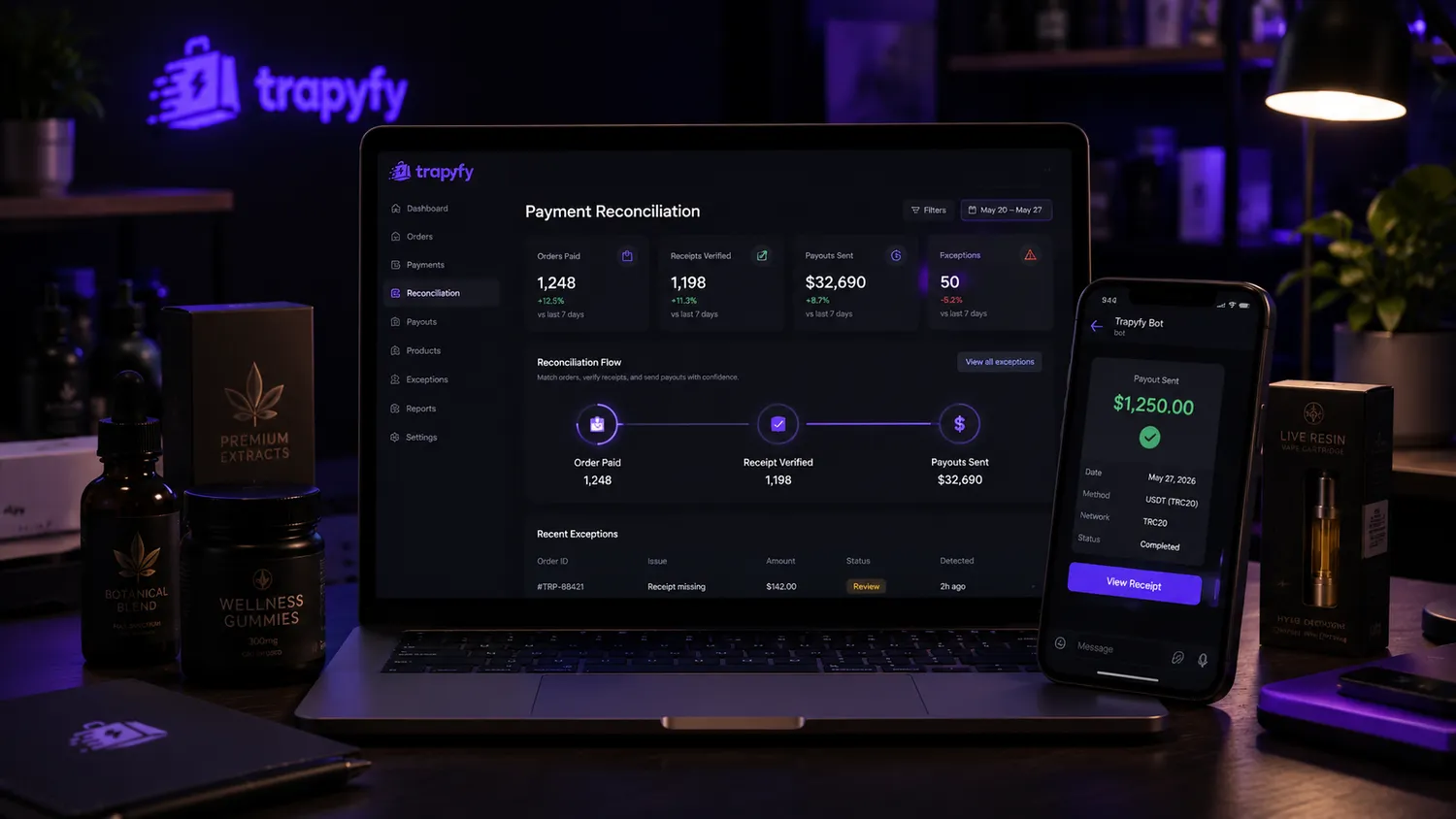
Selling on Telegram can feel fast and direct until the messages pile up. Buyers send screenshots, crypto hashes and bank confirmations from different apps, while orders sit in chats, notes and spreadsheets. Telegram payment reconciliation is the discipline that ties all of those signals together: each payment is matched with a specific order, customer, receipt and payout, so nothing is shipped twice, refunded by mistake or forgotten in a backlog. For sellers handling more than a handful of orders a day, reconciliation is the difference between a clean operation and constant firefighting.
Payment acceptance is the easy part. The hard part is knowing, at any moment, who paid, what they ordered, whether the receipt is real, when the funds will settle and which orders still need to ship. A reliable reconciliation flow makes those questions answerable in seconds rather than hours.
What Telegram payment reconciliation means
Telegram payment reconciliation is the process of comparing every order created inside your bot store with the matching payment record, the customer who sent it, the receipt or transaction hash, and the eventual payout to your account. The aim is to keep four ledgers in sync: the order ledger, the payment ledger, the customer ledger and the payout ledger. Keeping them aligned automatically is a systems problem, which is why most sellers eventually solve it with API and webhook integrations rather than more spreadsheets.
In a manual workflow, those ledgers usually live in different places. Orders are jotted in a Telegram chat or a Google Sheet. Payments arrive in a wallet, a bank account or as screenshots inside the conversation. Customer details sit in DMs. Payouts show up in a separate dashboard days later. Reconciliation is what closes the loop and gives a single, trustworthy view of the store.
Why payment confirmation is not the same as reconciliation
It is tempting to assume that once a payment is confirmed, the work is done. In practice, confirmation and reconciliation answer very different questions.
- Payment verification answers: is this payment real? It checks that the receipt, transaction hash or bank reference is genuine and not forged.
- Payment reconciliation answers: is this payment linked to the correct order, customer and payout, and has the order been fulfilled?
A seller can verify every single receipt and still end up with chaos if those verified payments are not mapped to the right orders. Equally, a perfectly reconciled flow built on unverified receipts will let fraud through. Sellers who want a tight operation usually start with strong Telegram payment verification and layer reconciliation on top, rather than picking one or the other.
The problem with receipts, screenshots and manual spreadsheets
Most Telegram sellers start with a spreadsheet. It works for the first dozens of orders. Then the cracks appear:
- Screenshots are easy to forge and hard to audit at scale.
- Crypto receipts arrive with hashes that no one has time to verify by hand.
- Buyers send partial payments, double payments or pay for the wrong product.
- Refunds are agreed in chat and never recorded in the sheet.
- Different staff members update the file at the same time and overwrite each other.
- Payouts from processors do not match daily totals, and no one knows why.
Once the store is processing dozens of orders a day across multiple products and currencies, the spreadsheet becomes the bottleneck. The team spends more time arguing about the sheet than fulfilling orders, and customer support starts to slip.
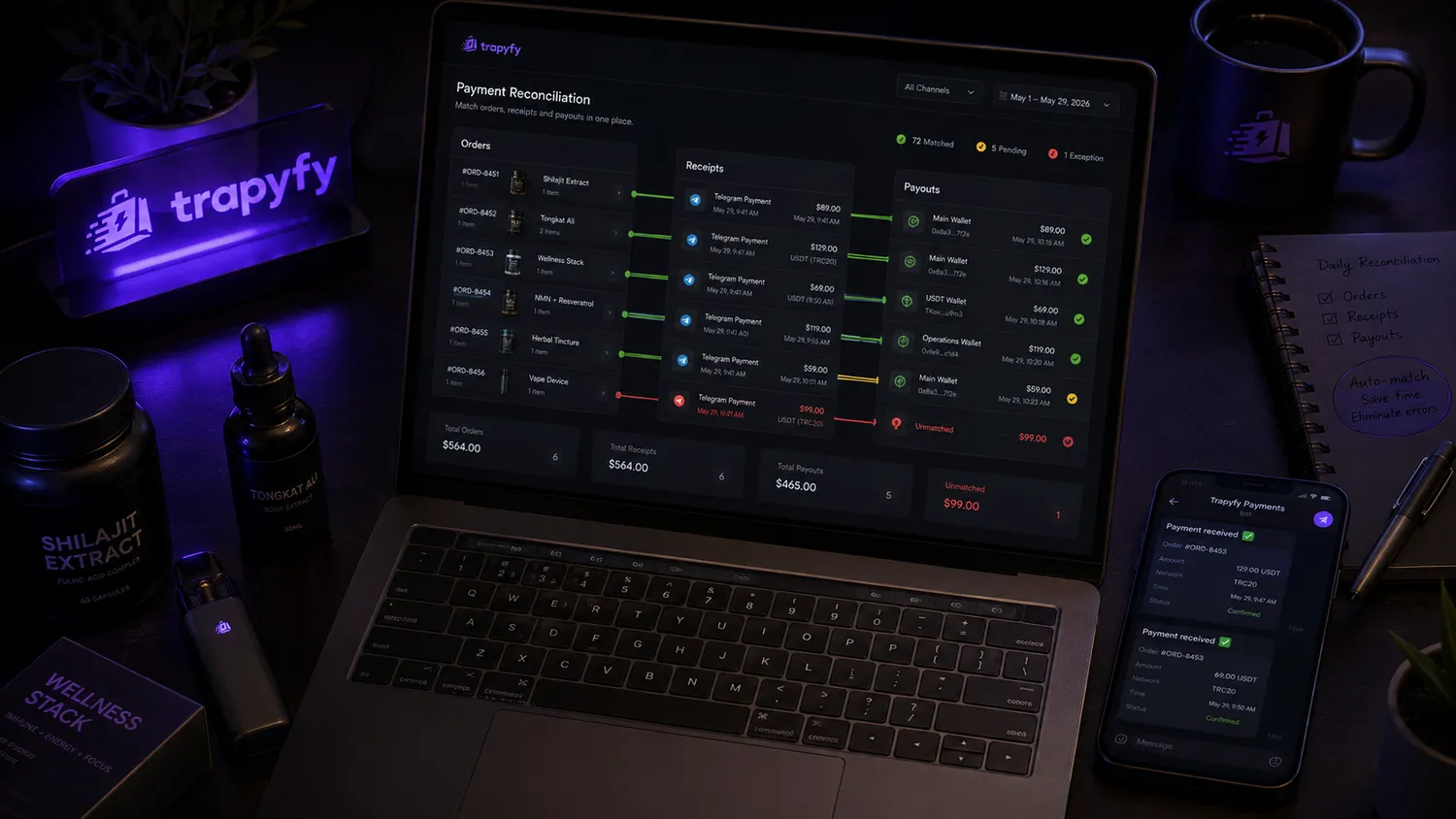
What sellers need to match: orders, customers, payments and payouts
A clean reconciliation model links four things for every transaction:
- Order — the product, variant, quantity, price and currency the buyer asked for.
- Customer — Telegram handle, contact details, shipping address and any KYC information collected.
- Payment — method, amount received, receipt or transaction hash, timestamp and verification status.
- Payout — when the funds will hit your account and which orders are included in that batch.
When those four elements are connected, every later step becomes easier. Telegram order tracking can pull the status of each shipment without searching chats. Telegram store analytics can report revenue, refunds and net payouts by product, by day, by channel. Support agents stop asking buyers to “send the receipt again”.
Common reconciliation mistakes in Telegram stores
Even careful sellers fall into the same handful of traps:
- Marking unpaid orders as paid because the buyer promised to send the receipt later.
- Shipping orders that were never reconciled, then chasing the buyer for payment after delivery.
- Treating duplicate payments as new orders when the buyer paid twice for the same item by mistake.
- Losing customer details because the address was typed in chat and the chat was archived.
- Confusing gross sales with payouts, especially when processor fees, refunds and chargebacks are subtracted from the final settlement.
- Mixing currencies in the same sheet without a clear conversion rule.
These mistakes do not just cost money. They erode buyer trust, which is the single most valuable asset for any seller working in Telegram payments for high-risk products, where margins are thin and reputation is hard to rebuild.
How reconciliation improves fulfilment and customer support
Reconciliation is not a back-office concern. It changes how the front of the store feels to the buyer.
- Fulfilment teams pick and pack from a list of verified, reconciled orders, not from messy chat threads.
- Customer support can answer “did my payment arrive?” with a clear yes or no, backed by a receipt and a timestamp.
- Refund requests are processed against a known payment record, which makes them faster and less risky.
- Disputes are resolved with evidence instead of memory.
- Repeat buyers are recognised on the next purchase because their previous orders are linked to their handle.
A reconciled store also feels different to staff. Fewer messages start with “can you check the sheet?” and more time is spent improving the product, the pricing and the Telegram checkout optimization that turns conversations into completed orders.
When a seller has outgrown manual payment tracking
There is no single order count where spreadsheets stop working, but the warning signs are consistent. A seller has usually outgrown manual tracking when:
- Reconciling yesterday’s sales takes more than an hour each morning.
- More than one person needs to edit the order sheet at the same time.
- Multiple payment methods or wallets feed the same store.
- Payouts are coming in batches that no longer line up with daily totals.
- Support tickets are increasingly about missing payments or duplicate charges.
- The team is afraid to take a day off because nobody else understands the sheet.
At that point, the cost of manual reconciliation — in errors, refunds, churn and stress — is usually higher than the cost of moving to a dedicated Telegram commerce platform for sellers.
How Trapyfy helps connect payments with orders and customer data
Trapyfy is built around the idea that a Telegram store should behave like a real commerce backend, not a chat with attachments. Every order created through the bot is stored as a structured record, with the buyer, the product, the price and the chosen payment method linked from the first message.
When the payment arrives, the receipt or transaction reference is attached to the same record. The status moves from pending to paid automatically once the payment is verified, and from paid to fulfilled once the order ships. Payouts are grouped by settlement batch, so each transfer to the seller’s account can be traced back to the exact orders that funded it.
The result is a single view where orders, customers, payments and payouts are no longer separate files. Sellers can search by handle, by product, by date or by payment status, and the answer is always the same across the team. Manual screenshots become an exception, not the default.
Turn payment chaos into a cleaner order flow
The sellers who scale on Telegram are not necessarily the ones with the cheapest prices or the loudest channels. They are the ones whose buyers always know what they paid for, when it shipped and how to reach support. Behind that calm front sits a reconciliation flow that is boring on purpose: every payment matched, every order accounted for, every payout traceable.
Moving from screenshots and sheets to a structured workflow takes a single decision. Once orders, payments and customer data live in the same place, the day-to-day work of running a Telegram store becomes a routine instead of an emergency.
Frequently asked questions
What is Telegram payment reconciliation in simple terms?
It is the process of matching every payment received through a Telegram store with the correct order, customer, receipt and payout, so the seller always knows what has been paid, shipped and settled.
How is reconciliation different from payment verification?
Verification confirms that a receipt or transaction is genuine. Reconciliation goes further and links each verified payment to a specific order, customer and payout, and tracks whether the order has been fulfilled.
Why do spreadsheets stop working for Telegram sellers?
Spreadsheets cannot handle concurrent edits, multiple payment methods, partial payments, refunds and payout batches at scale. As order volume grows, the time spent maintaining the sheet exceeds the time saved by using it.
Can reconciliation reduce refund and chargeback risk?
Yes. When every payment is linked to a verified order and customer record, disputes can be answered with evidence, duplicate charges are caught early and refunds are processed against the exact original transaction.
What happens to unreconciled orders inside a Telegram store?
Unreconciled orders typically end up as missed revenue, accidental shipments without payment or duplicate fulfilment. A structured workflow flags them automatically so staff can chase, refund or close them before they cause customer support issues.