
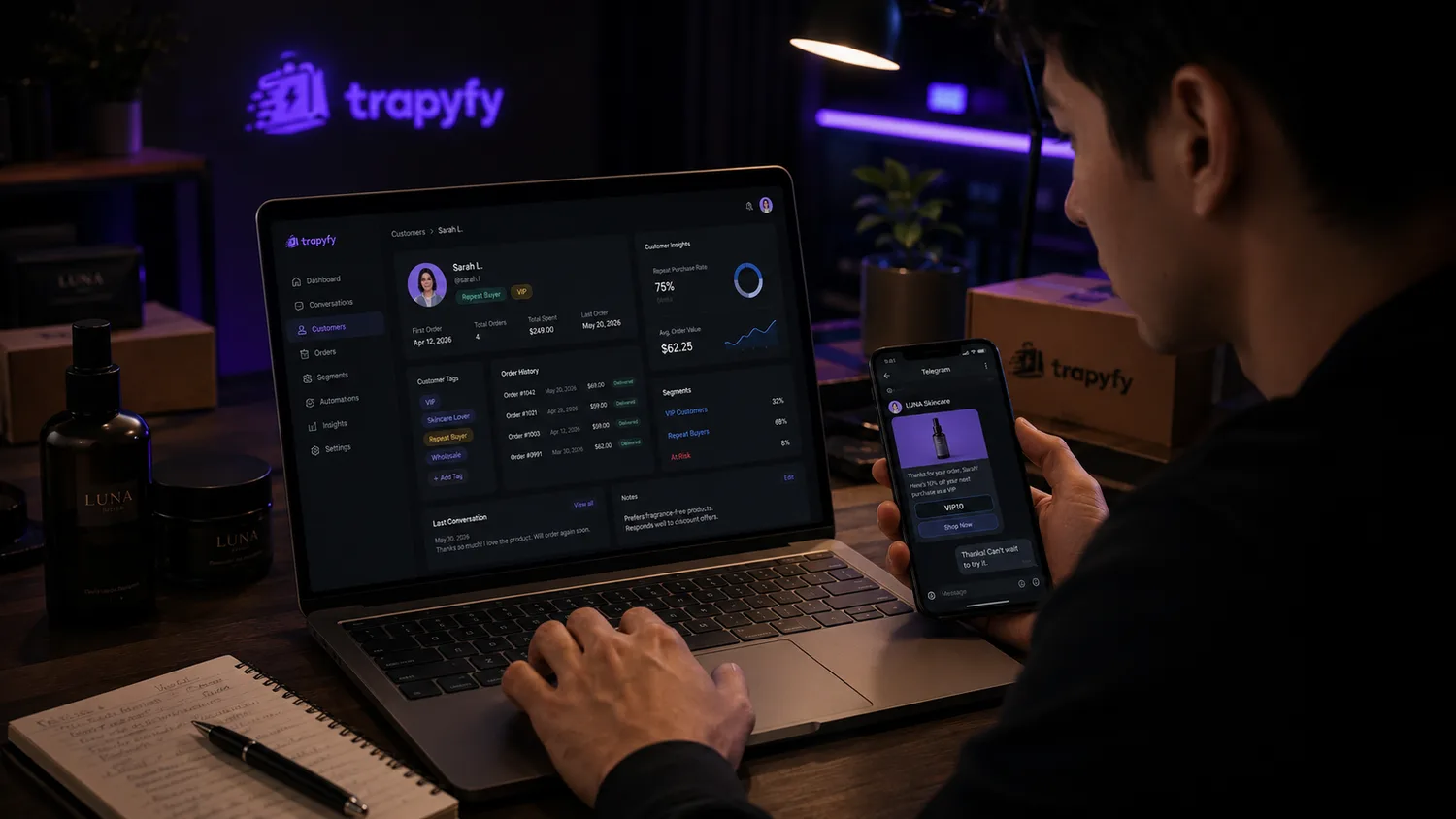
Chat-based selling on Telegram moves fast, but the data behind those orders often disappears the moment a buyer scrolls away. For merchants running bot stores, building a Telegram CRM for sellers is the difference between an inbox full of one-off purchases and a structured customer base that buys again, refers friends and responds to targeted offers.
A Telegram CRM helps sellers turn anonymous chat-based orders into structured customer relationships, repeat sales and better post-purchase communication. It captures phone numbers, order history and behavioural signals straight from the bot, then layers segmentation, automated messages and loyalty mechanics on top — without leaving the channel where the buyer already converts.
What is a Telegram CRM for sellers?
A Telegram CRM is a customer relationship management layer built on top of a Telegram bot store. Instead of treating each order as an isolated chat thread, it stores buyer identity, purchase history, lifecycle stage and preferences in a single profile. Sellers get the same operational visibility a Shopify or WooCommerce merchant takes for granted — applied to a channel where conversion happens inside the conversation.
The core promise is simple. Every interaction in the bot — view, add to cart, checkout, support reply, referral — feeds the profile. From there, the seller can segment, message and automate without breaking the native Telegram experience. This is why a Telegram commerce platform built for regulated and high-volume sellers ships CRM features by default rather than as an afterthought.
Why a generic CRM is not enough
Pasting Telegram orders into HubSpot or Pipedrive feels productive, but the integration tax is high: manual exports, mismatched IDs, missing chat context and zero ability to message buyers back through the same channel. A Telegram-native CRM removes that friction by keeping data, messaging and order flow in one place. According to the general CRM definition, the goal is to consolidate customer interactions across the lifecycle — and the Telegram lifecycle lives inside Telegram.
Why Telegram sellers need a CRM in 2026
Telegram has shifted from a messaging app into a serious commerce surface, and the merchants scaling on it are no longer hobby operators. They run catalogues with hundreds of SKUs, multiple warehouses and recurring buyers. Without a CRM, every repeat purchase still feels like a cold start — same questions, same payment friction, same lost upsell window.
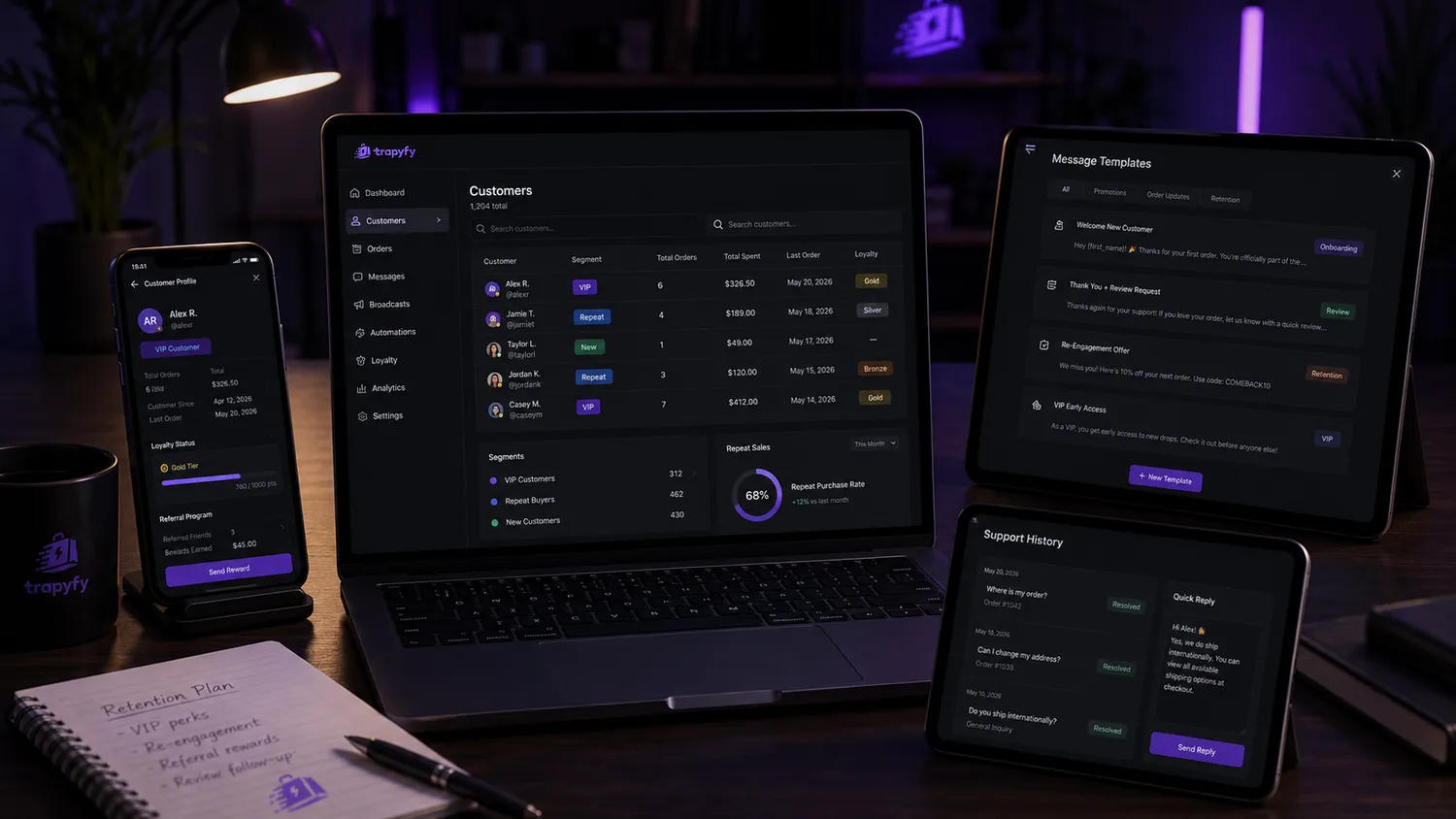
The operational gains compound quickly. Sellers who centralise Telegram customer data can answer three questions any real ecommerce operator should answer in seconds: who bought what, when did they last interact, and how much have they spent in total. Once those answers exist, retention tactics — loyalty tiers, win-back flows, referral incentives — finally have a foundation to run on.
Signals worth capturing from every order
- Identity: Telegram user ID, phone number when consented, display name.
- Commercial history: orders, value, products, fulfilment status, refunds.
- Behavioural events: catalogue views, abandoned carts, support tickets, referral clicks.
- Preferences: shipping address, preferred payment method, opt-ins for promotions.
Capturing customer data without breaking the chat flow
The most common mistake new Telegram merchants make is over-asking. A bot that demands name, email, postcode and phone number before showing a product loses the buyer to the next channel. A well-designed Telegram CRM captures data progressively, anchored to moments where the buyer already expects to share something — checkout, delivery confirmation, support escalation.
Practical defaults that work in production:
- Pull the Telegram user ID and language at the first interaction. No prompt needed.
- Ask for phone number and shipping address only at checkout, never before.
- Tag the buyer’s product affinity automatically from the first purchased category.
- Trigger an opt-in for promotional messages on the post-delivery confirmation.
Done right, the seller ends up with a clean profile per buyer after the first order — without ever forcing a form-style interrogation. Pair this with reusable customer message templates and the second purchase becomes a one-tap experience instead of a fresh sales cycle.
From first order to repeat buyer: the automation layer
Capturing data only matters if it triggers action. The CRM layer is where Telegram sellers turn data into revenue with three categories of automation: transactional, retention and acquisition.
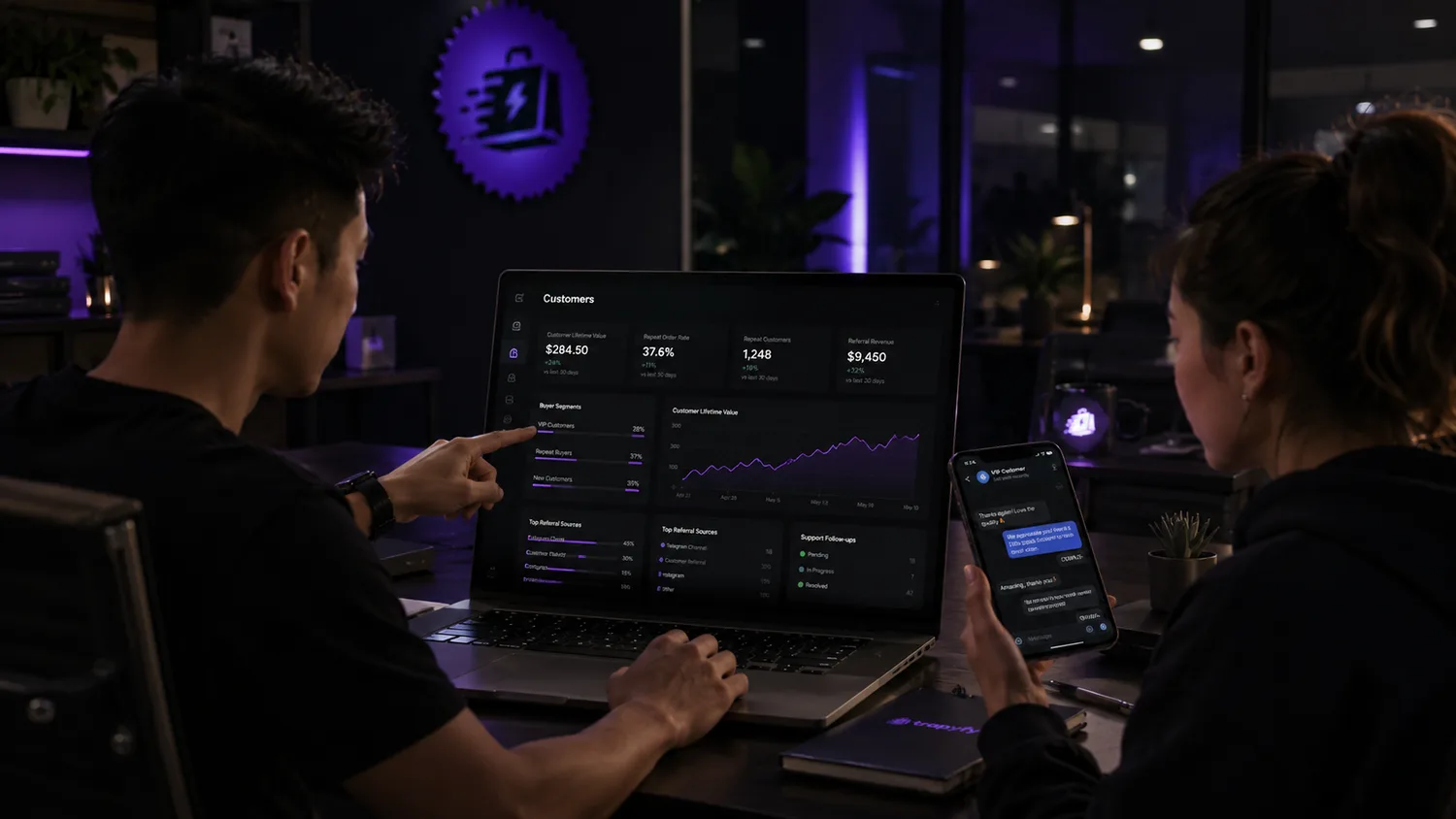
Transactional automation
Order confirmations, payment receipts, shipping updates and delivery alerts. Native to the channel, instant, and far higher open rates than email. This is the baseline — no Telegram seller should be sending these manually past their tenth order.
Retention automation
Post-purchase thank-you with a tiered discount, replenishment reminders for consumables, win-back messages after 60 days of inactivity, and loyalty point notifications. Combined with Telegram shop loyalty tactics, retention automation is what compounds revenue without compounding ad spend.
Acquisition automation
Referral programs that reward both sides of the share, broadcast offers to segmented audiences, and re-engagement nudges for cart abandoners. Because Telegram delivers messages in the same surface where the buyer transacts, the click-to-purchase distance is shorter than any email funnel.
Segmentation that actually drives repeat sales
A Telegram CRM is only as useful as the segments it can act on. Three segmentation axes do most of the heavy lifting for sellers operating at scale:
| Segment | Definition | Best action |
|---|---|---|
| New buyers | 1 order, < 30 days | Onboarding flow, second-order discount |
| Active repeat | 2+ orders, last 90 days | Loyalty tier upgrade, referral invitation |
| At risk | 2+ orders, no activity 60–120 days | Win-back offer, restock alert |
| Lapsed | No order 120+ days | Reactivation campaign or suppression |
| VIP | Top 10% by lifetime value | Early access, dedicated support, perks |
Each segment maps to one or two messages. The trap is launching ten flows on day one — start with new buyer onboarding and an at-risk win-back, then layer in VIP and referral as the data set matures.
Operational stack: what a Telegram CRM should ship with
Sellers evaluating Telegram CRM options should pressure-test five capabilities before committing:
- Native buyer profiles tied to Telegram identity, with merge logic for users switching usernames.
- Order history and lifetime value visible per buyer, including refunds and partial fulfilment.
- Segmented broadcast messaging with rate limiting and opt-out compliance.
- Event-triggered automations for cart abandonment, post-purchase and inactivity windows.
- Built-in referral and loyalty mechanics rather than a third-party patch.
Anything missing from that list pushes the seller back into spreadsheets and copy-paste. For builders who want to wire this up themselves, the official Telegram Bot API documents the messaging and identity primitives — but most merchants are better served by a platform that wraps them.
The Telegram CRM for sellers: 90-day rollout playbook
Reading about a CRM is easy; switching one on without losing momentum is the hard part. Sellers who get traction inside ninety days follow a phased rollout that respects two truths: data quality compounds, and over-automation in week one is the fastest way to burn a buyer list. The roadmap below maps the first quarter into three focused sprints.
Days 1–30 — Foundations and clean capture
The opening month is about plumbing, not campaigns. Connect the bot store to the CRM, switch on identity capture at first contact, and confirm that every order writes back a full profile — user ID, products, value, status, fulfilment channel. Resist the urge to send anything beyond order confirmations and shipping updates. By day thirty the seller should be able to answer, in one screen, who their last fifty buyers were and what they spent.
Days 31–60 — First retention loop
With clean data flowing, switch on the two highest-leverage automations: a new-buyer onboarding flow that ships a second-order incentive within seven days of the first purchase, and an at-risk win-back triggered at sixty days of inactivity. Build the segments live, monitor opt-outs daily, and rewrite copy that under-performs after the first hundred sends. This is also the moment to layer in the first cart abandonment nudge — short, useful, never pushy.
Days 61–90 — Loyalty, referrals and VIP
Once the retention loop has data, the acquisition and loyalty layers earn their keep. Activate a tiered loyalty program, open a referral flow that rewards both sides of the share, and carve out a VIP segment with early access to drops and dedicated support. The last week of the sprint is reserved for a review: which segments grew, which automations earned their place, and which messages will be retired in the next quarter.
Sellers who treat the first ninety days as a data project — not a marketing project — out-earn the ones who launch ten flows on day one. The CRM is a compounding asset; the patience is the unlock.
The bottom line for Telegram sellers
The merchants growing fastest on Telegram in 2026 are not the ones with the largest catalogues — they are the ones with the cleanest customer data and the tightest automation around it. A Telegram CRM is the operational backbone that makes every other tactic, from loyalty to referrals to broadcast offers, actually work. Treat it as core infrastructure, not as a future upgrade, and the second quarter of trading will look nothing like the first.
Frequently asked questions
What is a Telegram CRM for sellers?
It is a customer relationship management layer built on top of a Telegram bot store. It captures buyer identity, order history and behavioural events inside Telegram, so sellers can segment, message and automate without leaving the channel.
How does a Telegram CRM capture customer data?
It pulls Telegram user ID and language at first contact, then collects phone number, shipping address and preferences at checkout and post-delivery. Behavioural signals like catalogue views, cart abandonment and referral clicks feed the profile automatically.
Can a Telegram CRM increase repeat sales?
Yes. By segmenting buyers (new, active repeat, at risk, lapsed, VIP) and triggering automated flows for onboarding, replenishment, win-back and loyalty, sellers turn one-off orders into recurring revenue without extra ad spend.
Do I need a separate CRM tool for my Telegram store?
No, and you should avoid it. A Telegram-native CRM keeps order data, customer profiles and messaging in one system. External CRMs add manual exports, broken IDs and the inability to reply through the same channel where the buyer already transacts.
What automations should a Telegram seller set up first?
Start with two: a new-buyer onboarding flow that delivers a second-order incentive, and a 60-day at-risk win-back message. Add loyalty, referral and VIP perks once the underlying segments have enough volume to justify the workflow.