

The Fastest Way to Make Money Online Today
If you’re searching for a real way to generate income without huge startup costs or tech skills then you’ve probably looked into e-commerce. And while it’s true that anyone can open an online store today, the real challenge is managing everything: products, customer service, marketing, logistics… It’s overwhelming.
That’s exactly where assistant e-commerce solutions come in.
In this guide, you’ll learn how using an e-commerce assistant (AI-powered or human) can help you launch, automate, and grow your online business—even if you’re starting from zero and need to generate income fast.
What Are Assistant E-Commerce Solutions?
Assistant e-commerce solutions combine the power of automation, smart tools, and personalized guidance to help you manage every part of your online store.
Think of it as having a virtual partner who:
- Suggests products that sell
- Builds product listings for you
- Creates SEO-friendly descriptions
- Replies to customers
- Tracks orders
- Helps you with marketing campaigns
- Even manages social media
In short—an assistant handles the time-consuming work so you can focus on earning.
Why Assistant-Powered E-Commerce Is Becoming the New Trend
People are turning to e-commerce assistants because they solve three major problems:
1. They eliminate the tech overwhelm
Platforms, payment gateways, inventory management… assistants simplify everything.
2. They speed up money-making
Beginners usually take 2–6 months to set up a profitable store.
With an assistant? It can be weeks—or even days.
3. They reduce costs
Instead of hiring expensive staff for marketing, customer support, or operations, one assistant handles it all.
How Assistant E-Commerce Solutions Actually Work
Stripped of the jargon, the process most small e-commerce businesses follow looks like this.
Step 1: Choosing the Right Product (Your Assistant Does the Heavy Lifting)
Your assistant can analyze trends, pricing, competition, and profit margins to recommend products that perform well.
That is the part beginners usually get wrong on their own. Instead of guessing from a single marketplace bestseller list, an assistant can read demand signals across social platforms, marketplaces and search trends at once, and tell you where margin actually survives shipping and fees.
Step 2: Setting Up Your E-Commerce Store
An assistant can help you:
- Pick the best e-commerce platform
- Customize your store theme
- Optimize product pages
- Integrate payment systems
- Organize categories and menus
This saves hours of setup time. If your customers already spend their day in Telegram, a Telegram bot storefront collapses several of those steps into one — a structured catalogue and a checkout that live where the conversation already happens.
Step 3: Creating High-Converting Product Pages
Product descriptions are one of the biggest conversion factors.
Your assistant can write:
- SEO-optimized titles
- Benefit-focused descriptions
- Bullet-point features
- Emotional hooks
- FAQs
- Trust-building copy
And it does it quickly, consistently, and professionally.
Step 4: Managing Customer Service Automatically
Most sales happen when a customer feels safe and supported.
With an assistant, you get:
- Automated replies
- 24/7 customer support
- Instant order updates
- FAQ generation
- Return and refund coordination
The updates matter more than people expect. When order confirmations and status changes are sent automatically as the order moves, buyers stop opening “where is my order?” tickets — which cuts support volume and protects repeat purchases at the same time.
Step 5: Marketing & Sales Automation
Marketing is where beginners get stuck—but assistants make it easy.
They can create:
- Social media posts
- Email marketing series
- Paid ads scripts
- Blog content (SEO)
- Influencer outreach messages
The gain here is consistency rather than brilliance. A modest campaign that actually goes out every week beats an ambitious one that stalls after the first fortnight, and consistency is exactly the part an assistant is good at holding onto.
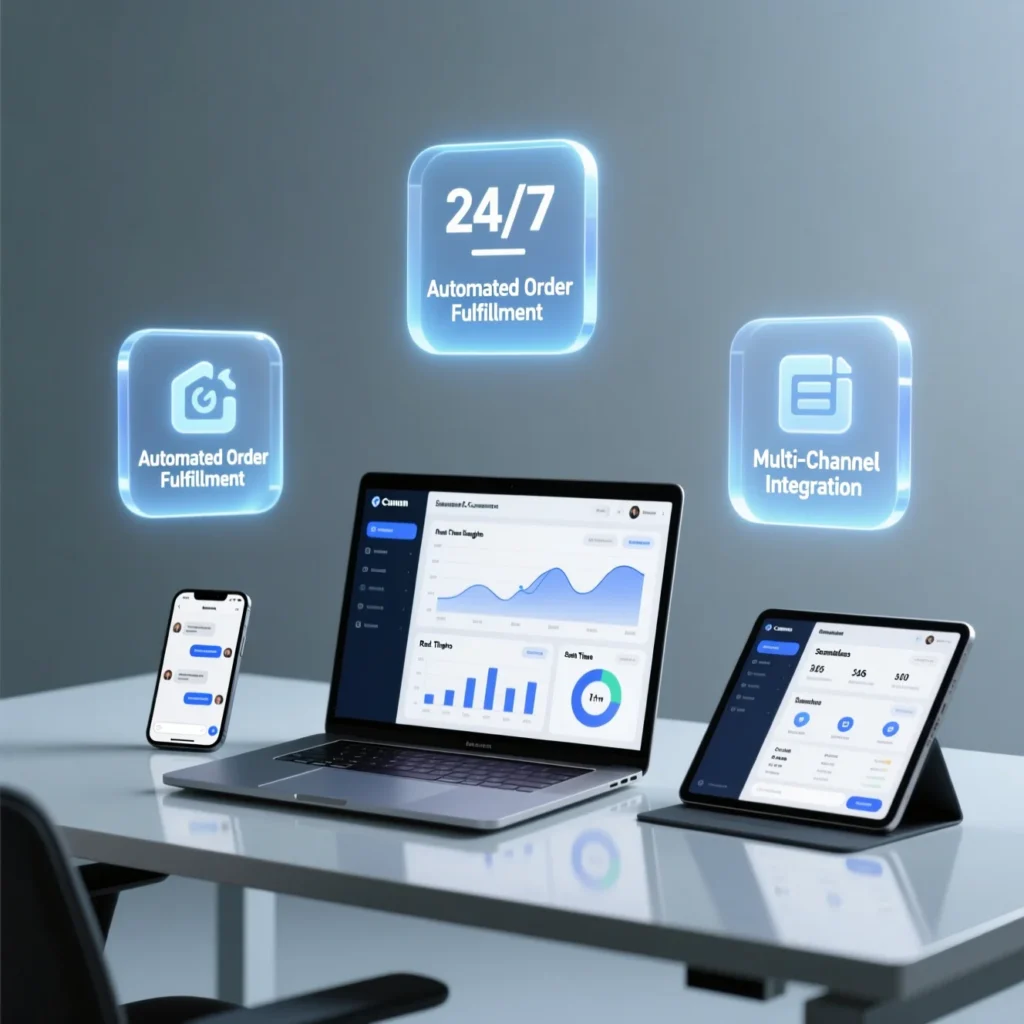
Top Benefits of Using Assistant E-Commerce Solutions
Here’s what makes assistant-powered e-commerce so effective:
- ✔ You save time
- ✔ You reduce costs
- ✔ You avoid tech frustration
- ✔ You earn faster
- ✔ You automate a large share of the day-to-day running
- ✔ You become competitive (even against big brands)
For people who need to generate income fast, this is a game-changer.
Who Should Use Assistant E-Commerce Solutions?
These solutions are ideal if you are:
- A beginner who wants to start earning online
- Someone without technical skills
- A busy parent
- A student
- A full-time employee looking for extra income
- Anyone tired of complicated online business models
If you want to make money with less stress, this is for you.
The Main Types of E-Commerce Solution for Beginners
Before you choose an assistant, it helps to know what you are actually going to be selling on. Not all tools are the same, and the right category depends on your goal and your budget.
1. Store-Building Platforms
Best for people who want a professional shop quickly. Shopify, Wix and Squarespace are the usual names.
They provide:
- Templates
- Drag-and-drop editors
- Built-in payment systems
2. AI-Powered E-Commerce Assistants
Built to absorb the difficult, repetitive work — writing, SEO, product research, customer service, marketing and branding. Some will generate a workable store in minutes. The different flavours of assistant are worth a section of their own, and get one further down.
3. Marketplace-Friendly Solutions
For selling on:
- TikTok Shop
- Amazon
- eBay
- Etsy
A sensible starting point if you would rather not manage a full website yet — the audience is already there, and you trade some control and margin for it.
4. Inventory-Free Solutions
These let you start earning without buying stock upfront:
- Dropshipping
- Print-on-demand
- Digital product stores
A powerful option on a very low budget. It is worth saying that inventory-free does not mean nothing to manage — the moment you sell the same product across more than one channel, keeping stock, pricing and availability aligned becomes the job.
Types of Assistant E-Commerce Solutions to Consider
Once you know where you are selling, here are the kinds of help available:
1. AI-Assisted E-Commerce Tools
These use artificial intelligence to handle tasks like:
- Writing product descriptions
- Analysing trends
- Managing customer support
- Editing product photos
- Generating ads
Examples include automation bots, Shopify AI tools, and product research assistants.
2. Virtual Assistants (Human)
Good for:
- Customer service
- Order management
- Social media
- Influencer communication
They add a human touch.
3. Full E-Commerce Assistant Packages
Some services combine everything:
- AI tools
- Human support
- Marketing systems
- Inventory management
This is the most complete solution.
How to Choose the Right E-Commerce Solution
Whichever category you land on, the same short checklist separates the tools worth paying for from the ones that quietly cost you months.
Choose a solution that offers
- Automation of the repetitive work, so your time goes to selling
- Easy integrations with the store, payment and messaging tools you already use
- Marketing tools included rather than sold as a separate upgrade
- SEO assistance for product pages and content
- Fees you can predict and read in full before you commit
- Scalable plans that still make sense at ten times your current volume
- Real support — usable documentation and someone to answer you
Avoid solutions that
- Hide costs behind add-ons, or reveal them only once you are set up
- Lock you into a long contract you have no way to test first
- Leave you waiting days for support when an order is stuck
- Require you to write code for things a merchant should be able to do from a dashboard
And most importantly: the ability to grow with your business.
How Much Do E-Commerce Assistants Cost?
This depends on the type:
- AI tools: £10–£49/month
- Virtual assistants: £5–£15/hour
- Complete solutions: £49–£199/month
Compared to hiring employees, this is extremely affordable—and often far more efficient. The pricing model matters as much as the number, though: some tools charge a flat monthly fee whatever you sell, while others charge a percentage only when you actually get paid, with no monthly fee and no contract — that is how Trapyfy is priced. If you are still pre-revenue, that difference matters more than the headline figure.
SEO Advantages of Using an E-Commerce Assistant
Your assistant can help you rank higher by:
- Optimizing product pages
- Creating blog content
- Improving site structure
- Suggesting keywords
- Increasing engagement (faster customer replies)
Better SEO = more traffic = more sales.
Best Practices When Using E-Commerce Assistants
Follow these to get maximum results:
1. Start with a simple store
Don’t launch with 40 products.
Start with 3–5 best-sellers.
2. Automate everything you can
Your time is valuable.
3. Keep your branding consistent
Your assistant can manage logos, colors, tone, and messaging.
4. Run small marketing tests
Test TikTok videos, Instagram stories, and short ads.
5. Track performance weekly
Assistants can create reports for easier decision-making.

Ready to Start Your E-Commerce Journey?
E-commerce is one of the fastest ways to start earning online—but only if you do it smartly. Assistant e-commerce solutions give you the tools, automation, and guidance you need to build a profitable business without stress, confusion, or expensive setups.
If you want a business that:
✔ Runs mostly on autopilot
✔ Lets you start earning quickly
✔ Doesn’t require complicated tech skills
✔ Is affordable to maintain
Then assistant-powered e-commerce is exactly what you need. Pick your selling model, pick the assistant that covers your weakest area first, and get the store in front of real buyers — you can open a store and start taking orders in Telegram the same day.