
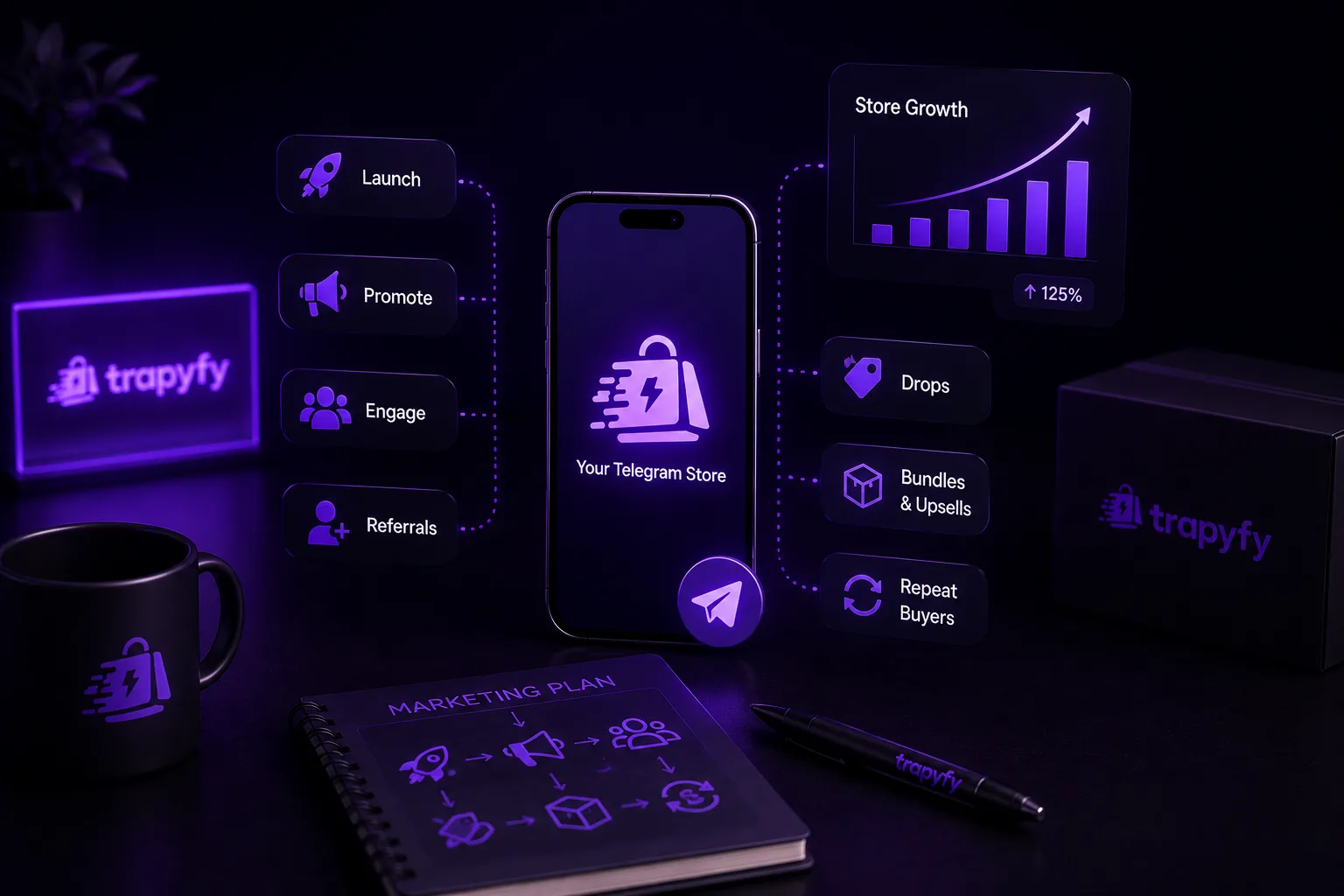
A Telegram store marketing plan earns its place when it does more than generate traffic. For an ecommerce brand, the point is a repeatable system that acquires qualified customers, converts them into orders and brings them back for a second and third purchase. Anything that stops at reach is a posting schedule, not a plan.
Telegram works best when you treat it as a commerce and relationship channel rather than another social feed. Customers opt in deliberately, read your messages in the same place they read messages from friends, and can move from a product announcement to a paid order without leaving the app. That short distance between discovery and checkout is the commercial advantage, and it is why Telegram store marketing should be built around the customer lifecycle rather than around campaign ideas.
This guide assumes you already sell online. Getting new people to find your bot in the first place is a separate discipline, covered in how to drive traffic to your Telegram bot. Here we deal with what happens across acquisition, conversion, retention, repeat purchase and advocacy once Telegram becomes part of how your brand sells.
Define the role Telegram plays in your ecommerce stack
Most plans fail at this step rather than at execution. A merchant who has not decided what Telegram is for ends up running a channel that posts a lot and sells very little.
Telegram can take several roles, and they are not mutually exclusive:
- Primary storefront for audiences that already live in Telegram, where the bot handles browsing, checkout and order updates end to end.
- Additional sales channel alongside an existing website, carrying a subset of your catalogue or your highest-repeat lines.
- Retention channel for customers acquired elsewhere, used for reorders, restocks and post-purchase communication.
- Community channel where product education, feedback and questions happen close to the point of sale.
- Launch and drop channel for limited releases, early access and seasonal collections.
- Support channel for order enquiries, delivery questions and returns.
None of this requires abandoning your website. For most established merchants, the sensible move is to add Telegram as an additional sales channel and let it earn a larger share of revenue if the numbers justify it. Brands running Shopify or WooCommerce usually start with retention and drops, where the messaging advantage is clearest, before moving more of the catalogue across. If you are weighing the two setups against each other, Telegram shop versus Shopify covers where each one fits, and migrating from Shopify to Telegram covers what moving products, orders and customer flow actually involves.
Write the decision down before you plan a single campaign. The role determines which lifecycle stage your plan should weight most heavily, which metrics matter, and how much of your catalogue needs to exist inside a Telegram storefront on day one.
Segment your customers before you plan campaigns
“Find your audience” is advice for people who do not have one. If you already sell, you have customer records, and those records are the raw material for everything that follows. Segmentation is what separates Telegram store marketing from broadcasting.
Useful segments for a Telegram store are the same ones you would use in email, and they should drive different messages and different offers:
- First-time visitors who have joined but never ordered. They need proof, clarity and a low-friction first purchase, not a loyalty pitch.
- Existing customers acquired on another channel. They need a reason to use Telegram specifically, usually speed, early access or order visibility.
- Repeat purchasers with an established cadence. They respond to replenishment timing and new lines within categories they already buy.
- High-value customers whose order value or frequency sits well above average. Worth treating separately with early access and direct contact.
- Product-category buyers who only ever buy one part of your range. The obvious opportunity is a relevant cross-sell, not a full-catalogue broadcast.
- Inactive customers who bought once and disappeared. They need a reactivation message, and often a specific reason to return rather than a generic discount.
- Community members who engage without buying. Some are researching, some never will buy, and the difference is worth measuring.
- Waiting-list and restock subscribers who have already told you exactly what they want. This is the highest-intent segment most merchants under-use.
A practical caveat: Telegram itself does not hand you a segmented customer database. Segmentation comes from your commerce data, which means order history, product categories and customer records held in your store platform or CRM. Trapyfy holds products, orders, customers and stock in one place, and a Telegram ecommerce API for reading and synchronising those records with your other tools is planned for a future release. Until it ships, plan segmentation around what you can manage and export inside the platform rather than around an automated sync.
Acquisition: qualified customers, not subscriber counts
Subscriber growth and customer acquisition are different objectives, and confusing them is the most expensive mistake in Telegram marketing. A channel of ten thousand members who joined for a giveaway is a cost. A channel of eight hundred people who arrived from your product pages and packaging is a sales asset.
Start with the channels you already control
Your existing commercial touchpoints convert far better than cold reach, because the people using them have already shown purchase intent:
- Your website, with a Telegram entry point on product pages, in the cart, and on the order confirmation page rather than buried in the footer.
- Your email database, where a single well-argued message to buyers usually outperforms months of organic posting.
- Post-purchase communications, which reach customers at their highest point of goodwill. Offering order updates inside Telegram is a reason to join that customers actually want.
- Packaging inserts and QR codes, which convert offline attention into an opted-in customer. Give the code a specific job: track this order, join the restock list, claim a reorder code.
- Your social profiles, treated as a route into the store rather than as the destination.
Then add paid, creators and communities
Paid campaigns and creator partnerships work for a Telegram store, but they need a defined landing behaviour. Sending paid traffic to a channel with no clear first action wastes it. Send it to a specific product, a launch, or a waiting list, and measure it on orders rather than joins. Existing communities in your category can be worth more than broad targeting, provided you arrive with something useful rather than a promotion.
Judge acquisition on qualification, not volume
Set the success measure at the point of commercial intent. A subscriber who reaches the storefront, opens a product or joins a restock list is qualified. A subscriber who joins and never interacts is not, and counting them flatters the plan while hiding the problem. Merchants working towards their first 100 orders on Telegram almost always get there faster by concentrating on a small qualified audience than by chasing membership. If your acquisition currently depends entirely on advertising spend, promoting a Telegram shop without relying only on paid ads sets out the alternatives in more detail.
Build direct customer relationships, without the ownership myth
You will read that Telegram gives you an owned audience. It does not, and merchants who plan on that basis are building on someone else’s platform while believing otherwise. Telegram is a third-party channel with its own rules, and access to your subscribers ultimately depends on it.
What Telegram genuinely offers is closer to the real benefit anyway:
- A permission-based audience. People choose to start your bot or join your channel. That opt-in is a commercial signal an algorithmic feed never gives you.
- A direct customer relationship. Messages reach subscribers without competing for placement in a ranked feed, which reduces your dependence on reach you cannot control.
- First-party customer data, provided you capture it. Orders, product preferences, purchase dates and lifetime value belong in your own commerce system, not in a chat history.
- A customer database you can move. If the records live in your platform or CRM, the relationship survives a change of channel.
The practical instruction is simple: treat Telegram as the place where the conversation happens and your commerce system as the place where the customer record lives. A Telegram CRM approach for sellers covers how to capture that data as orders come in. The moment your customer knowledge exists only inside a messaging app, you have the fragility of a rented audience without any of the benefits of a real one.
Conversion: shorten the path from message to paid order
Conversion on Telegram is mostly a question of how far a customer has to travel between seeing a product and paying for it. Every additional step, redirect or manual exchange costs orders.
The commercial fundamentals do not change because the channel does:
- Product clarity. Photographs that show the product properly, descriptions that answer the obvious question, and variants that are easy to choose between.
- Pricing and delivery information stated up front. Unexpected shipping costs kill orders in Telegram exactly as they do at web checkout.
- Payment methods the customer recognises and trusts. If your payment route is unfamiliar, explain it before checkout rather than at it.
- Trust signals. Delivery times, returns terms, contact routes and real customer feedback. Buyers on a messaging channel need more reassurance, not less, which is why Telegram shop trust signals deserve deliberate attention.
- One clear action per message. A product message asking the reader to browse, follow, reply and buy achieves none of them.
- Genuine urgency only. A real deadline you enforce concentrates demand. A countdown that resets on Monday teaches customers to ignore every future one.
Order value is part of conversion too. Bundling products that genuinely belong together, and offering a relevant add-on at the point of purchase, lifts average order value without adding acquisition cost. The mechanics of upsells and bundles inside Telegram are straightforward to set up once your catalogue is structured.
Two honest notes on recovery. First, customers who start an order and stop are worth chasing, but automated abandoned-checkout recovery is not something to assume your setup provides. In many Telegram stores it is a manual or semi-manual follow-up unless you have built it, so confirm what your platform supports before you plan campaigns around it. Reducing drop-offs at Telegram checkout covers the options. Second, resist the temptation to invent conversion uplift figures for internal targets. Measure your own baseline first, then improve it. If you want the detailed treatment of product messaging and checkout flow, Telegram store conversion rate optimisation goes considerably deeper than this section needs to.
Lifecycle marketing: what to send at each stage
This is where a Telegram store marketing plan stops being a list of tactics. Map every campaign to a lifecycle stage, and the gaps become obvious: most merchants are heavily over-invested in discovery and almost absent after the first order.
| Lifecycle stage | Campaign examples | What it needs |
|---|---|---|
| Discovery | Product education, category explainers, launch teasers, waiting lists | A clear entry point and a reason to opt in |
| First purchase | Welcome sequence, best-seller introduction, first-order incentive where margin allows | A working storefront and checkout |
| Post-purchase | Order confirmation, status and delivery updates, usage or care information | Automated order notifications |
| Repeat purchase | Replenishment prompts, complementary products, new lines in a bought category, restock alerts | Order history and segmentation |
| Reactivation | Win-back offers, “what you missed” collections, targeted discount codes | Purchase recency data |
| Loyalty and advocacy | Early access groups, VIP pricing, referral invitations, review requests | Customer value data and a tracking method |
A word on what is automated and what is not. Order confirmations, payment confirmation, status updates and delivery notifications run automatically once your store is set up: Telegram order automation covers that flow, and tracking details are shared with the customer through the bot as orders progress. Discount codes for first-purchase, win-back and VIP campaigns can be created as Telegram coupons with expiry dates, total and per-customer usage limits, minimum purchase values and targeting by product or category, which is enough to run most lifecycle offers cleanly.
Segmented sending, scheduled reorder reminders and multi-step win-back sequences are a different matter. Those typically depend on your own CRM or marketing tool, or on a manual process you run yourself, because Trapyfy does not yet offer external API access. Plan them as such rather than assuming they arrive out of the box. For the copy itself, customer message templates for Telegram stores saves rewriting welcome, recovery and post-purchase messages from scratch.
Repeat purchases are where ecommerce margin actually lives
Acquisition is the expensive part of ecommerce. The margin usually arrives on the second, fifth and tenth order, when there is no acquisition cost attached. A Telegram store marketing plan that treats retention as an afterthought is optimising the least profitable half of the business.
The measures worth building the plan around are the standard ecommerce ones:
- Repeat purchase rate. The share of customers who buy more than once, and how that share moves quarter to quarter.
- Purchase frequency and time between orders. This tells you when a replenishment message is useful rather than annoying.
- Customer lifetime value. The number that decides how much you can afford to spend acquiring a customer in the first place.
- Returning customer revenue share. A simple health check on whether growth is compounding or being rented.
Telegram earns its keep here because a message to an opted-in past customer is a direct re-engagement route that costs nothing per send. Replenishment products are the clearest case: if a customer’s consumable runs out in roughly eight weeks, a message in week seven is a service rather than a promotion. Telegram subscription and reorder flows covers how to structure that properly. New releases inside a category someone already buys, and cross-sells that genuinely complement a past order, do the same work for non-consumables.
Be careful about the claim underneath all this. Telegram does not create loyalty. It removes friction from staying in touch with people who already like what you sell, which is only valuable if the product and the service are worth returning to. A light loyalty mechanic can help, and Telegram shop loyalty tactics covers the practical options, though most merchants get further by making the second purchase obvious and easy than by building a points scheme.
From community to commerce
A brand community is only a marketing asset if it connects to purchasing. The chain worth designing runs community, trust, product discovery, purchase, retention, and every activity should sit somewhere on it.
Commercially grounded uses of a Telegram community include:
- Product education that removes the objection standing between interest and an order.
- Drop and launch announcements to an audience that has already asked to hear about them.
- Feedback collection on what to stock next, which doubles as demand testing before you commit to inventory.
- Questions answered in public, which resolves the same doubt for everyone reading.
- Early-access groups for high-value customers, giving genuine preferential treatment rather than a badge.
- Restock and waiting lists, the most directly commercial community mechanic available.
Limited releases fit naturally here. A fixed quantity, a stated date, and a product that will not return in the same form concentrates demand into a single moment and gives community membership an obvious value. The discipline is honesty about the limit, and enough stock control that you do not sell what you cannot ship. Running Telegram product drops without overselling covers the operational side, which is usually where drops go wrong.
Promotions and referrals as merchant-controlled acquisition
Referral marketing belongs in an ecommerce plan as one acquisition and advocacy tactic among several. It is not a business model, and it should not be framed as a way for anyone to earn an income from your store. The merchant sets the terms, the reward and the budget, and the objective is customers rather than sign-ups.
A refer-a-friend programme that works commercially usually has four properties: a reward on both sides, a reward that costs you less than paid acquisition for the same customer, an ask timed to just after a good delivery, and a way to attribute the resulting orders. Store credit or a product discount is generally a better structure than cash, because it returns the value to your store.
Attribution is the part merchants skip. Unique coupon codes per advocate are the simplest workable method, and coupon usage limits let you control exposure. Telegram referral tracking for ecommerce stores covers the mechanics, and running referral campaigns without fake referral bots is worth reading before you evaluate any off-the-shelf tool, since a large part of that market is built for engagement farming rather than commerce. For the programme design itself, adding a referral programme to a Telegram store sets out the structure.
Discounting deserves the same discipline. Coupons tied to a lifecycle purpose, such as a first order, a win-back or a minimum basket value, are marketing. A permanent sale is a price cut you have not admitted to, and it trains customers to wait.
Connect marketing to the systems that run your store
Marketing that sits apart from operations produces campaigns you cannot fulfil. A drop that oversells, a promotion on a discontinued line, or a reorder prompt sent to someone whose last delivery went missing all come from the same root cause.
The connections worth making are these:
- Catalogue and stock. Campaigns should reflect what can actually be sold. Keeping products, pricing, variants and availability in one system, as product and inventory control does, is what stops a successful drop turning into refunds.
- Orders and notifications. Payment confirmation, order routing and customer status updates running automatically means marketing volume does not translate into admin volume.
- Fulfilment. Orders routed to the right warehouse or supplier based on stock, location and payment status keep delivery promises credible. Fulfilment routing matters more than it sounds during a launch.
- Customer records. Order history is the input to every retention campaign you will run, which is why it needs to live somewhere queryable.
- Integrations. An API that moves products, orders, customers and stock between your Telegram store and the inventory, CRM, analytics or accounting tools you already run is planned for a future Trapyfy release. Today those records live in the platform.
Merchants who want the broader operational picture will find it in end-to-end Telegram store automation and when a Telegram store API becomes necessary. The test for any of it is simple: if a campaign succeeds beyond expectation, does anything break?
Measure commercial outcomes, not audience size
Member count is the metric most Telegram stores report and the one that explains the least. Put it at the bottom of the list, then judge your Telegram store marketing on the same terms you would apply to any other sales channel.
| Priority | Metric | What it answers |
|---|---|---|
| Primary | Orders and revenue from Telegram | Is the channel commercially real? |
| Primary | Conversion rate from qualified subscriber to first order | Is the storefront doing its job? |
| Primary | Repeat purchase rate and returning-customer revenue | Is growth compounding or rented? |
| Secondary | Average order value | Are bundles and cross-sells working? |
| Secondary | Revenue per campaign | Which messages are worth repeating? |
| Secondary | Reactivation rate | Is dormant customer value recoverable? |
| Where measurable | Customer acquisition cost and lifetime value | How much can you afford to spend acquiring? |
| Context only | Qualified subscribers added | Is the top of the funnel healthy? |
Be realistic about what you can measure. Attribution across a messaging channel is harder than on a website, and how much of this you can actually see depends on your analytics setup and how your commerce data connects to it. Campaign-specific coupon codes and distinct entry points are the two most reliable low-effort attribution methods available. Telegram store analytics and weekly KPIs covers what to review and how often, and is worth setting up before you start spending against this plan rather than after.
Your 30-day Telegram store marketing plan
Four weeks is enough to get a lifecycle-based plan running, provided each week has one job. This assumes you already sell online and have products, pricing and delivery worked out.
Week 1: foundation
- Decide and document the role Telegram plays in your stack.
- Build the storefront: catalogue structure, categories, pricing, variants, stock and delivery information. A Telegram shop launch checklist stops the obvious gaps.
- Test the full customer journey yourself, from first message to order confirmation to delivery update.
- Set up tracking: entry points, campaign coupon codes, and whatever analytics connection your stack allows.
- Define your initial segments and confirm where customer records will live.
Week 2: acquisition
- Add Telegram entry points to your website product pages, cart and order confirmation.
- Email your existing customer database with a specific reason to join, not a general announcement.
- Put a QR code on packaging and order paperwork with one defined job.
- Announce on your social profiles, treating them as a route rather than a destination.
- Run your first acquisition campaign against a single product or launch, and record the baseline.
Week 3: conversion
- Review where customers stop between product view and paid order, and remove the largest obstacle first.
- Set up two or three bundles and a relevant add-on at the point of purchase.
- Rewrite your product messaging around one clear action per message.
- Run one genuine, time-limited offer with a deadline you enforce.
- Test two versions of your main product message and keep the one that produces orders, not reactions.
Week 4: retention
- Set up post-purchase communication: confirmation, delivery updates, and usage or care information.
- Send your first replenishment or cross-sell campaign to customers whose order history justifies it.
- Run a reactivation message to customers who bought once and went quiet.
- Create an early-access group for your highest-value customers and give it something real.
- Review performance against the metrics table above and decide what to repeat in month two.
Set an operating cadence you can sustain
Consistency beats intensity, and a predictable weekly rhythm keeps the store present without the boom-and-bust of random campaigns. A workable pattern:
- Monday — review last week’s orders and revenue, then post a value-led message such as a guide, a restock preview or product education.
- Wednesday — engage. Run a poll, answer questions, or share customer feedback. Mid-week is for building the trust that Friday converts.
- Friday — sell. Launch the drop, open the bundle, or announce the weekend offer while intent is highest.
- Weekend — follow up. Order updates, post-purchase messages, and next week’s plan.
The specific days matter less than the fact that they repeat. A steady cadence trains customers to open your messages, and it makes campaign performance comparable week to week instead of a series of one-offs you cannot learn from.
What the plan looks like for different types of merchant
The lifecycle is constant; the weighting is not. A Telegram store marketing plan for a fashion brand and one for a supplements merchant share a structure and very little else. Four common shapes:
- DTC fashion brand. Weighted towards drops and advocacy. Telegram carries early access for repeat buyers, launch announcements to a waiting list, and restock alerts on sold-out lines. Acquisition runs through the existing website and packaging inserts.
- Beauty or wellness merchant. Weighted towards replenishment. Product education builds the case for correct usage, and reorder timing based on purchase history does most of the commercial work. Cross-sells within a routine outperform broad promotions.
- Specialist retailer. Weighted towards high-intent community. Product alerts, restock notifications and expert answers to detailed questions. The audience is smaller and considerably more valuable per member, so qualification matters more than growth.
- Established Shopify or WooCommerce merchant. Weighted towards retention. Telegram runs as an additional channel for order updates, reorders and launches, while the website continues to handle broad acquisition and the long tail of the catalogue.
Pick the shape closest to your business and weight the 30-day plan accordingly rather than running all stages at equal effort.
Where Telegram store marketing plans usually go wrong
Most struggling Telegram stores are not failing at strategy. They are repeating a handful of avoidable mistakes:
- Measuring members instead of orders. The clearest sign that a channel is being run as social media rather than as a sales channel.
- Spending everything on acquisition. Chasing new buyers while ignoring the customers you already have leaves the cheapest revenue in the business untouched.
- Marketing disconnected from operations. Promoting products you cannot ship, or launching without stock control, converts a good campaign into refunds.
- Treating the audience as owned. Building customer knowledge that exists only inside a chat, with no record in your own systems.
- Discounting on a schedule. Permanent sales teach customers to wait and quietly erode both margin and price credibility.
- Broadcasting to everyone. One message to the whole list, regardless of what each segment has bought, is the reason engagement decays.
Build the plan around the customer lifecycle

Every section of this plan is useful alone, but the return comes from the sequence. Acquire qualified customers rather than subscribers. Convert them by removing distance between the message and the paid order. Retain them with post-purchase communication that is worth reading. Reactivate the ones who go quiet, using data you hold rather than guesswork. Then let the customers who genuinely like your brand bring the next ones.
Read separately, “post more” and “run a promotion” are noise. Sequenced across the lifecycle, the same actions become a commercial system where each stage feeds the next and each campaign has a measurable job. Start with the role Telegram plays in your stack and the storefront that supports it, then add acquisition, conversion and retention one layer at a time. You do not need every mechanic running in month one, only all of them pointing the same direction.
Trapyfy exists to keep that system in one place: storefront, catalogue, stock, checkout, orders, customer records and fulfilment. Marketing plans fail more often on operations than on ideas, and infrastructure is what turns a plan on paper into a channel that runs. You can set up a Telegram store and start with the foundation week.
Frequently asked questions
What should a Telegram store marketing plan actually contain?
A plan built on the customer lifecycle rather than on tactics: a defined role for Telegram in your ecommerce stack, customer segments based on order history, an acquisition approach that draws on the channels you already control, a storefront that converts, post-purchase and repeat-purchase campaigns, a reactivation route for dormant customers, and a measurement framework based on orders and revenue rather than member count.
Do I own my Telegram audience?
No. Telegram is a third-party platform, and access to your subscribers depends on it. What you can build is a permission-based audience and a direct customer relationship, with the underlying first-party customer data held in your own commerce system or CRM. Keep order history, product preferences and customer value in records you control, so the relationship survives a change of channel.
How do I promote a Telegram shop without a big following?
Start with the commercial touchpoints you already own: your website product pages and order confirmations, your email database, packaging inserts and QR codes. These reach people who have already shown purchase intent, so they convert far better than cold reach. A small qualified audience produces more orders than a large unqualified one, and it is a much cheaper base to grow from.
Can Telegram replace my Shopify or WooCommerce store?
For most established merchants it should not, at least at first. Telegram usually earns its place as an additional sales channel, weighted towards retention, drops and repeat purchases, while the website continues to handle broad acquisition and the full catalogue. Some brands with Telegram-native audiences do run it as their primary storefront, but that is a decision to make on your own customer data rather than by default.
How do I get repeat customers for a Telegram store?
Use the order history you already hold. Time replenishment prompts to when a consumable actually runs out, cross-sell products that complement a specific past order, alert customers when a line they buy is restocked, and give your highest-value customers early access. The channel makes re-engagement cheap and direct; the product and service are what make customers willing to return.
Which metrics should I track for a Telegram store?
Orders, revenue, conversion rate from qualified subscriber to first order, and repeat purchase rate first. Then average order value, revenue per campaign and reactivation rate. Customer acquisition cost and lifetime value where your setup can measure them. Member count belongs at the bottom as context. How much of this you can see depends on your analytics and integration setup, so campaign-specific coupon codes and distinct entry points are worth using as a practical attribution method.
Is Telegram store marketing different from driving traffic to a bot?
Yes. Driving traffic is about getting new people to find your bot or channel. A Telegram store marketing plan is the wider commercial system for what happens next: converting those people into customers, keeping them informed after the order, and bringing them back. Traffic fills the top of the funnel; the plan is what turns it into revenue and repeat revenue.