
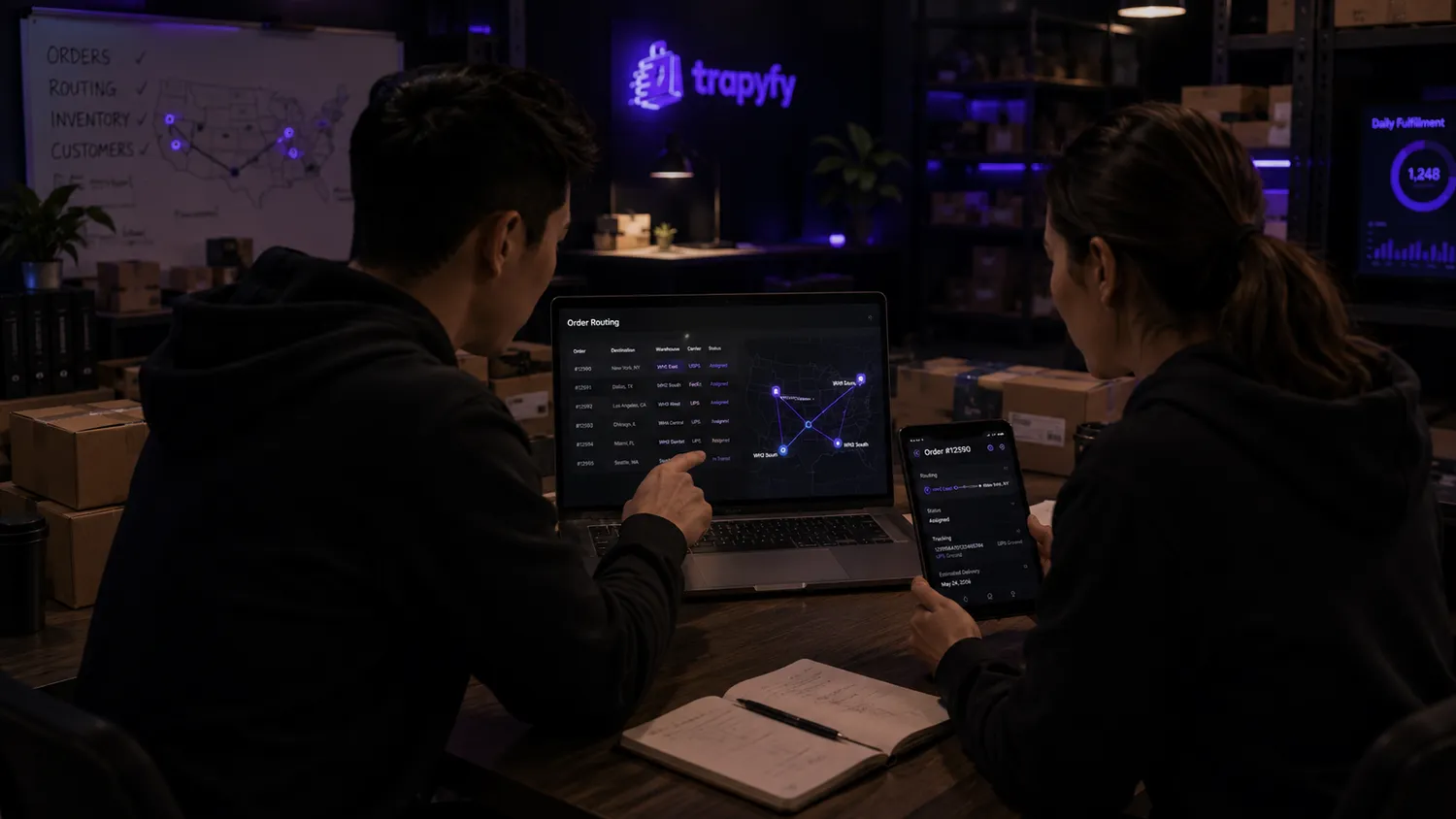
Telegram-native stores have grown past the spreadsheet stage. Sellers now process hundreds of paid orders a week through a single bot, with stock spread across multiple warehouses, regional suppliers and dropship partners — and a shared sheet cannot keep up. Telegram fulfillment automation closes that gap, routing each paid order to the right warehouse, supplier or fulfillment path the moment payment clears, without human triage.
Automating fulfillment inside Telegram replaces manual lookup with rule-based routing, real-time stock checks and supplier handoff. Sellers ship faster, oversell less and recover the hours previously spent reconciling rows. The rest of this guide covers when automation is actually worth the effort, how routing logic works conceptually, and which signals should decide where a Telegram order ships from — so you can judge a setup before committing to one.
What is Telegram fulfillment automation?
Telegram fulfillment automation is the layer that takes a paid order placed inside a Telegram bot and pushes it through the full fulfillment chain — stock check, warehouse assignment, supplier handoff, tracking update and customer notification — without manual intervention.
In a manual setup, a paid order is a message in a chat. Someone reads it, copies it into a spreadsheet, checks stock by memory or by calling the warehouse, marks the row, and replies to the buyer. In an automated setup, the same steps run as rules rather than habits: the SKU is checked against live inventory, a warehouse is selected on stock and shipping zone, and the buyer is updated in the same Telegram chat.
The unit of work is the same — a paid order — but the cost of handling it falls sharply, and the common failure modes (oversold stock, wrong warehouse, missed shipment) become far less frequent.
Why manual spreadsheets break Telegram stores at scale
Spreadsheets work for the first dozen orders a day. They break the moment two things happen at once: stock moves across multiple warehouses, and orders arrive faster than a human can reconcile rows.
The failures are predictable. Two operators edit the same row and overwrite each other. A SKU shows as in stock in the sheet but was already shipped from warehouse B that morning. A customer in Berlin gets routed to the Madrid warehouse because the rule lived in someone’s head, not in the system. None of these are exotic edge cases — they are the default outcome of running fulfillment in a tool that was not designed for live operations.
Automation changes the substrate. Stock state lives in one source of truth, every paid order reads it atomically, and routing rules execute the same way at 3 a.m. as they do at noon. The operator stops being the bottleneck.
How order routing works in an automated Telegram stack
Routing is the heart of Telegram fulfillment automation. When payment clears inside the bot, the system evaluates a routing graph: which warehouses hold the SKU, which supplier covers the buyer’s region, which fulfillment method the SKU is flagged for (in-house, dropship, supplier-direct), and which carrier serves the destination cheapest or fastest.
The output of that graph is a single decision: this order ships from this location, via this carrier, with this tracking ID. The decision is written back to the order record, inventory is updated, and the tracking link is pushed to the customer chat.
Routing decisions are not a one-shot, and this is worth testing before you commit to any setup: if the chosen warehouse runs out of stock mid-day, does the rule re-evaluate and move to the next eligible location, or does the order sit until someone notices? Fallback behaviour is where the difference between setups usually shows up.
Multi-warehouse fulfillment for Telegram stores
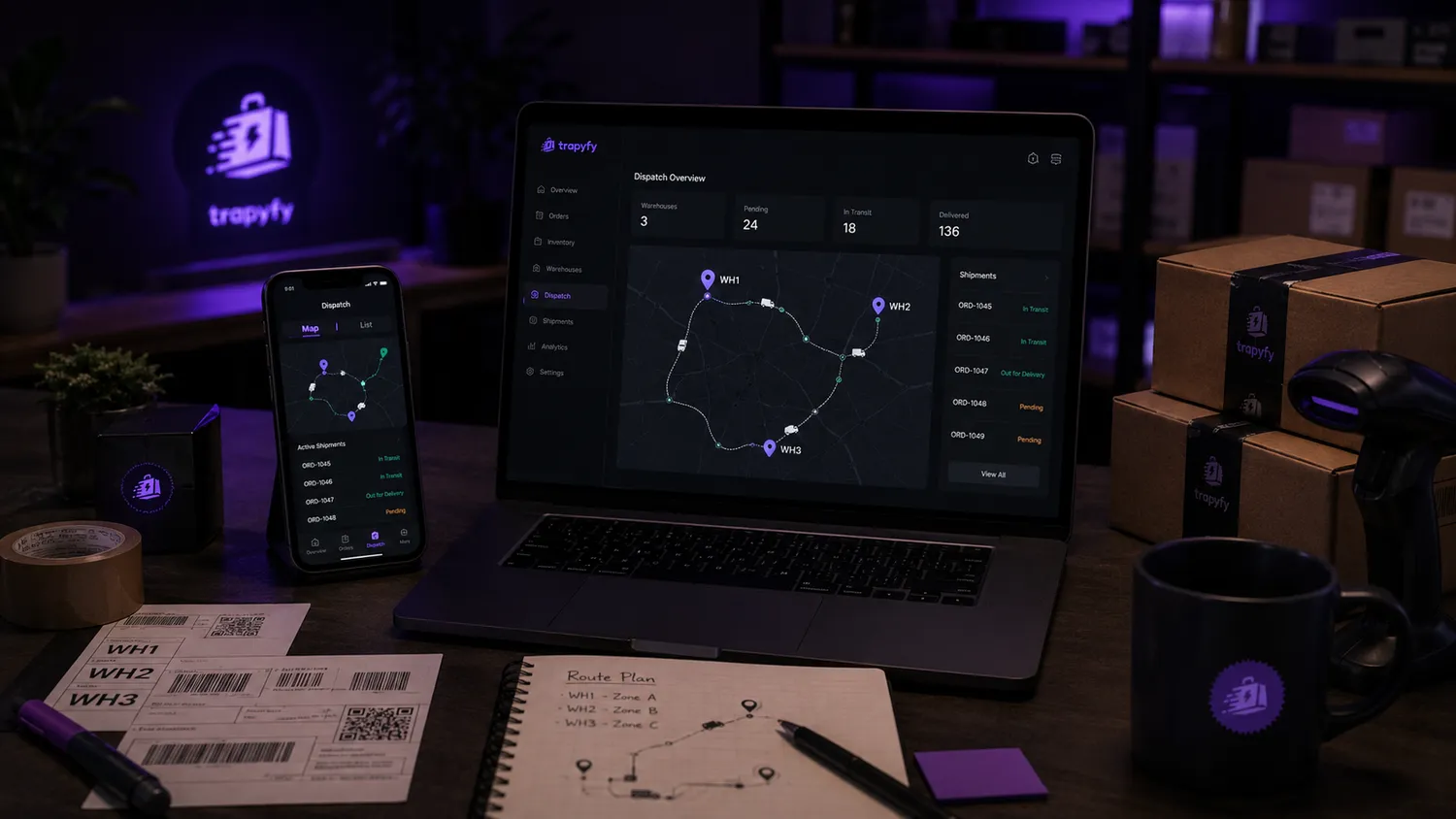
Multi-warehouse routing is where automation pays for itself first. A seller with stock in three locations can cut shipping cost and transit time simply by always shipping from the closest warehouse with availability — but only if the routing logic actually runs on every order.
An automated Telegram stack tracks stock per location, attaches a shipping-zone rule to each warehouse, and combines the two on every paid order. A Lisbon buyer ships from the Madrid warehouse. A Frankfurt buyer ships from Rotterdam. A Manchester buyer ships from the UK warehouse, because post-Brexit customs would erase the savings of shipping from the EU. None of this requires anyone to read the order. Trapyfy uses a simpler rule: Telegram orders are allocated from the fullest warehouse serving the buyer’s country first.
Sellers running this setup typically pair it with Telegram inventory management to keep stock counts consistent across the bot, the warehouse, and the supplier feed — the same source of truth the routing graph reads from.
Routing rules that actually matter
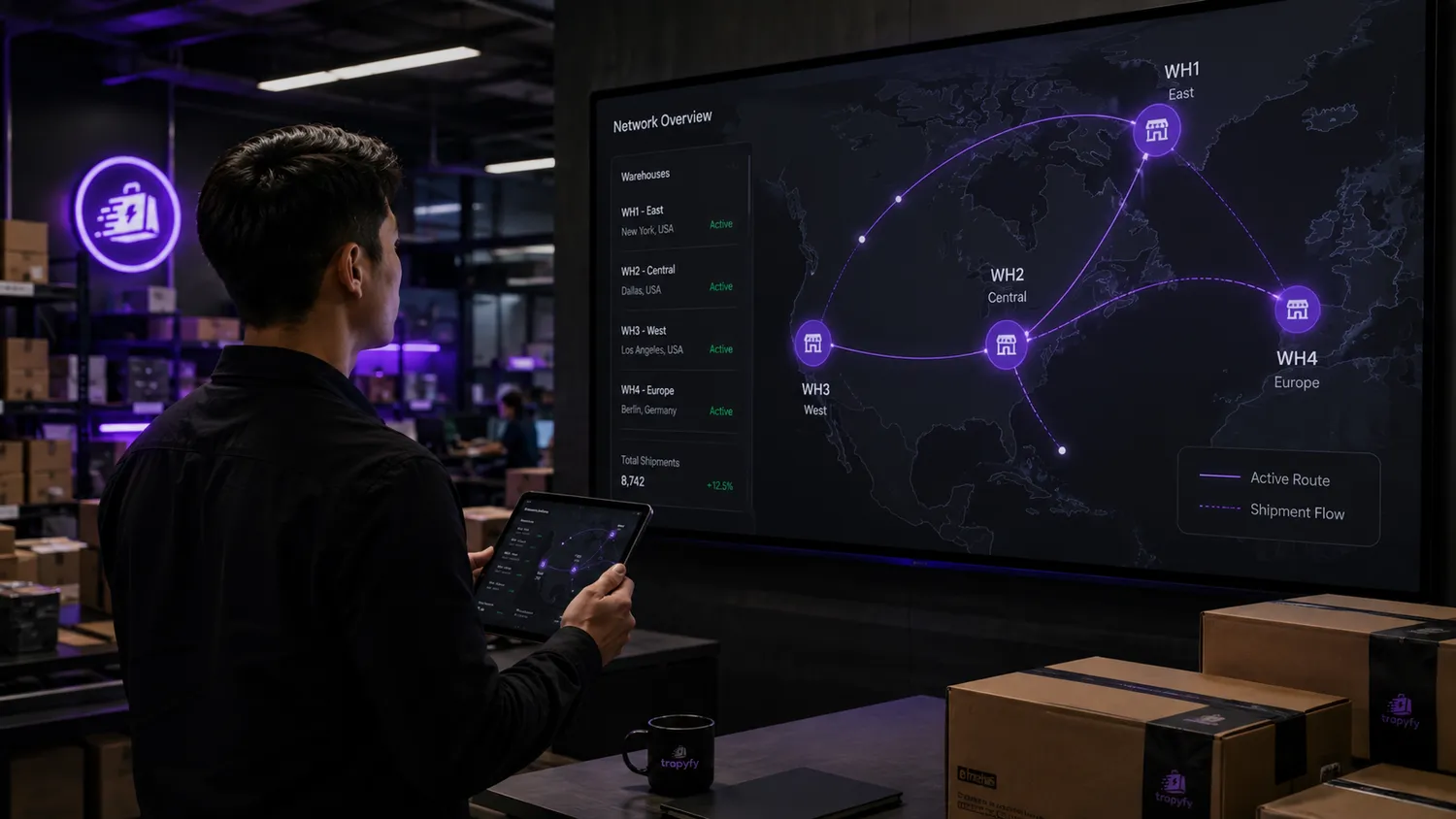
Not every routing rule earns its complexity. The ones that consistently change the outcome of Telegram fulfillment automation are:
- Stock availability per location — the first filter; a warehouse with zero stock is never eligible, period.
- Shipping zone — distance and customs determine which eligible warehouse wins.
- Fulfillment method flag — in-house, dropship, supplier-direct; some SKUs ship one way only.
- Supplier lead time — a supplier that dispatches same day beats a slower one when the buyer sits in their zone.
- Carrier cost & speed — applied last, after the warehouse is chosen.
Layered, these five rules cover the vast majority of routing decisions a Telegram store needs. Anything beyond them (priority customers, fragile-SKU lanes, restricted-product carriers) is an exception layer, not the default path.
From paid to delivered: the end-to-end Telegram flow
The full lifecycle of a single paid order in an automated stack looks like this: buyer confirms payment in the bot → order record is created → routing graph picks warehouse, supplier and carrier → inventory decrements at the chosen location → tracking details are written back to the order → the tracking link is pushed to the buyer chat → status updates continue in the chat until the order is delivered.
This is what sellers mean when they talk about order routing from paid to delivered — a single deterministic path where every state transition fires a Telegram message back to the buyer, and every exception (stock-out, address rejection, carrier delay) routes to a fallback rule before it becomes a support ticket.
Sellers who need bespoke routing or external integrations (ERP, 3PL APIs, accounting) typically extend the stack through custom Telegram store workflows rather than re-introducing manual steps.
Where dropshipping fits into the routing graph
Telegram dropshipping automation is a special case of routing, not a separate system. The order still hits the routing graph; the graph just resolves to “send PO to supplier X” instead of “pick from warehouse Y”. The supplier confirms, ships, and the tracking details flow back through the same order record.
The advantage of treating dropshipping as a routing decision rather than a parallel workflow is consistency: the buyer sees the same chat updates, the seller reads the same dashboard, and the same exception rules apply. If a supplier misses its lead time, a well-designed graph can fall back to the in-house warehouse when stock allows.
Closing the loop on Telegram operations
The shift from spreadsheets to automated routing is what separates a Telegram store that scales from one that stalls at the operator’s bandwidth. If you have worked through the questions above and want to see one implementation of it, Trapyfy’s fulfilment routing is the product side of this guide. Sellers ready to consolidate the full stack into one place can move toward end-to-end Telegram automation — orders, inventory, support and fulfillment under a single bot, with no spreadsheet in the loop.
FAQ
What is Telegram fulfillment automation?
It is the system that takes a paid order placed in a Telegram bot and moves it through stock check, warehouse assignment, supplier handoff and tracking updates automatically — no spreadsheet, no manual lookup.
Can a Telegram store really handle multi-warehouse routing?
Yes. Modern Telegram commerce stacks track stock per location and apply routing rules on every paid order, picking the closest warehouse with availability, provided the setup defines what happens when stock runs out mid-day. In Trapyfy, Telegram orders are allocated from the fullest warehouse serving the buyer’s country first.
Does this replace dropshipping or work alongside it?
It works alongside it. Dropshipping becomes a routing decision: when a SKU is flagged supplier-direct, the routing graph resolves to “send PO to supplier” instead of “pick from warehouse” — same flow, different endpoint.
What happens when the chosen warehouse runs out of stock?
In a well-designed setup the routing rule re-evaluates and assigns the next eligible warehouse. It is worth confirming that this fallback exists before you commit, because setups that stop and wait for a human are where delays reappear.
Do I need custom development to run this?
Not for the standard flow — the default routing graph runs out of the box. Bespoke integrations (ERP, 3PL APIs, restricted-product carriers) will depend on the Trapyfy developer API, which is planned for a future release and is not available today.