

Cannabis brands, peptide vendors, and other restricted-product merchants have spent the last few years being pushed off Stripe, Shopify Payments, and almost every mainstream checkout. The result is a category of sellers running real businesses on a payment infrastructure that can be revoked overnight — and looking for somewhere to land that does not collapse the moment a card network reviews the merchant code.
Telegram payments for high-risk products have become the answer for a growing number of cannabis and peptide operators in 2026. The channel is fast, native to a chat app buyers already trust, and supports both card and crypto rails inside the same flow. The catch: it only works long-term when the payment stack, KYC, and fulfilment workflow are designed for the category, not bolted on afterwards.
Why high-risk sellers are rethinking the payment stack
Standard processors classify cannabis derivatives, research peptides, and similar items as high-risk merchant categories. In practice that means rolling reserves, sudden freezes, and termination clauses that read more like trapdoors than contracts. Telegram has filled the gap because it gives sellers a direct route to the buyer that does not depend on a single acquirer staying friendly.
Telegram has filled the gap. The platform supports built-in invoice payments, bot-driven checkout, and crypto rails, all wrapped inside a chat interface customers already trust. For a category that lives or dies on direct customer access, that combination is hard to ignore. Trapyfy works with sellers in exactly this position — teams who need order, payment, and fulfilment infrastructure that does not collapse the moment a card network reviews the merchant code.
What Telegram payments for high-risk products actually offer
Telegram’s native payments API connects merchants to a list of approved providers (Stripe, Smart Glocal, Tranzzo, and several regional processors). Bots receive an invoice, the buyer pays inside the chat, and the seller gets a structured order object with an attached receipt. There is no separate storefront, no abandoned-cart funnel, and no third-party checkout redirect.
For cannabis and peptide sellers, the practical advantages are concrete:
- Direct buyer relationship. Orders, support, and re-orders all happen in the same conversation, which protects lifetime value if a payment provider drops you.
- Multiple payment rails. Card, crypto, bank transfer, and regional wallets can run side by side, so a single processor change does not stop the business.
- Lower checkout friction. Buyers in restricted categories are used to being declined; in-chat checkout closes the loop in seconds.
- Granular order data. Bot logs every order, attempt, and message, which matters when you need to dispute a chargeback or evidence repeat consent.
How does payment risk actually work for cannabis and peptides?
Card networks (Visa, Mastercard, Amex) classify products by Merchant Category Code. Cannabis derivatives, research peptides, and similar items typically map to MCCs that processors flag automatically. This is not a Telegram-specific rule — it is the same gating that drives terminations on Shopify and Stripe.
What changes on Telegram is who carries the risk. If a high-risk merchant uses a Telegram-approved provider that already underwrites the category (for example, a specialised European acquirer), the chargeback ratio, refund policy, and reserve are negotiated up front, not discovered after a freeze. According to the U.S. Financial Crimes Enforcement Network, cannabis-related businesses also need ongoing transaction monitoring and clear customer due diligence — obligations that a structured Telegram checkout makes easier to evidence than a free-form chat.
The compliance layer cannabis and peptide sellers must build
Telegram payments for high-risk products only work long-term when the compliance layer is treated as part of the product, not a back-office afterthought. The non-negotiables for sellers in 2026:
Age and identity verification
Peptide and cannabis buyers should pass a documented age check (18+ or 21+ depending on jurisdiction) before payment is requested. A bot-driven KYC step, with selfie + ID match, removes the “we did not know” defence that processors and regulators no longer accept.
Geofencing and shipping controls
Sellers need country and region-level rules wired into checkout. Shipping cannabis-derived products to a US state where they are not permitted, or peptides to a country with an import ban, will trigger seizures and processor reviews. A structured Telegram store should reject the order before payment, not refund after the fact.
Transaction monitoring
Velocity checks (orders per buyer, value per day, sudden country changes) should be automated. The same data that protects you from fraud is the data your acquirer asks for during quarterly reviews.
Clear product claims
Peptide listings cannot make therapeutic claims. Cannabis listings cannot make medical claims unless properly licensed. Telegram bots are easier to audit than a sprawling website — use that to your advantage and keep copy clean across every product card.
Cards, crypto, or both? Picking the right rails
Most high-risk Telegram operators end up running a hybrid stack: cards for mainstream and recurring orders, crypto for jurisdictions where cards routinely decline these categories. The table below summarises which rail fits which scenario, and the trade-off attached to each.
| Payment rail | Best for | Watch out for |
|---|---|---|
| Card via high-risk acquirer | Repeat customers, subscriptions, mainstream buyers | Chargeback ratio above 1%, rolling reserves, MCC reviews |
| Stablecoin (USDT, USDC) | Cross-border buyers, large baskets, processor-blocked regions | On-chain compliance, off-ramp banking, buyer onboarding friction |
| Bank transfer / SEPA | EU wholesale, B2B and high-ticket peptide orders | Slow settlement, manual reconciliation, no instant confirmation |
| Regional wallets | Local cannabis markets, country-specific consumer flows | Limited cross-border coverage, fragmented integrations |
For a deeper read on operating without a traditional storefront, see our piece on why high-risk sellers are moving to Telegram and the practical playbook for Telegram storefronts for cannabis brands.
What a robust Telegram payment flow looks like in practice
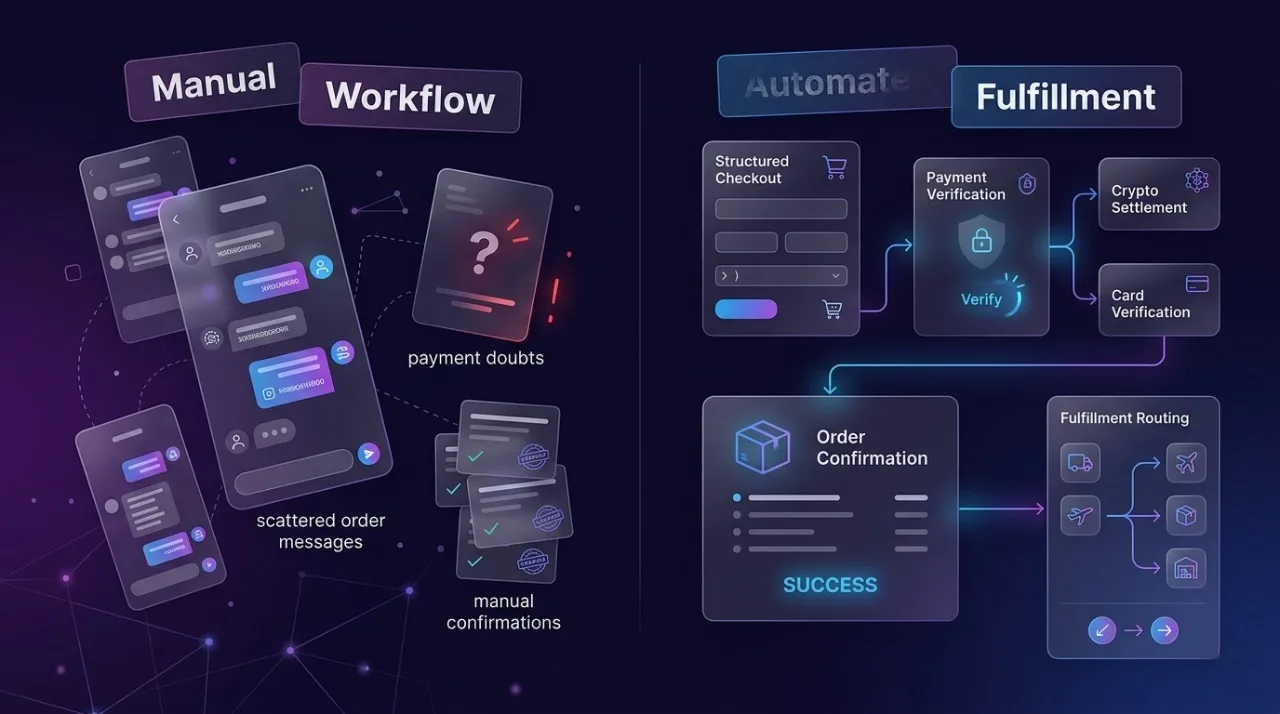
A well-designed Telegram checkout for cannabis or peptide sellers compresses the order into four predictable steps, each enforced by shop security controls rather than manual trust:
- Catalogue selection — product cards rendered inside the bot, with stock and shipping rules applied at the point of click.
- KYC + age gate — one-time verification, stored against the buyer’s Telegram ID, reused on repeat orders.
- Payment — native Telegram invoice for cards, deep-linked address or QR for crypto, single confirmation message either way.
- Fulfilment routing — order object pushed to a warehouse, courier, or 3PL with discreet packaging defaults.
Repeat-buyer flows compound the advantage: once a peptide or cannabis customer has paid once, the next order is two taps. Sellers focused on subscription mechanics should also review repeat peptide orders on Telegram for the workflow patterns that actually retain customers.
Common mistakes that get high-risk Telegram stores shut down
- Mixing personal and business Telegram accounts — loses the audit trail and complicates chargeback evidence.
- Accepting payment before age and geo checks pass.
- Running a single processor with no crypto fallback.
- Free-text orders instead of structured invoices — impossible to reconcile and easy to dispute.
- No refund or returns policy linked from the bot — one of the first things acquirers ask for during review.
Key takeaways
- Telegram payments give cannabis and peptide sellers a controllable, native checkout that survives processor turbulence better than mainstream ecommerce.
- The risk is not the channel — it is the compliance layer. KYC, geofencing, and transaction monitoring are non-negotiable.
- Run a hybrid card + crypto stack so a single acquirer change never stops the business.
- Structured order objects (not free-text chats) are what protect the merchant during chargebacks and quarterly reviews.
- Repeat-buyer mechanics inside Telegram are where the unit economics for high-risk categories actually work.
FAQ
Are Telegram payments legal for cannabis and peptide sellers?
Telegram payments are legal where the underlying product, processor, and shipping route are legal. The platform itself does not certify products; legality depends on the acquirer’s licence and the buyer’s jurisdiction. Sellers should always confirm with a high-risk payments lawyer before launch.
Which providers support high-risk Telegram payments?
Telegram’s payment partners vary by region. In Europe, specialised high-risk acquirers cover cannabis-derived and supplement categories; in the US, options are narrower and most cannabis merchants combine bank transfer with stablecoin payments. Always check the provider’s current MCC list before signing.
How do chargebacks work inside Telegram?
Chargebacks follow the underlying card network rules, not Telegram. The platform stores the invoice and message log, which becomes evidence. Structured order objects, age verification records, and shipping confirmations win disputes; free-text chat threads usually do not.
Can crypto fully replace card payments for high-risk products?
For some sellers, yes — particularly cross-border peptide vendors. For most cannabis brands serving local buyers, a hybrid stack converts better. Crypto removes processor risk but adds on-ramp friction for casual buyers.
What is the biggest reason Telegram stores get shut down?
Insufficient compliance evidence. Stores that cannot show KYC, geofencing, and transaction monitoring on demand are the ones that lose their acquirer first, and their Telegram bot second.
Where high-risk sellers should focus next
The sellers who treat Telegram as a payment channel and a compliance surface tend to outlast the ones who treat it as a Stripe replacement. Build the structured checkout, lock in two payment rails, document every age and geo check, and let the bot do the audit work for you. If you want a tested foundation rather than building one from scratch, Trapyfy ships the order, payment, and fulfilment infrastructure for high-risk Telegram operators — so the team can focus on product and customer access rather than processor firefighting.