
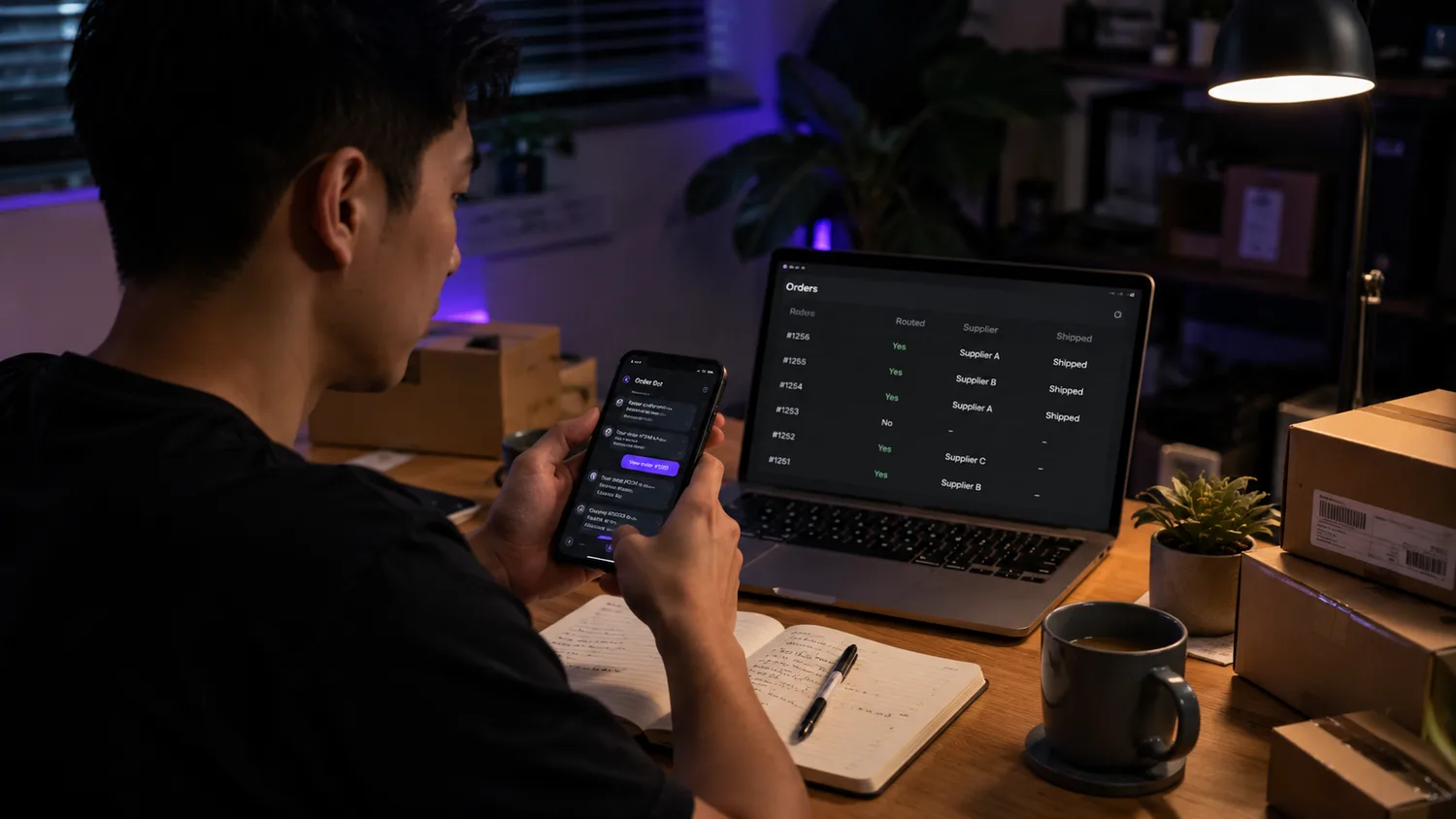
A customer taps a button inside a Telegram bot, pays, and minutes later a supplier on the other side of the country prints a shipping label — no spreadsheets, no copy-paste, no late-night reconciliation. That is the promise of Telegram dropshipping automation, and it is quietly becoming the default playbook for sellers who treat the messenger as their main storefront in 2026.
This guide walks through how a fully automated Telegram dropshipping stack works end to end — from the moment a buyer opens the bot to the second a tracking number lands back in the chat. You will see where the bot handles checkout, where the platform reroutes orders to suppliers, and which integrations keep stock, payments and customer comms in sync. Deciding automatically which supplier receives which order is the part most setups get wrong, and it is why sellers move to a platform that can route orders for fulfilment on its own.
What is Telegram dropshipping automation?
Telegram dropshipping automation is the set of workflows that turn a Telegram bot into a self-running shop: the bot lists products, takes payment, then triggers a third party — a supplier, a 3PL or a brand partner — to ship the order directly to the buyer. The seller never touches stock. The same supplier-ships-direct mechanic underpins several business-to-business ecommerce models, where the buyer at the far end is a company reordering on a schedule rather than a consumer.
The model only works when three pieces talk to each other without human glue: the bot interface, the commerce engine behind it, and the supplier's fulfillment system. Strip any one of those out and you are back to a Telegram channel where someone retypes orders into a supplier portal at midnight.
What changed in the last 18 months is the maturity of platforms that wire those three pieces together natively. Sellers no longer have to script their own bots or maintain Zapier chains between Telegram, an inventory tool and a courier API — the orchestration is baked in.
How a bot checkout works inside Telegram
Checkout inside Telegram is built around a conversational pattern, not a checkout page. The buyer browses categories, adds an item to a cart, confirms shipping and pays — all within the chat. A well-structured catalog organised by clear product categories is what keeps that flow from collapsing once you list more than 30 SKUs.
Payment is the step where most homemade bots break. Automated stacks rely on a payments layer that supports Telegram's native checkout plus card and crypto rails through high-risk-friendly providers. The bot generates an invoice, the buyer pays, the platform records the transaction — and only then does the order move downstream.
The Telegram Bot API itself is publicly documented and stable, which is why so many ecommerce vendors are building on top of it (see the official Bot API reference). Automation, though, sits one layer above: it is the platform that decides what happens after the "Pay" button is tapped.
Stock sync and supplier routing
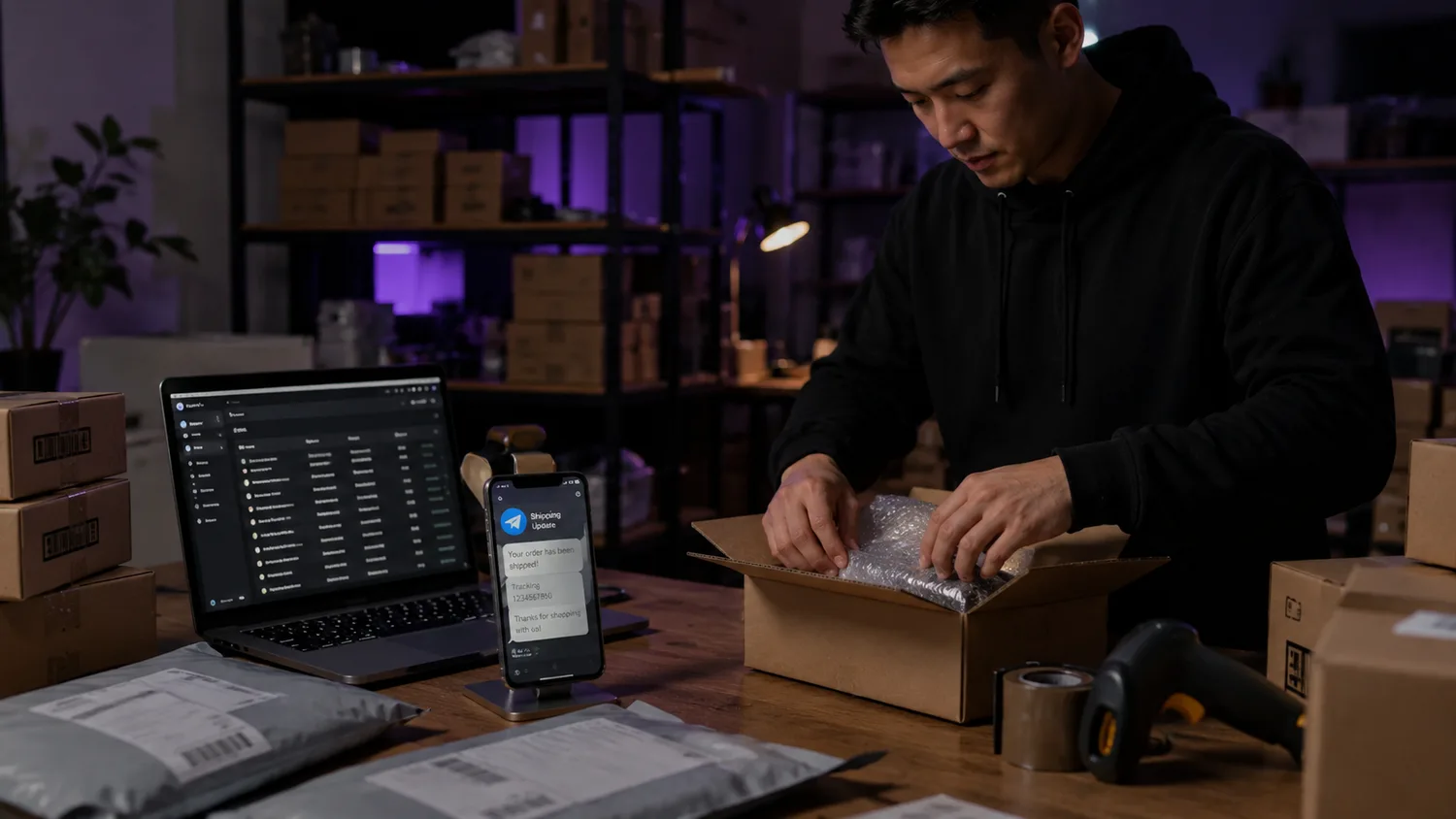
The hard part of dropshipping is not selling — it is not selling what you do not have. Automated Telegram stacks solve that with continuous stock sync: the platform polls each supplier's feed (or receives webhooks) and updates the bot's catalog in near real time. If you are on the other side of this relationship and supplying resellers yourself, Telegram B2B and wholesale selling covers warehouse share links and transfer costs from the supplier's side. Sound inventory management on Telegram is what stops the bot from accepting payment for items that left the warehouse hours earlier.
Routing logic decides which supplier gets each order. Rules can be simple (one SKU = one supplier) or layered: route by buyer postcode, by supplier capacity, by margin, by stock level. The platform fires the purchase order to the chosen supplier through an API call, an EDI message or an email gateway — whichever the supplier supports. In Trapyfy, the supplier shares products through a warehouse share link, and each sale of a shared product automatically raises an S-prefixed supplier order in the supplier's own account.
The seller's job shrinks to defining the rules once and watching exceptions. Everything that fits the pattern moves on its own.
Order tracking and customer notifications
Once a supplier accepts an order, the automation loop turns outward again. The platform pulls the tracking number, attaches it to the original Telegram order, and pushes a message back into the buyer's chat — usually within seconds of the courier scanning the parcel. A clean order tracking workflow from paid to delivered is what turns Telegram from a sales channel into a support channel buyers actually trust.
Notifications are not just "your parcel shipped." A solid setup pings the buyer at each stage — payment confirmed, supplier dispatched, courier picked up, out for delivery, delivered — and quietly opens a re-order shortcut once the package lands. The same channel that took the sale now retains the customer.

Scaling with APIs and multi-warehouse routing
Sellers who outgrow a single supplier hit two scaling problems at once: more SKUs and more dispatch points. The answer is rarely a bigger spreadsheet — it is opening up the platform to other systems through a commerce API designed for Telegram stores.
With that kind of API access, the bot becomes one node in a wider stack: ERP for accounting, WMS for stock, CRM for buyer history, BI for margin analysis. Trapyfy does not currently expose an external API and one is planned for a future release, so today products, stock, orders and customers are managed from the Trapyfy dashboard.
Multi-warehouse routing layers on top. When inventory lives across two, five or twenty locations, many platforms pick the warehouse closest to the buyer, with stock, and inside the seller's cost ceiling. In Trapyfy, Telegram orders for stock you hold are allocated from the fullest warehouse serving the buyer's country first, while shared products stay linked to the supplier's warehouse, which fulfils them. Sellers running this model usually start with the playbook in our guide to automating Telegram commerce before scaling, then layer warehouses on as volume grows.
The quiet compound effect of automating the whole chain
Automation rarely feels dramatic on day one. The first week, you save maybe thirty minutes of order copy-pasting. The first month, you stop refunding oversold stock. The first quarter, customer-service tickets drop because buyers can see their own tracking inside the chat where they bought. By the second quarter, the store is processing volumes that would have required a small ops team to handle by hand.
The point of Telegram dropshipping automation is not to remove humans from the loop. It is to free the few humans in the loop to do the work software cannot do — choosing suppliers, negotiating margins, designing the product range, talking to the buyers whose questions actually matter. Everything else becomes background noise that the bot, the platform and the supplier handle between themselves.
Frequently asked questions
Do I need a developer to set up Telegram dropshipping automation?
No. Platforms built specifically for Telegram commerce let you launch a bot storefront, connect a payment provider and define supplier rules from a dashboard. A developer only becomes useful once you want custom API integrations with an ERP or a private supplier system.
How does the platform stop the bot from overselling stock?
Stock sync runs on either a polling schedule or supplier-triggered webhooks. The catalog refreshes inventory levels every few minutes and blocks checkout for items that drop below the configured threshold, so buyers never pay for a SKU that just sold out. In Trapyfy, a shared product stays linked to the supplier's warehouse, and the supplier's stock is reserved automatically when the supplier order is created.
Can I use multiple suppliers for the same SKU?
On some platforms, yes. Routing rules let you assign a primary supplier and one or more fallbacks. If the primary is out of stock or slow to respond, the platform automatically reroutes the order to the next supplier in the chain without manual intervention. In Trapyfy, each shared product stays linked to the supplier who shared it, and its supplier order goes to that supplier.
Does Telegram dropshipping automation work for regulated or high-risk products?
It does, and it is often a better fit than mainstream ecommerce platforms because Telegram itself does not impose the same merchant restrictions. The catch is the payment provider — you still need a processor willing to settle the category, which is why crypto rails and specialist providers are popular in this space.
What metrics should I watch in the first 90 days?
Track order-to-dispatch time, supplier acceptance rate, oversell incidents, repeat-purchase rate inside the bot, and refund volume. These five numbers together tell you whether the automation is genuinely shortening the chain or just hiding the friction.