

A telegram storefront for cannabis brands is no longer a niche idea. For many sellers in legal cannabis markets, it is becoming a practical response to the limits of traditional ecommerce. The challenge is not always demand. In many cases, the real issue is finding a sales environment that can support payments, customer communication, order flow, and day-to-day operations without constant friction.
More cannabis brands are starting to look beyond the standard online store. Rather than relying on a rigid ecommerce setup for every step of the customer journey, many are turning to Telegram as a more direct and adaptable commercial channel.
Why traditional ecommerce often creates friction for a telegram storefront for cannabis brands
Cannabis brands operate in a more complex environment than most mainstream online sellers. Even in legal markets, many businesses deal with platform limitations, payment instability, account reviews, and store policies that make growth harder than it should be.
A traditional store may look polished, but that does not always mean it is built for a regulated category. For cannabis brands, the problem often sits beneath the surface: too many moving parts, too little control, and too much dependence on systems that were not designed for high-friction selling.
A website can still play an important role in brand visibility, education, and search discovery, but it does not always need to carry the full weight of the sales process on its own.
Why Telegram is becoming more relevant
Telegram offers something many cannabis brands value: a more direct path between seller and buyer. Instead of forcing customers through a long or disconnected flow, it allows brands to create a buying experience that feels faster, more personal, and easier to manage.
That can make a real difference in a category where trust, clarity, and repeat orders matter. Customers often want quick answers, a simpler purchase path, and a smoother way to come back and buy again. Telegram fits that behavior well.
It also helps brands stay closer to their audience. Product updates, customer support, reorder flows, and notifications can happen in the same environment where the relationship already exists. For brands with strong communities, returning customers, or private audiences, that makes Telegram a natural commercial extension rather than a side channel.
For many sellers, a telegram storefront for cannabis brands offers a more direct and manageable way to connect product discovery, communication, and conversion.
More control is the real reason behind the shift
The move toward Telegram storefronts is not about novelty. It is about control.
Cannabis brands often need more flexibility than traditional ecommerce systems are willing to provide. They need to control how products are presented, how customer conversations happen, how payments are handled, and how orders move through the business.
A stronger Telegram setup gives brands more room to shape the storefront around the way their customers actually buy, rather than forcing the business into a static catalog and a rigid checkout flow.
That is where bot storefront creation becomes more valuable. The point is not simply to launch a bot, but to build a storefront experience that supports smoother order handling, stronger customer flow, and less operational friction.
Cannabis brands need more than a storefront
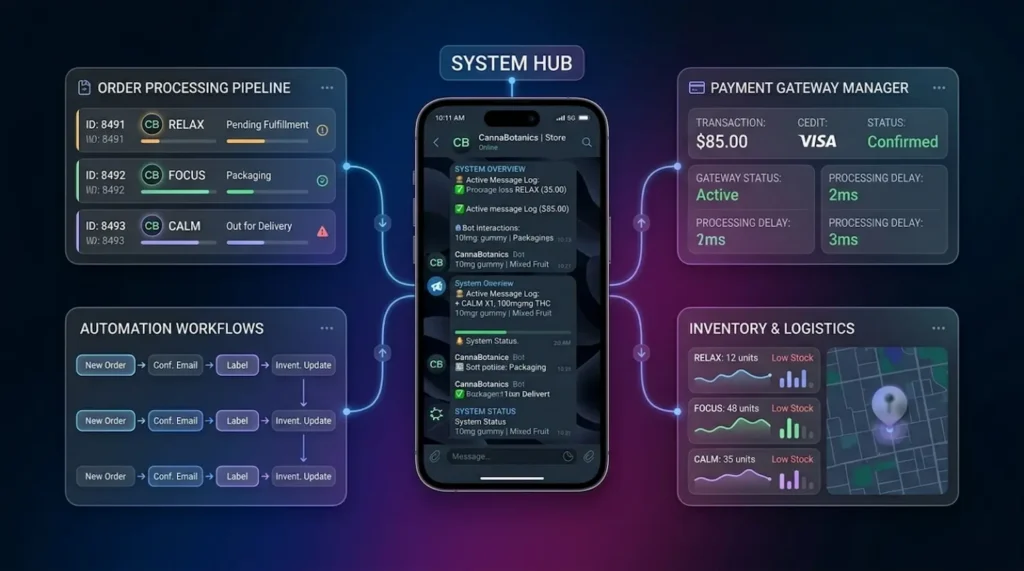
For many sellers, the real challenge begins after the customer decides to buy. Payments, product availability, routing, notifications, shipping, and post-purchase communication all need to work together. If they do not, the entire experience becomes fragile.
Telegram storefronts become much more effective when the infrastructure behind them supports the operational side of selling, not just the customer-facing side.
Direct customer communication
Cannabis buyers often want reassurance before purchasing. They may have questions about products, availability, delivery, or reorder options. A Telegram storefront makes those interactions easier and more immediate than a standard store environment.
Faster repeat orders
In categories driven by familiarity and trust, repeat business matters. Telegram makes it easier for customers to come back, browse again, and complete another purchase without going through a bulky ecommerce journey every time.
Better operational flow
A storefront is only as strong as the systems behind it. When product management, order handling, payments, and fulfillment work together more cleanly, brands spend less time fighting process issues and more time focusing on growth.
More adaptable selling
Cannabis brands do not always need a one-size-fits-all online store. In many cases, they need a more flexible environment that supports private selling, community-driven demand, product drops, and a more controlled customer journey.
Payments remain one of the biggest pressure points
For cannabis brands, payments are often where friction becomes most visible. A store can attract interest, but if the payment flow is unstable or badly matched to the business, conversions suffer quickly.
Any serious move toward Telegram commerce depends on a payment setup that feels secure, reliable, and easy to complete. Sellers exploring this model are not only looking for a better storefront. They are looking for a better commercial system.
For cannabis brands, payments are not a secondary detail. They are one of the main reasons many sellers start looking beyond the traditional store model in the first place, especially when evaluating how to accept payments in Telegram safely and easily in 2026.
Security matters as much as convenience
A more direct sales channel only works if customers trust it. Payment reliability, order confirmation, and data protection all shape how secure the experience feels from the buyer’s perspective.
That is why Telegram shop security is part of the conversation, not an afterthought. A cannabis brand cannot afford to treat security as a secondary layer once the store is already live. It has to be built into the buying experience from the beginning, especially in a category where customer trust is essential.
When security and operations are handled well, Telegram becomes more than a messaging app. It becomes a serious commercial environment.
Websites still matter, but their role is changing
Cannabis brands are not moving away from websites because websites no longer matter. A strong site still supports brand legitimacy, content marketing, search visibility, and public-facing information.
What is changing is the role of the storefront.
For many brands, the website works best as the public layer of the business, while Telegram supports direct conversion, customer interaction, and a more controlled purchase path. That combination can be more resilient than forcing every sale through a conventional ecommerce setup.
Instead of asking a traditional store to do everything, brands are building a broader system where each channel has a clearer job.
Why this model fits cannabis particularly well
Cannabis is one of the categories where commercial friction tends to appear earlier and more often. Brands in this space are used to dealing with restrictions, limitations, and a need for greater operational flexibility.
That is why Telegram storefronts for cannabis brands are gaining traction here faster than in many lower-friction markets. They support a more direct and adaptable way to sell, while giving brands more room to shape the customer journey around real buying behavior.
For sellers in legal cannabis markets, that can make a meaningful difference. A more controlled flow can improve customer experience, simplify repeat purchases, and reduce dependence on systems that often create unnecessary constraints.
Where Trapyfy fits
For cannabis brands exploring this shift, Trapyfy helps turn Telegram into a real sales environment rather than a simple messaging channel. It brings together storefront creation, payments, order flow, automation, and product control in one place, making it easier to run commerce inside Telegram with more structure and less friction.
For cannabis brands, that means a setup built for actual selling, smoother operations, and a stronger connection between customer communication and completed orders.
A more flexible sales model for a more demanding category
A telegram storefront for cannabis brands is gaining attention for a simple reason: many sellers need more control than traditional stores can offer.
For brands looking for more flexibility, a telegram storefront for cannabis brands is becoming a more practical alternative to the limits of traditional ecommerce.
For brands operating in legal cannabis markets, Telegram opens the door to a more direct buying experience, stronger repeat-order potential, and a sales flow that feels less rigid and more aligned with how customers actually behave.
As the category keeps evolving, more sellers are likely to move toward storefront models that give them greater flexibility around payments, communication, and operations. Telegram is becoming part of that shift because it answers real commercial needs.